need4sneed
FNG
- Joined
- Jul 21, 2024
- Messages
- 53
Appreciate it! That perspective helps greatlyYou’ll need to measure some, but 16-17” back to brisket will probably be closer to reality for you. 18” is a big deer back to brisket.
Follow along with the video below to see how to install our site as a web app on your home screen.
Note: This feature may not be available in some browsers.
Appreciate it! That perspective helps greatlyYou’ll need to measure some, but 16-17” back to brisket will probably be closer to reality for you. 18” is a big deer back to brisket.
Yes I have. Dropped one and it was done.Don’t take shots I need a rangefinder for or use OnX for an estimation. If your limit is 400, you can just use some form of MPBR. Ranging with a reticle isn’t super great, but would likely be ok inside of 400. Have you had an RF take a dump? Maybe I’ve just been lucky, but I’ve never had one go down on me other than out of batteries. I have extra rangefinders I can leave in the truck too
Don’t take shots I need a rangefinder for or use OnX for an estimation. If your limit is 400, you can just use some form of MPBR. Ranging with a reticle isn’t super great, but would likely be ok inside of 400. Have you had an RF take a dump? Maybe I’ve just been lucky, but I’ve never had one go down on me other than out of batteries. I have extra rangefinders I can leave in the truck too
If my kill zone is 2-3x the 1 MRAD box, do I actually need a numeric range?I'm thinking the box on the THLR reticle will prove useful here.
I track what you’re saying and I understand the “aim short, aim long” components of the reticle….If my kill zone is 2-3x the 1 MRAD box, do I actually need a numeric range?
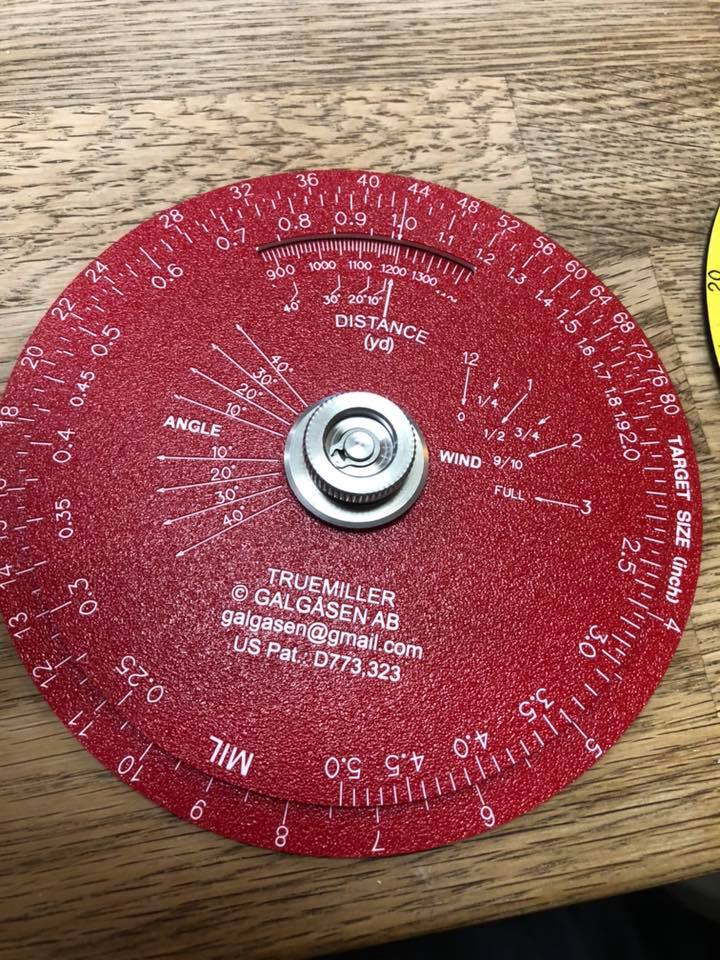
This seems pretty handy to practice with and have on hand. Really seems like a great way to establish baseline measurements for deer as well - reversing known ranges & MRAD to inches on chest.I have been bringing this with me on hunts or when I go shooting in mountains lately. Just stick it in back of bino harness. Easy access and it weighs next to nothing. I’ve been ranging stuff and then measuring for practice. So far what I’ve tried it with has been accurate.
![]()
Truemiller Milrad Range Calculator - Red Hill Tactical
Made in Sweden by Truemiller, this modified tool features US measurements and a new color for easy visibility, helping you find distances on target sizes.redhilltactical.com
I was hunting for an average male Antelope in WY. Chest measurements there average 14.5” from my research and limited actual measurements previously.I’m going to be doing this with whitetail and 18” chest. - realistically off of way more doe and immature bucks when practicing.
Did you find 14.5” for antelope applicable and accurate to any and all antelope? Just bucks? Or just adult antelope of either sex?
This will be done with a: mil R F1. Which has a 2 mil on 1/10ths scale. (Haven’t stated that yet).
I've been practicing with using the reticle to range things. All this math involving complex/non integer conversions is too tough for me to do in the field in my head with any kind of pressure. Measuring in inches is also too "precise" and hard to do on targets that like to move around.
The thing that I have found to work best is to measure distance on target in yards or fractions of yards. This is adequate precision, and means the conversion factor is a simple "1000". So for example, a shootable buck is ~1 yard tall to the back. The front and back legs are ~1 yard apart. A bull's head is ~2 yards tall when he's standing normally. A smaller cow might be ~3/2yds tall. And I try to also convert the reticle reading to fractional. Then the mental math is with fractions, which I at least have a shot at doing correctly from behind the scope
It does take me a lot more time and I often do it 2-3 times before I converge on an answer I trust. I will say I have not shot an animal with this method since my RF has never failed (knock on wood). I definitely would not use it beyond 3-400yds unless I had a really certain dimension to mil against and maybe time to break out the calculator.
The formula is:
(# yds measured on target / number of mils to cover that measurement) * 1000 = range (in yds)
So for a ~1yd tall deer, which measures 2.5mils in the reticle, my range would be:
(1/2.5) * 1000 = 400yds
Didn't need fractions for that one. But now let's say I have an elk ribcage I've decided is ~18", and measures 1.5mil in the reticle:
(1/2) / (3/2) = (1/2) * (2/3) = 2/6 = 1/3 * 1000 = 333yds
If I have a 1.5yd tall bull elk shoulder that measures 4mils:
(3/2) * (1/4) = 3/8 * 1000 = 375yds
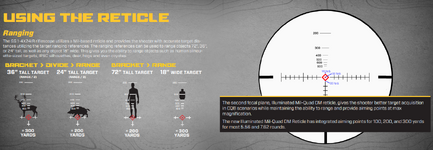
I haven't used something like that, but yes that's what we're getting at here. Classic one is the average male is about 2yds tall and 1/2yd wide... My SWFA 1-4 LPVO has a ranging tool built in:So, I'm a bit confused about ranging with a reticle, as I thought it was an art/science that everyone just did in the precision rifle space...at least back in the 1990s? A very close friend had been a Marine Scout/Sniper, and gave me a cheat sheet they'd had made up, of how big various items were - everything from soda cans and different countries' license plates, to car types and canteens. Knowing those dimensions was the basis of finding distance with their mil-dot reticles. Is this just not done anymore, or something?