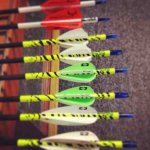
Darin- thanks. Is there much of a change in point of impact with the 360's compared to a shorter higher profile vane? Or what about compared to a 4 fletch small vane arrow?
They shoot right with the shorter vanes out to about 80 yards, then you might see them drop a bit more depending on what you're comparing. Some high-profile, short vanes drop as much or more though (NAP quickspins for instance). Some of the extra drop with the 360 is due to drag and some is a function of mass weight. I don't get too hung up on trajectory because you're going to adjust your pins for that and the difference is insignificant when you think about real shooting conditions. If one set of vanes shoots a yard lower at 90 yards than another set, it means you're going to have slightly wider pin gaps out there. However, if you make a 2-yard ranging error you probably wouldn't be able to measure the difference between the two vane types assuming both are sighted in properly. Anymore, my focus is almost entirely on accuracy and creating a setup that's simple and bullet-proof.
I have set up arrow combinations with mechanicals and small vanes for hunting in windy conditions at long range that are totally different than my normal elk/deer setups. I've done it for caribou and dall sheep because I knew that a 20 mph wind was probably going to be the norm rather than the exception. Small vanes coupled with mechanical broadheads are an advantage in the wind without question. It's a matter of physics.
The driving force behind wind drift is often misunderstood. It's really a function of reducing the overall aerodynamic drag on the arrow. Your arrow aligns itself in flight with the nose pointed slightly into the wind. Crosswind from the right = arrow pointed slightly right on it's way to the target. Therefore, the resulting drag forces acting on the arrow are pulling back through the centerline of the arrow (opposite the direction of the arrow point). The higher the total drag, the greater the angle of the shaft AND the higher the force pulling the arrow off-line. This is why a longer bullet of the same caliber (with a higher ballistic coefficient) drifts less in the wind even though a cross-wind would seemingly have more surface area to push on.
For this reason, it also makes sense to fletch your target arrows straight with only a small offset so they will still spin stabilize - and even a hunting arrow
IF you are shooting a low-profile mechanical and don't need a lot of drag to stabilize the broadhead you choose.
Broadhead accuracy problems occur with fixed blades when the drag up front in the arrow is too close to the drag in the rear - the arrow does not find a consistent flight angle and the drag forces pulling backward are all over the place.
This causes your groups to open up. That specifically is why it's always better to err on the side of too-much-drag (vane) when using a fixed blade head.
In my experience, the 360 FF, with a helical fletch job will stabilize broadheads with cut diameters up to about 1-3/16" very reliably. Any more than a 360 FF is overkill and will just add wind drift, and anything less (for my setups) is borderline. Your results may vary slightly depending on your broadhead, your tuning abilities, and your luck. There are infinite ways to arrive at a similar amount of drag and stability with differnt vane shapes, lengths, textures, more/less vanes, etc... You could experiment for a lifetime and probably find a better vane combo or one that perfectly suits your setup, but in my opinion there is very little to gain - except fletching practice.
Coop



 ...they look good too but that is never a criteria for me. I'm running speedpro 6.2 shafts and can afford plenty of weight out back and still have very high foc.