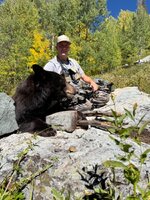
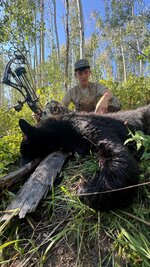
Idaho DIY Spot and Stalk Success!

Joined
Apr 13, 2023
Messages
73
Hi there,
I got back a couple weeks ago from my second attempt at an Idaho spring bear DIY spot-and-stalk hunt.
I have been on a lot of hunts around the world, and I can honestly say nothing has worked me harder than
two straight years chasing early spring bears in Idaho. Idaho spring bear hunting has a way of pushing me
to my absolute max every single day.
I used to struggle sleeping in the backcountry, but I have learned something: if you are not sleeping well in
the backcountry, you probably are not working hard enough. After a long day chasing bears in Idaho, I
sleep like a baby.
I am happy to share any details people may want to know, with the exception of exact locations. I want to
protect the area for others who hunt it.
Last year, we went during the last week of May. We worked hard for six days and only managed to see
three bears. Only one was in range, and I wanted my buddy, who had never shot a bear, to take it.
Unfortunately, the bear was gone within minutes before he could get to me.
We learned the hard way that some bears are simply not reachable without risking your life. One day, after
spotting a bear about 1.5 miles away, we spent nearly 10 hours trying to get into that area. We were
crawling on our hands and knees through swamp, blowdowns, and crossing whitewater creeks on slippery
logs. It was incredible how long it could take to move just 100 yards.
I am competitive, and I hate giving up or feeling defeated. So even though we came home empty-handed
that first year, I knew I had to come back to the same general area, apply what we learned, and try to be
successful.
The biggest lesson from year one was that we had hunted too low. The other major factor was the weather.
It was in the 70s almost the entire week, and with very little wind, it felt even warmer. The few bear
sightings we had were brief and usually close to dark, which made a stalk nearly impossible.
Fast forward to this year.
 
Fast forward to this year.
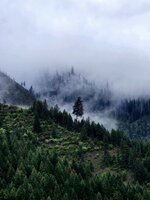
Based on the weather reports, we decided to go a week earlier than last year. Things were still a little
greener than I had hoped. The snowline in our area was around 6,000 to 6,500 feet, which meant the bears
were going to be higher than I was hoping for.
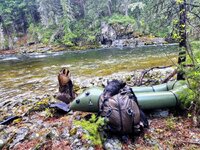
We also added a pack raft to our setup. Crossing the main river would give us access to twice as much
country, including bears I believe receive less pressure. That river was not easy to cross, and there were no
trails nearby on the other side. That decision paid off in a major way. We saw the majority of our bears on the
far side of the river this year.
The river crossings were still risky, but the Alpacka Scout did a great job keeping us dry and getting us
across when we needed to chase a bear.

Over the course of the hunt, we saw 16 bears total, including five cubs. We saw two or three very small
bears that looked like they were out on their own for the first time, probably 80 to 100 pounds. We saw two or
three sows and two or three nice boars.
One thing I will openly admit is that we were fortunate not to shoot a sow.
I have heard people say young cubs stay right at their mother’s heels, but I have video proof from several
occasions that this is not always true. I have footage of two different sows feeding alone, 200 yards away
from their cubs, with no cubs in sight for an hour straight.
I am not sure how shooting a sow with cubs can be 100 percent avoidable in every real-world hunting
situation. I recognize that experienced bear hunters can often tell the difference between a sow and a boar,
but that is not always easy. And sows without cubs are legal to shoot anyway. Based on what I watched all
week, simply watching a bear for 10 or 20 minutes does not guarantee she does not have cubs tucked away
a couple hundred yards up the mountain.
We got to watch one sow almost every day, and she spent more time away from her yearling cubs feeding
than she did with them at her side. Sometimes she was away from them for an hour.
I am thankful both bears we took were boars. I would have felt awful shooting a bear with yearling cubs. But I
will say it again: I would love for someone to explain how that is 100 percent avoidable. Based on the bears I
studied for hours every day, I do not believe it always is.
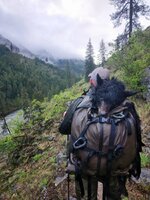
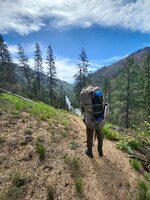
On day one, we hiked around 10 miles. We went in deep, but decided not to get high right away. It is
amazing that of all the places I have hunted, only in Idaho can you walk 10 miles and find one single place to
camp that barely fits your tent.
We saw four bears on the hike into base camp, which was already a great sign. One sow with two cubs, and
one very small bear. They were all out around 1:00 to 2:00 p.m. It was much cooler than the year before, and
I believe that helped our sightings a lot.
After the long hike in, we still had a few hours of daylight, so we walked uphill from camp to gain some
elevation and glass until dark. We had a small front coming in over the next two days, and that seemed to
really get the bears moving.
That evening, we saw six more bears. Of those bears, only one looked like he was likely a boar. He came out
at last light, marked his territory, and generally acted different from the other bears. He did not seem like an
Idaho monster, but we were mainly looking for a legal bear without cubs.
We needed to cross the river to get to him, and we did not have enough daylight or energy left to do that on
day one. So we decided that if the weather allowed, we would go after him on day two.
 
Images from our trip
 

Attachments

  • IMG_3327.jpeg
    IMG_3327.jpeg
    480.4 KB · Views: 26
  • IMG_3317.jpeg
    IMG_3317.jpeg
    391 KB · Views: 27
  • IMG_3246.jpeg
    IMG_3246.jpeg
    477.4 KB · Views: 27
  • IMG_3229.jpeg
    IMG_3229.jpeg
    676.8 KB · Views: 27
  • IMG_3330.jpeg
    IMG_3330.jpeg
    371.5 KB · Views: 25
Images
 

Attachments

  • 63989cbb-bc33-4e1f-b787-5a9320767467.jpeg
    63989cbb-bc33-4e1f-b787-5a9320767467.jpeg
    396.4 KB · Views: 22
  • ceece347-6f88-4ade-a222-a678ad2e622a.jpeg
    ceece347-6f88-4ade-a222-a678ad2e622a.jpeg
    748.9 KB · Views: 22
  • cf78168a-ba5d-4383-a8c7-a5923c94635a.jpeg
    cf78168a-ba5d-4383-a8c7-a5923c94635a.jpeg
    279.1 KB · Views: 21
  • IMG_3353 (1).jpeg
    IMG_3353 (1).jpeg
    303.7 KB · Views: 21
Images 3
 

Attachments

  • IMG_3135.jpeg
    IMG_3135.jpeg
    486.9 KB · Views: 13
  • IMG_3100.jpeg
    IMG_3100.jpeg
    221.1 KB · Views: 13
  • cf78168a-ba5d-4383-a8c7-a5923c94635a.jpeg
    cf78168a-ba5d-4383-a8c7-a5923c94635a.jpeg
    279.1 KB · Views: 13
  • IMG_3342.jpeg
    IMG_3342.jpeg
    282.2 KB · Views: 12
  • IMG_3322.jpeg
    IMG_3322.jpeg
    305.8 KB · Views: 12
Images
 

Attachments

  • IMG_3100.jpeg
    IMG_3100.jpeg
    221.1 KB · Views: 6
  • IMG_2929.jpeg
    IMG_2929.jpeg
    494.9 KB · Views: 6
  • IMG_2966.jpeg
    IMG_2966.jpeg
    549.7 KB · Views: 6
  • IMG_2986.jpeg
    IMG_2986.jpeg
    235.7 KB · Views: 6
  • IMG_2918.jpeg
    IMG_2918.jpeg
    173.9 KB · Views: 6
Final Images
 

Attachments

  • IMG_3355.jpeg
    IMG_3355.jpeg
    453.9 KB · Views: 14
  • IMG_3185.jpeg
    IMG_3185.jpeg
    576.5 KB · Views: 14
  • IMG_3325.jpeg
    IMG_3325.jpeg
    339.5 KB · Views: 14
  • IMG_3213.jpeg
    IMG_3213.jpeg
    552.8 KB · Views: 14
  • IMG_3206.jpeg
    IMG_3206.jpeg
    698.9 KB · Views: 14
  • IMG_3194.jpeg
    IMG_3194.jpeg
    698.8 KB · Views: 12
  • IMG_3301.jpeg
    IMG_3301.jpeg
    123.4 KB · Views: 14
The weather report was spot on. Day two was cold, windy, rainy, and constantly changing. The sun would
come out just long enough for you to start drying out, and then the rain, sleet, and wind would roll right back
in.
We decided the weather was still huntable. It helped that we had a sow and cubs within 500 yards of camp.
Every time we saw her out feeding in the misty, windy rain, we thought, “If she is out in this, maybe other
bears are too.”

So we crossed the river and got set up for the final two hours of daylight to see if the boar from the night
before would come back out.
He did.
The bear appeared within a minute or two of the time we had spotted him the evening before. My buddy Brad
shot, and the bear turned, ran, and disappeared into cover. We were not completely sure what to make of the
reaction. We were pretty confident it was a hit, but we only saw the bear for maybe 10 yards before he was
back in thick cover.
With darkness coming fast, we made the difficult but wise decision to back out.
A 265-yard retrieval sounds easy. It was not. I bet it took us three hours to get over to him the next day. The
country was five times thicker and steeper than it looked through the glass. Bears will make you believe the
terrain is much more open and manageable than it actually is for humans.
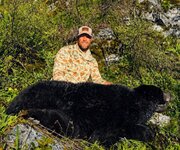
We went back to camp, crossed the river again the next day, and recovered his bear. It ended up being
almost an all-day project. Finding the bear was actually the easy part. He had only gone about 30 yards from
the shot, just out of sight.
He was not a monster, but he was a boar, which was a huge relief for both of us.
The river was getting more dangerous by the hour. The weather was windy, snowy, and rainy. Everything
was slippery, steep, cold, and genuinely dangerous. Looking back, some of those river crossings were pretty
dumb. But I am also the kind of person who is willing to take some risks. I know I am not invincible. I also
know I do not get to live forever, and the last thing I want is to live with regrets, wondering what I could have
tried or how far I could have pushed myself.
That mindset may kill me someday, and somehow I am at peace with that.
Unfortunately, the only way we had to get the raft back across the river for my partner was with 100-pound
test fishing braid. In theory, it worked great. The boat scooted across the water and rode high with very little
effort. The problem was that after we recovered Brad’s bear, the river had gotten much more violent.
We had to cross it to get back to camp. We were cold, shivering, and daylight was running out. We needed to
get back to the stove and dry gear to stay warm and healthy.
I crossed first, and it went okay. Then I sent the raft back. It got caught in whitewater and started taking on
water badly. I was standing on the far side watching as Brad pulled a boat that was now filling with water and
getting heavier by the second. I just stood there praying the line would not snap.
If that line had broken, I believe that raft would have gone miles downriver before it was recoverable, if it was
recoverable at all. And if that happened, swimming 60 yards in near-freezing water may have been his only
option. I do not know how that would have gone.
Thankfully, the line held and we both made it back across.
In the future, I would bring enough braid to have a second backup line attached from my side. If the pulling
end broke, I would still have the raft secured. I also would not buy cheap 100-pound braid. I would make sure
I had high-quality line.

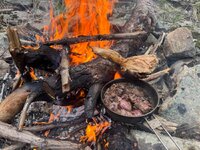
One thing I was excited about was trying bear meat cooked in rendered bear fat. I was about 80 percent sure
it would be edible, but not amazing. I have tried all kinds of wild game, and I would consider myself pretty
picky.
That said, Idaho spring mountain bear meat is now one of my favorite wild game meats. I could not believe
how good it was. It smelled like a steakhouse while cooking and tasted even better. We ate a lot of it.
 
Because of the mild winter, both of our bears had a ton of fat, which I hear is not always the case. We had
plenty of it. I strongly suggest adding spring bear rendered in bear fat to your list of wild game meals you
need to try.
On day four, we decided to “take it easy.” It is funny because we both agreed to that, but we probably should
have called each other out, because neither one of us seems to know how to actually do that.
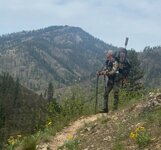
I decided to separate from Brad and gain a little elevation. My plan was to climb maybe 300 to 500 feet.
Once I got there, I realized that if I went a little higher, I could see a few flat benches in the distance. So I
kept pushing higher and higher.
I ended up climbing 1,500 to 2,000 feet.
I decided that at 4:00 p.m., no matter how high I had gotten, I would stop and start glassing. In classic Idaho
fashion, I had been glassing for maybe 15 minutes when I saw a big storm system in the distance that was
not predicted. It was dumping rain and snow and heading my direction.
I had my puffy and rain gear, so that was not the issue. But some of the country I had climbed through was
steep, and I thought it would be smart to slowly drop back down while glassing every couple hundred yards.
I gathered my things, took one more look around with my eyes, not even through glass, and I kid you not,
about 500 yards above me on the same slope, I saw a bear that immediately looked like an absolute pig.
You may be shocked to hear this, but I did not have the rifle with me.
We only brought one rifle. Brad was already tagged out, but we both still had wolf and cougar tags. I had my
9mm with hard-cast bullets for protection. I had not planned to go very far from camp that day, so I assumed
the rifle would only be minutes away if I needed it. I also assumed that if I glassed up a bear, there was a 99
percent chance I would have to drop off the finger anyway, and grabbing the rifle on the way would only be a
minor inconvenience.
I also thought that since I was only about a quarter mile from Brad, he could bring it to me pretty quickly if I
could signal him.
That turned out to be a mistake.
This bear was in range, about 500 yards. That was about the farthest I planned to shoot, but the wind was
perfect to try to get closer. He was feeding and moving, and I believe I could have closed the distance if I had
the rifle with me.
You would think I would have been furious, but I was not. I wanted Brad to be there. I wanted both of us to
see the bear and make the stalk together. I also did not really want our seven-day adventure to be over on
day four. I wanted to keep hunting.

I made it back to camp well after dark, and we made a plan to go after that bear over the next two full hunting
days.
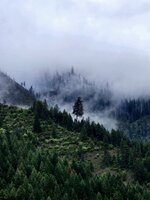
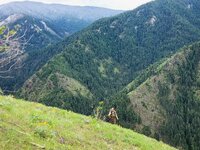
He was high, near the snowline, and I was not even sure he lived in that drainage. It looked nothing like the
country where we had been seeing bears. It was green and open, almost like hills in Ireland. A few rocks, a
few trees, a little brush, but mostly wide open. I expected a big mature bear to be closer to thick cover,
because that is where we had seen every other bear up to that point.
Either way, I knew I had not spooked him. He was feeding calmly when I left him. I was hopeful he would be
in that area again.
I had spotted him around 5:00 p.m., so we decided we wanted to be in position by around 1:00 p.m. the next
day to give ourselves plenty of time.
Day five came, and we had breakfast and started hiking. Thankfully, the weather for the last two days of our
hunt was supposed to be nearly perfect: partly cloudy, lower winds, around 55 degrees. And for the most
part, it was. The winds were a little shifty, which caused some issues, but the weather itself was awesome.
We got up to where I had seen the bear the night before, and I started second-guessing myself. I told Brad I
may have exaggerated the size of the bear. Maybe I was just excited and shocked to see one in the wide
open. Maybe it was just a medium-sized bear. Bears are hard to judge. What did I really know?
All I remembered was that this bear looked like a circle. He did not look skinny. But the more I thought about
it on the hike up, the less certain I became. I even wondered if I had been so excited that maybe there were
cubs around and I had not noticed.
So at that point, I was no longer sure what the bear even was. But I had definitely told the story the night
before like he was a giant.
We got to our knob, sat down, and started eating a snack. We also started bickering about dumb stuff, like
long-time hunting buddies do. I thought Brad was skylined. He thought I was talking too loud. Normal hunting
partner stuff.
I glanced up the hill and did not see anything, so we kept eating. I figured the bear would probably show
around 5:00 or 6:00 p.m., so I thought we were early.
About five minutes later, around 1:45 p.m., I grabbed my binoculars and started glassing. Almost
immediately, I saw a bear.
It was him.
He was feeding in one of the only thickets on the entire mountain face. He was up, moving higher, and
feeding. The problem was that he was about 800 yards away, which was well beyond my range.
I had to gain elevation fast. I pushed so hard I had to stop several times because I thought I was going to
puke. Eventually, I realized I needed to slow down. If this was going to happen, it was not going to happen in
a few minutes. I had to trust that the bear would not go over the top. And if he did, I hoped maybe he would
come back into the basin before dark.
So I slowed down and focused on getting into range without blowing the whole thing.
 
I am not sure exactly how long it took, maybe an hour, but I finally got into position. Brad stayed back with the
spotter to signal me where the bear was. I think he also knew that climb was going to be brutal, and he was
right.
When I got up to where I believed the bear had last been, it put me in the 250- to 400-yard shot range. I got
set up and waited.
Brad signaled that the bear was bedded, or at least that is what I thought he was saying. That got me excited
because I believed the bear was somewhere across or below me, just out of sight. The signaling was hard to
understand, but I clearly understood that I should stay put.
At one point, I got the impression that maybe the bear was directly below me and I just could not see him. So
I stood up, eased toward the edge of the cliff face, looked down, and saw nothing.
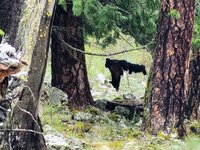
Then I looked left and saw something that looked like a bear’s head.
I stared at it for about 60 seconds, and it did not move. I started to believe it was just a black stump. Right as
I was about to look away, it took off running.
That is when I realized I had just had a stare-down with this bear at about 175 yards.
The wind was swirly, so it is very possible he caught some of my wind. Either way, that bear was leaving
town.
I jumped back down on the rifle and saw him busting out of the cover. Luckily, instead of running straight up
toward the top where I probably would not have had a shot, he ran 300 to 500 yards across the wide-open
face. That was exactly what I needed.
I ranged him at 300 yards and sent a bullet. By the time I pulled the trigger, the shot was about 325 yards.
One shot, and I could not believe my eyes. He was rolling down the mountain and falling off cliff faces.
Of all the running shots I have made on animals, shooting a bear on the run was not as difficult as I would
have expected. They do not bounce like deer. They run more in a straight line, so the vitals stay on the same
horizontal plane for the most part.
Either way, I got lucky and drilled him.
I had not really had a chance to size him up before the shot. So I waited for Brad to hike up to me and asked,
“Hey, was this a decent bear?”
He said, “Man, he is an absolute hammer.”
Brad is not one to call an animal big unless he means it, so I was excited. It sounded like the bear was
exactly what I had described the night before.
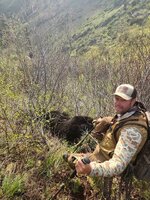
As always, a 300-yard retrieval takes forever when you are climbing through rocks, brush, and steep hills. It
took us maybe an hour to get to him. And as expected, it was much thicker and rockier than it looked through
the glass.
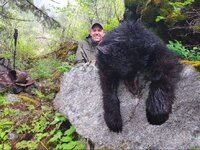
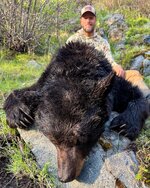
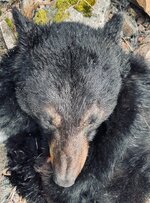
When we got to him, he was every bit as big as we had hoped. I am not great at guessing weight, skull size,
or square etc. I just know he was a mature old bear, and I could not move him by myself.

Where I live, a big whitetail can weigh around 300 pounds, and I can move one on my own. I could not do
that with this bear.
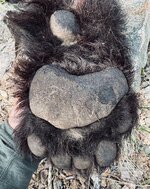
I figured people who know bears better than me would be able to look at the pictures and guess his age and
weight, but I have learned bears are hard to judge even when they are dead. Some said he would square six
feet. Some said seven. Some guessed 250 pounds, others guessed 450. He had a ton of fat on him, so I
think that added a lot to his overall size.
His teeth were worn. The biologist who checked him in looked at his head and said, “This is the largest boar I
have ever checked in out of those mountains.”
He was younger, so I doubt he has checked 1,000 bears, but I am guessing he has still seen plenty.
Either way, weight, age, and score aside, he was a gorgeous bear, and I could not have been happier with
my first DIY spot-and-stalk Idaho bear.
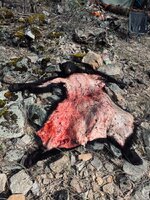
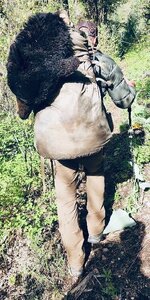
The hike back to camp was brutal. Just his head and cape must have weighed around 50 pounds. With all
the gear I already had, it made for a very heavy pack coming down the mountain that night.
We made the hard choice to use the next two days to get everything out in separate loads instead of killing
ourselves trying to do it all at once. Even then, I would still call the pack-outs near-death experiences. But it
was easier knowing we were both coming home with nice bears and had redeemed ourselves after last
year’s hard hunt.
I love Idaho. Spring bear is addicting. I will be back next year.
I have decided I need a color-phase bear now.
I tried to attach several photos of the trip to go along with the story! Attached above
 
A few lessons from my two years:
1. Be extremely careful when judging sows. I am not sure it is possible to avoid every bad scenario with 100
percent certainty. Yearling cubs are not always with their mom. I would try to video or document a bear as
long as possible before shooting. That is essentially what we did. I am not saying that automatically makes
anything legal, but we had several minutes of footage of both of our bears alone with no cubs in sight before
pulling the trigger. Thankfully, both were boars.
2. Be in shape. I run six miles a few times a week and work out in the gym three other days. I used to run
marathons and triathlons. This was still one of the hardest things I have ever done. If someone in your group
is not honest about their conditioning, it will show on day one and hurt the group. Choose your hunting
partners wisely.
3. If you plan to cross rivers, have more than one raft or a better system for getting the raft back across. Have
backups.
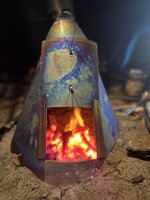
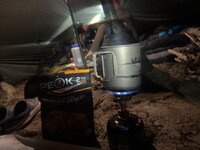
4. A hot stove is essential for drying gear, getting warm, and feeling human again at night. I would not go
without one.
5. Get high and glass for miles. You may see a bear in range, but in many cases, you are finding bears for
the next day. I see people glassing only small basins where they can shoot 500 yards or less. That can work,
but I would rather see miles and miles of country. At one point, I was on a knob where I could have seen all
16 bears from the trip from that one spot. Even bears you cannot reach are still valuable information. They
help you learn what elevation, slopes, and conditions bears are using.
6. It takes four or five times longer to get somewhere than you think.
7. It is steeper, thicker, and more dangerous than it looks through glass.
8. Know your rifle. A 200-yard shot is possible, but not always likely. Be prepared for 200- to 500-yard shots
if you want to give yourself the best chance.
9. Bear meat is excellent. Eat it. But cook it properly. Make sure it reaches 165 degrees. No medium-rare
bear meat unless you want to take a serious health risk.


Gear that worked great and was absolutely worth the weight:

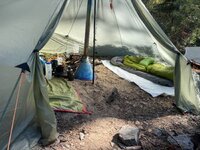
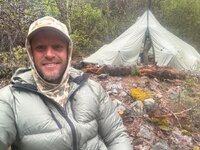
Seek Outside Redcliff - For two people, it is like a palace. I love it.
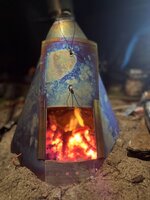
Pyro Rock Stove - Fast setup, great heat, and the expandable/excavated burn chamber held coals for hours
and kept us warm.
Alpacka Scout Pack Raft - I would not use it for long travel, but it worked well for crossing major rivers with
some Class I and Class II whitewater.
Leki Trekking Poles - I could be a salesman for trekking poles. I am shocked when I see guys without them.
Four points of contact saved me daily. They protected my knees and kept me from falling down countless
mountains.
Kowa TSN-55 Spotter - Great performance and lightweight for what it is.
Peak Refuel Meals - I actually enjoy these meals.
Zenbivy Sleep System - Very comfortable and worth the extra weight.
6.5 PRC Tikka build on an MDT HNT26 chassis - Worked great. Two shots, two bears.
Good binoculars - Buy the best glass you can afford.
There is a lot of other gear I could mention, but those are the main items I would not want to hunt without.
 
Back
Top