
Luked
WKR
Marking for suture reference and reading.

Follow along with the video below to see how to install our site as a web app on your home screen.
Note: This feature may not be available in some browsers.


Does bottom of port = center of bore hold for both T3 and T3x? I know the latter has a larger port but don't know in which direction.Tikkas are easy, the ejection port bottom is center of bore. Just measure from center of scope to bottom of ejection port. Measure the red line.
View attachment 572509

Does bottom of port = center of bore hold for both T3 and T3x? I know the latter has a larger port but don't know in which direction.

Make sure to loosen it enough that you can lift it off the splines, and make sure it doesn't click when you spin it to zero.

Get about 100 rounds down the barrel without cleaning it and don't fuss over "groups" or "velocity" until then.Curious for those with a Tikka 65prc using an oem barrel (mine is a roughtech), what's the avg muzzle vel you've been getting?
Diving into the mils concept now, after 1 round of 100 yards dialing. Starting to understand why mil is so beloved!
Ahh good catch - I meant to add that info in.Get about 100 rounds down the barrel without cleaning it and don't fuss over "groups" or "velocity" until then.
What is your planned bullet and barrel length? We have a lot of data on 6.5 bullets with PRC's, just need some more info.
Question to the group, that seems pertinent on this thread (imo)Now how do you take a zeroed rifle and use those turrets and that reticle?
You need a dope card or drop card that tells you how much to adjust for a given range.
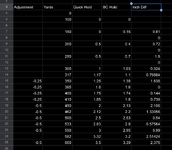
We used to have to hang targets at every 100 yard line and walk our rounds into the target, note the required adjustments, and move to the next. With the advent of accurate ballistic solvers you no longer need to do that. You can use the ballistic program to "true" your data. If you know the real BC of the bullet you can true the velocity, or if you know the real muzzle velocity you can true the BC for an unknown bullet. In general chronographs are the weakest link and I would default to velocity calibration.
It's pretty easy to find accurate BC's for most bullets by selecting the bullets with "Litz" next to them in the ballistic program as those have been tested and verified by Applied Ballistics and Bryan Litz. While it is improving, manufacturers love to inflate their BC numbers.
The best way to true is to shoot a target as close to transonic speed as possible- as close to 1,340fps as you can. If you can't get that far, then do it as far as possible. If you input all the variables correctly scope height, BC, range, weather, etc. the outcome will be VERY accurate data out to the range that you trued.
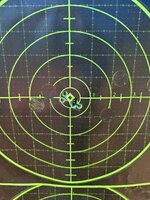
For a target I use a piece of steel with a waterline across the middle (this one is set at 600). The goal is to get your rounds splitting the line. This allows you to true your velocity by manipulating the app.
You need a good app. There are quite a few good ones, but in this case I use Shooter on an IPhone. It's simple and provides good data. Regardless of what app you use, you follow the same general steps.
First build the rifle profile. Measure and input accurate data with regards to sigh height. I've named the gun, input the barrel twist, sight height, and set everything to mils, and 1/10th graduations-
Then I go to "Ammo" hit the "+" sign, and a screen pops up. Select "from bullet library" as I know the bullet I am using will be in there.
A "bullet diameter" screen pop up. Select your bullet diameter- for this one ".224".
![[Linked Image]](http://i.imgur.com/7GSQn94.jpg "[Linked Image]")
Tikka T3X you measure from the bottom of the ejection port (center of bore) to the center of the reticle.Question to the group, that seems pertinent on this thread (imo)
1. Across all these apps, does "Sight Height" using a standard definition?
Google search defines as: "the vertical distance between the center of the rifle's bore and the center of the sight or scope" but that doesn't really mean it's standard because Google has a definition.
For example, I'm entering data into Maven's online calculator (for now).
Tikka T3 + UM Med + RS1.2 - my caliper is showing 1.85 based on the above definition.

Huh, I've had 1.5" in my calcs...RS1.2 in UM lows. Wonder how much error that could cause.Tikka T3X you measure from the bottom of the ejection port (center of bore) to the center of the reticle.
With Maven RS1.2 and UM lows use 1.65" in the apps and 1.8" with mediums.

Most use 1.5" in calcs because it's close to a lot of actual heights and is default for many Apps.Huh, I've had 1.5" in my calcs...RS1.2 in UM lows. Wonder how much error that could cause.
Tested it out...0.03 MIL difference at 1000 in my BH 77 TMK load per Revic.
Must be why I missed my first CBC shot
I mean, not sure how an app could consider sight height as anything other than center of bore to center of scope. It's what I've always considered that input to be. FWIW I have seen it make quite a bit of difference in a ballistic solution at 500+ yards.Question to the group, that seems pertinent on this thread (imo)
1. Across all these apps, does "Sight Height" using a standard definition?
Google search defines as: "the vertical distance between the center of the rifle's bore and the center of the sight or scope" but that doesn't really mean it's standard because Google has a definition.
For example, I'm entering data into Maven's online calculator (for now).
Tikka T3 + UM Med + RS1.2 - my caliper is showing 1.85 based on the above definition.
These measurements are super helpful, thanks for posting! These measurements should hold for all 30mm tubes, with UM Tikka lows and mediums.Tikka T3X you measure from the bottom of the ejection port (center of bore) to the center of the reticle.
With Maven RS1.2 and UM lows use 1.65" in the apps and 1.8" with mediums.
@Formidilosus is there a pinned post you've done (or someone else) on RS that explains a "how to" for judging distance only using a mil reticle?
I watched the TLHR.No videos and at one point he uses a yellow circular wheel, then later he's using the additional tools on that reticle. For the simplified Maven or SWFA reticles (or any mil reticle), is there a "quick range" way to do it?
Digesting this for a moment (I'm slow sorry). For your example: "(Example: 3.2 mil = 32 tenths → 45/3.2 ≈ 140 yards)" --- 3.2 mils is using your reticle to measure from what to what on the deer, hoof to top of back?RULE OF THUMB — USING MIL-TENTHS
Deer
Range (yards) ≈ 45 ÷ (mil-tenths)
(Example: 3.2 mil = 32 tenths → 45/3.2 ≈ 140 yards)
Bear
Range (yards) ≈ 55 ÷ (mil-tenths)
Elk
Range (yards) ≈ 75 ÷ (mil-tenths)
Why these numbers work
They come from:
Deer chest ≈ 18"
Bear chest ≈ 22"
Elk chest ≈ 30"
Range (yards) ≈ 25 × chest(in) ÷ mils
Converting to tenths just divides by 10, giving the simple constants (45, 55, 75).
The final version you can memorize in 5 seconds
Deer: 45 ÷ mil-tenths
Bear: 55 ÷ mil-tenths
Elk: 75 ÷ mil-tenths
Or using mils
Deer: 450 ÷ mils
Bear: 550 ÷ mils
Elk: 750 ÷ mils


![[Linked Image]](http://i.imgur.com/yTOWe2g.jpg "[Linked Image]")
![[Linked Image]](http://i.imgur.com/7Wppl6S.jpg "[Linked Image]")
![[Linked Image]](http://i.imgur.com/aNgrvmk.jpg "[Linked Image]")


