Homeless, How do towns deal with it?

Its easy to dehumanize and present extreme solutions for these people, but most of us are closer to being in their shoes than we'd like to admit. I would rather my tax dollars go towards helping these people than any sort of overseas venture.

Down here there's a big gap between true homeless due to mental/physical issues and fake homeless panhandlers who make good livings on the corner.
 
I never understood why supermarkets don’t give expiring food to the homeless.
Becasue of non profits/ programs that get tax benefits and funding to provide meals to the homeless, same with the company’s that supply those with food or even the land and property shelter or low income housing is on.
At the end of the day the homelessness issue has huge dollar signs attached to it.
 
I have heard that some of ours have houses but mentally can't handle being in a house. I feel much of this may have started when they cleared out the mental hospital and put them on the street.

I the 80s I witnessed a number that moved from other states because our system would pay them to live here for nothing. Many in the 70s bought a place for low prices and then signed up for welfare while generating money with cash generating jobs that are not reported.

I fear we are paying for a lot of junk that creates many of our problems.
 
Know of a couple guys who had bum camps edging into their neighborhood. After one too many problems. They started going on night walks, motivating people to go somewhere else.

Took a bit, but it seemed to work.
 
  • Like
Reactions: CMF
JFK shutdown mental institutions starting in 1963. They need to be brought back. That would eliminate 50% of the homeless.

Sent from my SM-S931U using Tapatalk
 
My former town on the front range allowed a huge encampment to develop on a 13 acre public natural area with a major river running through it less than a mile from the homeless shelter and downtown. There were numerous tents, tons of pollution of the river via feces/urine/garbage/needles, and often times fires burning visible from the state highway that is the main artery through town. Families and women no longer felt safe on the city's recreation trail because it went right through the camp.

By the time they shut it down, their official list of damages looked like this:

  • Damage to native grasses and plants.
  • Promoted untreated weeds and invasive species as a result of not being able to treat noxious species with active camps in these areas.
  • Human waste and trash have impacted the water quality of the river.
  • Human waste, food waste and trash have attracted unwanted rodents and insects.
  • Fencing, gates, signage, trash cans, etc… have been removed, damaged or destroyed.
  • Hazardous waste, small trash, cans, straws, etc…scattered throughout the site.
  • Burnt, broken and cut trees and limbs.
  • Soil damage.
  • Made-made holes, bunkers and fire pits.
  • Wildlife habitat has been destroyed, moved and impacted.
  • Evidence of fires throughout the site, including burnt benches, fencing and materials.
  • The soft-surface trail has been widened and rutted into a wider corridor. There are dozens of new social trails throughout the vegetation.
  • Damage to the river banks and eroded areas

The solution ended up being an outdoor camping ban within city limits. I no longer live there and can't comment on how many more of them it just funneled into alleys and parking lots, but you don't see tent cities popping up along populated and commonly used trails and recreation areas anymore, at least not as visibly.
 
There are multiple moving parts, some of which have been noted (moving people from institutional settings in the late 80's early 90's etc.). At that time it was part of a radical re-framing of how to manage folks with complex care needs.

Unfortunately there began a big push in the mid to late 90's of relying on those with "lived experience" and phrases such as "nothing about us without us" began to form public health policies across the G20 nations. This was literally having unwell people inform care models that have proven to be ineffective and enabling.

Then came the analog opioids that we are just now beginning to understand the degree to which they hi-jack complex areas of brain functioning. Perfect storm.

I will point out that substance use disorders (alcohol and other drugs) ARE mental health issues themselves, not something aside (they are listed as medical disorders in the ICD-11 and DSM-V) and SUD's are often co-occurring with other mental health issues.

Yes, there are scammers and folks with no shame that have found a way to game systems and get by, but they are the minority. Just as there is a stream of professionals that literally use phrases like "job security" when discussing the problem while cashing their pay cheques. But for every one of them, there are four that would love to be obsolete and not have to witness the self immolation of an entire group of people that, given a different hand of cards, would have been healthy productive members of society.

There has to be an informed and multi pronged approach to this, and it needs to include involuntary care as well as long term evidence based therapeutic interventions (especially medications that are actually taken by patients).
 
My former town on the front range allowed a huge encampment to develop on a 13 acre public natural area with a major river running through it less than a mile from the homeless shelter and downtown. There were numerous tents, tons of pollution of the river via feces/urine/garbage/needles, and often times fires burning visible from the state highway that is the main artery through town. Families and women no longer felt safe on the city's recreation trail because it went right through the camp.

By the time they shut it down, their official list of damages looked like this:


The solution ended up being an outdoor camping ban within city limits. I no longer live there and can't comment on how many more of them it just funneled into alleys and parking lots, but you don't see tent cities popping up along populated and commonly used trails and recreation areas anymore, at least not as visibly.
Must be COS. The homeless population tripled after pot was made legal. Last number I heard was around 3k homeless.

As far as fixing it, many need assistance due to mental health issues. Having talked with people who worked in that industry, if you have a coordinator/overseer who helps them keep on track, housing can work. Unfortunately it’s expensive and no one wants to pay for it. Without someone to keep them on track, housing alone doesn’t fix the problem for many. For some, it does, but not the chronically homeless.
 
What's the solution ? Put them in jail ? How can you force someone NOT to be homeless ? What would the penalty be ?
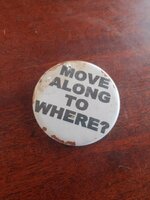
At a prior job I dealt with a lot of homeless camps in the mountains along the Front Range. The best solution seemed to be tolerating them in a few large areas because once you kick them out of places they inevitably end up other places which aren't necessarily better, such as private property. This also makes them harder for Law Enforcement to find if they commit crimes. I found this button at a transient camp once and kept it because I thought it was both funny and sadly true.

0107260836.jpg
 
There was a 9th circuit case that came out of Boise that said you couldn't criminalize camping but it was basically over turned when SCOTUS ruled on another case saying it didn't violate the 8th amendment.
 
I saw aton of homeless in Anchorage. Not sure how that works.

*unhoused*
Interesting. I am not aware of any homeless where I live. There’s a couple pan handlers every now and then.

I also live very close to Wilderness and NF ground. I am sure they filter through there and it just looks like they are camping.
 
Interesting. I am not aware of any homeless where I live. There’s a couple pan handlers every now and then.

I also live very close to Wilderness and NF ground. I am sure they filter through there and it just looks like they are camping.

Well the inverse could also be true. Maybe I just was looking at hipsters.
 
Jail them, determine what treatment they need, and treat them. I believe it’s Providence, RI that does this.


Sent from my iPhone using Tapatalk
 
Back
Top