Back to my Namibia trip as
@Lou (Louis) requested.
This is just an overview with a few details that I think would be most relevant to what I think this forum’s audience mostly is (i.e., primary experience and interest in western North America big game hunting).
I went with an outfit in Namibia for two main reasons: I specifically love Namibia (and deserts) and had been there decades ago on a non-hunting trip, and because it is relatively affordable. In general, South Africa has the most affordable hunting, followed by Namibia, then by the more premium experiences one can get in countries like Zimbabwe, Mozambique, Zambia and Tanzania.
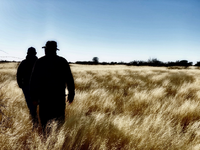
The outfit I went with has two main areas to hunt. One area is pretty empty grassland at the edge of the Kalahari desert. You could easily hunt this terrain in running shoes. I absolutely loved just being there. The grass rippling in the wind is mesmerizing.
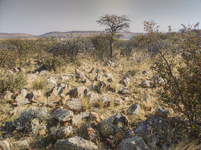
The other area has lots of bare rock ridges, with some cattle ranches in the flatter areas. It’s not at all hard-core mountaineering, but you definitely have to watch your step, and boots with good support are a good idea. I’m used to walking among loose, wobbly rocks in the Canadian Shield, but where I was in Namibia there’s often lots of long grass growing around those rocks on the hillsides so it’s hard to see where you’re stepping. There were some nice views.
The approach to hunting is generally to drive to promising areas, and upon spotting a herd, get out and stalk. A few times there was a lot of waiting, and other times I had to do pretty long crawls on hands and knees, up to a couple hundred yards staying low like that. Overall, I typically walked about 4-6 miles a days, sometimes longer. On a ten day trip, I took five animals, including a few dry periods with nothing for a few days. I’m saying this to give an idea of the relative sportiness of it.
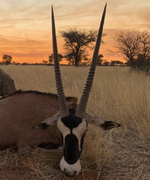
My favourite African animal is the gemsbock or oryx, and it was my favourite hunt on this trip. This is the same animal that has established wild populations in the US southwest. After several unsuccessful stalks over a few days, this one worked out. We were trying to get close to a small herd of about 15 animals, and the professional hunter (PH) guessed that they were likely to move in a certain direction, so we waited for about 45 minutes until they were in reasonable range. In my binos it was pretty easy to spot the best bull among the cows. The bulls have thick horns, while the cows’ horns are longer and thinner. The gemsbock shot was at about 120 yards.
My shots on the trip were between about 80 and 150 yards, which is good, because I have very little experience shooting at ranges longer than that, given where I live and shooting ranges I have access to. I made sure to tell this to the PH, and it was fine because typically they stalk to 100 to 200 yards anyway. From what I’ve read and heard, this is pretty common across much of African hunting.
One usually doesn’t need specialized gear for an Africa hunt. Durable pants and a light long sleeved shirt are typical. I wore regular hiking boots, nothing special. I like wearing a boonie hat for sun protection. I had a fleece jacket for cold drives in the back of the truck in the morning and evening. “Technical” clothing isn’t needed.
Binoculars are not essential, but I like having them and it enhances the experience. The PH and trackers will do the hard work of putting you on the right animal, but it’s nice to see for yourself. I was using 8x42s, and the PH said he alternates between 8x and 10x binos; he didn’t have a compelling reason to say one or the other is more suitable for the area we were hunting.
For various reasons, I combined this trip with another non-hunting trip, so it wasn’t possible for me to bring my own rifle. I used a camp rifle, a Sauer in .308 shooting 180 grain cup and core bullets, with a 3-90x40 Leupold. It did everything I needed it to.
One thing you should absolutely do to prepare is practice using shooting sticks. There often aren’t trees you can use for a rest, and shooting prone isn’t practical because of the tall grass. Sticks are usually how it’s done in Africa. I practiced back home using a tripod style set with a Y-rest, but when I arrived I found they were using quad-sticks. That took a little getting used to, but it would’ve been much harder if I hadn’t practiced using sticks before the hunt.
I want to go back, and will probably go back to the same place because I absolutely love Namibia.
While this forum is mostly about a different style of hunting, I like to see what there is to learn here and apply it in my own context. When I go back, I want to bring my own .375 H&H for an eland, and it now has a scope that passed the Rokslide test! The hunting isn’t nearly as rugged as a back country mountain hunt, but I still want to limit potential failure points.



