Flintlock and patched roundball performance

Regarding patch thickness, those are great questions. It also makes me wonder what common patch cloth would have actually been like then, right at the dawn of machine textile weaving, both in weave density and in material thickness. As well as just consistency. I mean, was there a standardized "patch cloth" they had access to, or was it kind of a get-what-you-can type of situation?

@Olsolitaire1 , you have any info on this?


I have a good relationship with a community that weaves their own cloth- shear the sheep, spin the cotton, loom, etc. All exactly as they have down for hundreds of years. Their cloth is as consistent and perfect as any I have seen from any machine or company. Consistent material for patches in the 1700’s isn’t even a factor- they had it.
 
Ive got a colonial 58 and a woodsrunner 54.

I ran them both pretty hot.

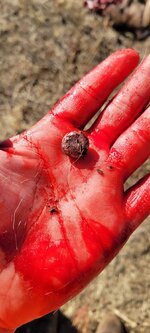
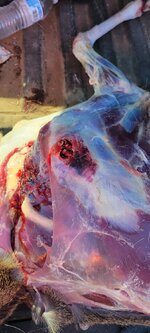
Shot a few deer with the 58 cal. 110gr 2f. Just poked a 58 cal hole in the deer, pretty underwhelming damage, ball slightly deformed but not much. Im guessing 1600 fps, but not sure. Had an elk hunt get western in the worst way possible. Turns out I was blowing patches and likely thru a shot 6" higher then anticipated about every 5th or 6th shot. I started putting a felt wad over the powder to protect the patch. Seemed to help.

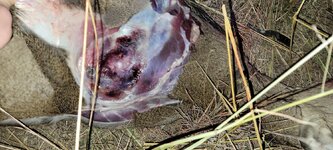
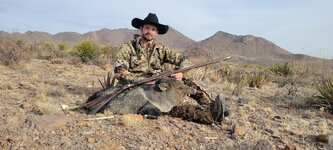
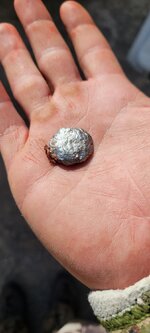
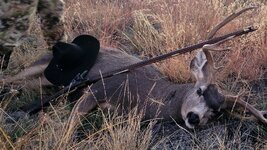
Got the woodsrunner. Pretty sure I was getting near 2000 fps with 105 gr of 2f. Everything that thing has touched was ko'd. 1 mule deer buck at 110 yards (spine), 1 whitey doe at 75 (frontal, ball curved to the right and stopped behind shoulder). And 2 javelinas, one point blank, one at 35 yards which surprisingly caught the ball. The balls flattened out dramatically and dumped energy. Might be the most damage from a muzzleloader ive made.


20231028_183817_03.jpg

20231029_123538.jpg

20231101_193633.jpg20240120_092511.jpg20240120_104753.jpg
All that being said... ignition has cost me 2 elk. The learning curve is steep (im self taught on this). And you can do everything right and still have issues. My last hunt, lightly rained on us in the morning. Did my best to cover the gun and swap prime frequently. Caught one bedded. Primed and pricked, made my stalk. He caught me at 75. Stood up and stepped towards me. Went prone. And slight delay 😩. The slick brass butt plate on my kifaru strap slid upwards on recoil (which i did checker a little bit, but not enough). Missed low best I can tell.
 
I have a good relationship with a community that weaves their own cloth- shear the sheep, spin the cotton, loom, etc. All exactly as they have down for hundreds of years. Their cloth is as consistent and perfect as any I have seen from any machine or company. Consistent material for patches in the 1700’s isn’t even a factor- they had it.

That's pretty amazing, and great to know.
 
Ive got a colonial 58 and a woodsrunner 54.

I ran them both pretty hot.

Shot a few deer with the 58 cal. 110gr 2f. Just poked a 58 cal hole in the deer, pretty underwhelming damage, ball slightly deformed but not much. Im guessing 1600 fps, but not sure. Had an elk hunt get western in the worst way possible. Turns out I was blowing patches and likely thru a shot 6" higher then anticipated about every 5th or 6th shot. I started putting a felt wad over the powder to protect the patch. Seemed to help.

Got the woodsrunner. Pretty sure I was getting near 2000 fps with 105 gr of 2f. Everything that thing has touched was ko'd. 1 mule deer buck at 110 yards (spine), 1 whitey doe at 75 (frontal, ball curved to the right and stopped behind shoulder). And 2 javelinas, one point blank, one at 35 yards which surprisingly caught the ball. The balls flattened out dramatically and dumped energy. Might be the most damage from a muzzleloader ive made.


View attachment 1019163

View attachment 1019164

View attachment 1019166View attachment 1019167View attachment 1019168
All that being said... ignition has cost me 2 elk. The learning curve is steep (im self taught on this). And you can do everything right and still have issues. My last hunt, lightly rained on us in the morning. Did my best to cover the gun and swap prime frequently. Caught one bedded. Primed and pricked, made my stalk. He caught me at 75. Stood up and stepped towards me. Went prone. And slight delay 😩. The slick brass butt plate on my kifaru strap slid upwards on recoil (which i did checker a little bit, but not enough). Missed low best I can tell.

Nice share, and great looking gun.
 
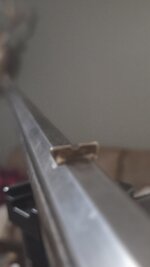
Did the math and filed the sight down. Have t shot it at 100 yards, but it’s now in the 10 ring at 25y offhand. But, I don’t like it that low. So I’ll be getting another tall rear sight and a taller front to match.

IMG_3828.jpeg

IMG_3835.jpeg
 
Spit or water, tow, let it rust, get it refreshed down the line.

Also, if you've looked at many originals a lot of them had crazy deep and narrow rifling, case in point being the original Hawkens and they were touted as being fine, accurate rifles. No way they would actually be able to get a good seal in the bore with that rifling unless the extra material in front of the ball somehow would wad up and seal it, but I doubt it.

They also surely didn't have the same patch thickness with them all the time... And we're acting like a 0.018 vs 0.020 patch makes a big difference.

So it really brings into question.... What was their accuracy truly like on a day to day basis? How would Daniel Boone have barked all those squirrels if he didn't have his 0.020 patching with him but had to use 0.018 and also didn't have his bore in the exact condition of when he regulated his sights?
Just pointing out assumptions that generally don’t hold. You know all this because you’ve read the original sources and know what’s in the trade lists. People depended on their guns on the frontier and beyond. But they definitely didn’t have ballistol, solvents, or soap, often didn’t have anything like tow, and generally didn’t have access to gunsmiths to fresh barrels if they let them rust. No precut patches, no micrometers. And mythical shooters were just that… Myths. Evidence of successful long range sniping in the day is rare and doubtful. Successful battles were won and lost through close range surprises. The most common long gun in the western fur trade was a smooth bore fusil. Long range was anything that was able connect further than a fuzee ball or an arrow from a 3-foot long sinew-backed bow.

I am and will enjoy the fact that Form is getting into this foray into flintlocks. But really understanding how effective they are/were requires some historical context.
 
Nice share, and great looking gun.
She's a beaut. Im a trad bow guy at heart. But hurt my shoulder in '21. So had to find an outlet (shoulder is fine now).

I definitely would have killed 2 bulls with an inline though 🥲. Also was hard to watch a 330" type bull broadside at 200, and a few days later a similar bull at 150...and do nothing 😅...

My 25 prc has fixed that issue 🤪😎


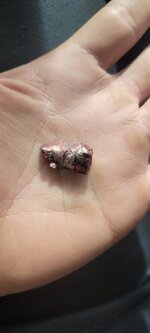
Here's my 58 cal pics. Exit on a doe. And a ball i recovered from a buck.

20221119_120429.jpg20221119_111253.jpg
 
Just pointing out assumptions that generally don’t hold. You know all this because you’ve read the original sources and know what’s in the trade lists. People depended on their guns on the frontier and beyond. But they definitely didn’t have ballistol, solvents, or soap, often didn’t have anything like tow, and generally didn’t have access to gunsmiths to fresh barrels if they let them rust. No precut patches, no micrometers. And mythical shooters were just that… Myths. Evidence of successful long range sniping in the day is rare and doubtful. Successful battles were won and lost through close range surprises. The most common long gun in the western fur trade was a smooth bore fusil. Long range was anything that was able connect further than a fuzee ball or an arrow from a 3-foot long sinew-backed bow.

I am and will enjoy the fact that Form is getting into this foray into flintlocks. But really understanding how effective they are/were requires some historical context.

My man, relax here. At no point was anyone asking about period-specific cleaning regimes when we were offering up what we know, until you asked about it.

As to real-world accuracy, I have personally seen steel banged down past 500 yards with an original, rifled .80cal flintlock. There may be a lot of myth that popped up, but I also think there were a hell of a lot more masterful shooters than would be believed.
 
My man, relax here. At no point was anyone asking about period-specific cleaning regimes when we were offering up what we know, until you asked about it.

As to real-world accuracy, I have personally seen steel banged down past 500 yards with an original, rifled .80cal flintlock. There may be a lot of myth that popped up, but I also think there were a hell of a lot more masterful shooters than would be believed.
Did not mean that to come off badly. Apologize if it did. Form has a tendency to focus on boiling things down and decanting the mythology. There’s a lot there to skim when it comes to flintlocks. The reality is that people used them in rough conditions without fancy supplies or gunsmiths. We tend to try to make things more complex to justify myths. The reality is that back in the day, 100+ yards was likely a pretty long shot given the guns and supplies that most people had to feed them.
 
Did the math and filed the sight down. Have t shot it at 100 yards, but it’s now in the 10 ring at 25y offhand. But, I don’t like it that low. So I’ll be getting another tall rear sight and a taller front to match.

View attachment 1019183

View attachment 1019184

Im hardly an expert. Just winged it and made it work for me, i dont have any contact with anyone who has ever used a flinter. Pretty well ignored the online flintlock forums, the fuddiest of fudds.

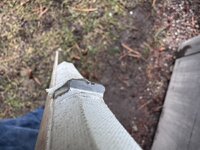
Here's what worked for me for the sight. I dont like the shallow v, found it too easy to lose the blade. So I crudely u notched the rear. I liked having some daylight around the blade vs almost completely obscuring it. And I deburred the sight as well. That thing was just waiting to rip me open.

20260209_204601.jpg20260209_204611.jpg

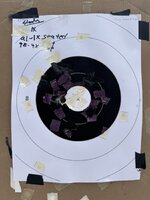
The sights were not my limiting factor. The ignition inconsistencies are what got me in the field. But if i recall, 4-5" was about what id get if everything went right.
 
The sights were not my limiting factor. The ignition inconsistencies are what got me in the field. But if i recall, 4-5" was about what id get if everything went right.

Growing up, I looked up to the guys competing with flintlocks, and asked a lot of questions about how they got their ignition so good - the top guys virtually never had hangfires or missfires, and the lock times were nearly indistinguishable from percussion locks. Unfortunately, I never got into the flinter game, but a huge amount of the speed and reliability these guys talked about came down to flint geometry, edge, and orientation. Can't offer more than that, but they were all obsessed about it.
 
Did not mean that to come off badly. Apologize if it did. Form has a tendency to focus on boiling things down and decanting the mythology. There’s a lot there to skim when it comes to flintlocks. The reality is that people used them in rough conditions without fancy supplies or gunsmiths. We tend to try to make things more complex to justify myths. The reality is that back in the day, 100+ yards was likely a pretty long shot given the guns and supplies that most people had to feed them.
Also, most people today don’t realize that flint longrifle stock are pretty fragile things if you take the barrel out. Most of those guns likely never had the barrel removed after they were built.
 
Growing up, I looked up to the guys competing with flintlocks, and asked a lot of questions about how they got their ignition so good - the top guys virtually never had hangfires or missfires, and the lock times were nearly indistinguishable from percussion locks. Unfortunately, I never got into the flinter game, but a huge amount of the reliability these guys talked about came down to flint geometry, edge, and orientation. Can't offer more than that, but they were all obsessed about it.
Oh at the range I was fine. Probably 19 out of 20 would break nice. The kibler guns are great sparkers and my ignition was as good as a percussion.

The problems come when hunting. I think after carrying the gun around all day, the powder would obscure the flash hole or humidity would get to it. You gotta keep the flash hole open or the charge will "fuse", you want the prime to send hot sparks straight to the main charge.

I tried to keep it pricked often. Carry it so the prime banks away from the touch hole. Etc. Despite my efforts I was closer to 50/50 on clean ignition in the field after carrying the thing for 5 miles. 😅
 
Oh at the range I was fine. Probably 19 out of 20 would break nice. The kibler guns are great sparkers and my ignition was as good as a percussion.

The problems come when hunting. I think after carrying the gun around all day, the powder would obscure the flash hole or humidity would get to it. You gotta keep the flash hole open or the charge will "fuse", you want the prime to send hot sparks straight to the main charge.

I tried to keep it pricked often. Carry it so the prime banks away from the touch hole. Etc. Despite my efforts I was closer to 50/50 on clean ignition in the field after carrying the thing for 5 miles. 😅


Interesting. I am at about 20 shots so far, and all have went off perfectly. Today was raining a bit and very humid. The pan turned slushy after each shot. Gun worked great.
 
Interesting. I am at about 20 shots so far, and all have went off perfectly. Today was raining a bit and very humid. The pan turned slushy after each shot. Gun worked great.
A box of those little alcohol wipes is a worthwhile investment for cleaning up a gummy pan.

My biggest issues seemed to come after carrying the gun all day. I think i even drilled out the touch hole a teeny smidge to try to help. Im probably still on the wrong side of the learning curve....orrrr....they got obsoleted for a reason 😅
 
I have a good relationship with a community that weaves their own cloth- shear the sheep, spin the cotton, loom, etc. All exactly as they have down for hundreds of years. Their cloth is as consistent and perfect as any I have seen from any machine or company. Consistent material for patches in the 1700’s isn’t even a factor- they had it.
I believe it as far as quality and tightness of weave goes. I was recently at the Utah history museum near the U and in the native Utah section there was the remnants of an old woven cloth done with a loom.... It was from if I remember right around 1300AD. It looked better and tighter than any canvas cloth I've seen at Walmart or Michaels. About as good as duck canvas from Joann's.

Surely though, they'd have run out and used something else if on the frontier. Different types of fabric, different supplier, etc.
Oh at the range I was fine. Probably 19 out of 20 would break nice. The kibler guns are great sparkers and my ignition was as good as a percussion.

The problems come when hunting. I think after carrying the gun around all day, the powder would obscure the flash hole or humidity would get to it. You gotta keep the flash hole open or the charge will "fuse", you want the prime to send hot sparks straight to the main charge.

I tried to keep it pricked often. Carry it so the prime banks away from the touch hole. Etc. Despite my efforts I was closer to 50/50 on clean ignition in the field after carrying the thing for 5 miles. 😅
If you hunt in humid areas, I'd recommend not using anything smaller than 4f. I use 4f and hunt in Utah. It doesn't ignite as quick after a few days of stormy weather, but it still goes without fail. Also, line the pan, anywhere water could get in, with chapstick. Keeps it waterproof but maybe not humidity proof.

I think Larry Pletcher busted the myth about priming location in the pan. Not enough difference to matter for the most part. He did slow motion tests. Very good stuff. Look him up. Let me know if you can't find it.

Interesting. I am at about 20 shots so far, and all have went off perfectly. Today was raining a bit and very humid. The pan turned slushy after each shot. Gun worked great.
Both Kibler and Dave Pearson seem to be students of good lock geometry and function. Dave's into British stuff ... The best locks. He has a thread where he reworked a not so great lock and had it showering with sparks using a dull looking rock from his driveway. I've been wanting Dave to build me one but I don't think he'd do it. Seems to be picky about when and who he does lock work for.
 
I believe it as far as quality and tightness of weave goes. I was recently at the Utah history museum near the U and in the native Utah section there was the remnants of an old woven cloth done with a loom.... It was from if I remember right around 1300AD. It looked better and tighter than any canvas cloth I've seen at Walmart or Michaels. About as good as duck canvas from Joann's.

Surely though, they'd have run out and used something else if on the frontier. Different types of fabric, different supplier, etc.

If you hunt in humid areas, I'd recommend not using anything smaller than 4f. I use 4f and hunt in Utah. It doesn't ignite as quick after a few days of stormy weather, but it still goes without fail. Also, line the pan, anywhere water could get in, with chapstick. Keeps it waterproof but maybe not humidity proof.

I think Larry Pletcher busted the myth about priming location in the pan. Not enough difference to matter for the most part. He did slow motion tests. Very good stuff. Look him up. Let me know if you can't find it.


Both Kibler and Dave Pearson seem to be students of good lock geometry and function. Dave's into British stuff ... The best locks. He has a thread where he reworked a not so great lock and had it showering with sparks using a dull looking rock from his driveway. I've been wanting Dave to build me one but I don't think he'd do it. Seems to be picky about when and who he does lock work for.
Yeah. I tried that stuff. Didn't help when that elk stepped out, even with a fresh prime.

You definitely dont want it banked over the touch hole.
 
Back
Top