EdP
WKR
New flintlocks from custom builders usually shoot low so that you can file down the front sight to bring it up to shoot where you want. You may need to file down the rear sight a bit if you can but try it without shooting bags first.

Follow along with the video below to see how to install our site as a web app on your home screen.
Note: This feature may not be available in some browsers.


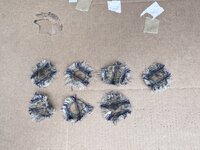
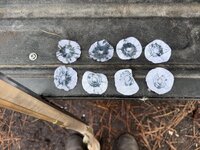

Patches look mostly ok but one looks blown and some show some fraying/stress where the lands would be I think. The blown patch certainly will not help accuracy but I'm not sure how much the stress marks matter. Supposedly, they should look completely free of fraying/stress.A few of the patches from today. .490” ball, .020” ticking, spit lubed.
View attachment 1018700
Swabbed after shooting. Top left to right, top then bottom.
View attachment 1018699
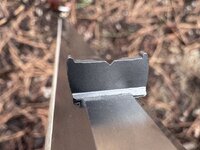
The wings on the rear sight have to go. Tries to lay you open any time you get near it.
View attachment 1018708

Patches look mostly ok but one looks blown and some show some fraying/stress where the lands would be I think. The blown patch certainly will not help accuracy but I'm not sure how much the stress marks matter. Supposedly, they should look completely free of fraying/stress.
It could be sharp edges/burrs on the corners of the new barrel's lands (typical with green mountain) or could be the sharp edges of the crown on the new barrel if your patch/ball combo is tight.
There's two ways to fix the first problem. Shoot a few hundred shots. Supposedly that works. Or use 0000 steel wool wrapped on a jag, oiled, so tight you may have to beat in it into the bore, then go up and down the bore until it loosens up and repeat for a hundred strokes or so. I believe that originated with Lee Shaver. I've done it and it works. I've also used Marron 3m pads then steel wool. It works faster. I had a barrel that did this, verified the land edges being sharp with burrs, and the patches looked perfect after smoothing the land edges.
For the crown, this likely only applies if your load is tight and hard to start. Use some emery paper or 300ish grit wet/dry paper, wrapped around the tip of your thumb to make a cone, then work the crown rotating the barrel 90 degrees often to help make the smoothing even. Repeat until it looks real smooth and doesn't tear patches on loading. This also works.
Patches look mostly ok but one looks blown and some show some fraying/stress where the lands would be I think. The blown patch certainly will not help accuracy but I'm not sure how much the stress marks matter. Supposedly, they should look completely free of fraying/stress.
It could be sharp edges/burrs on the corners of the new barrel's lands (typical with green mountain) or could be the sharp edges of the crown on the new barrel if your patch/ball combo is tight.
There's two ways to fix the first problem. Shoot a few hundred shots. Supposedly that works. Or use 0000 steel wool wrapped on a jag, oiled, so tight you may have to beat in it into the bore, then go up and down the bore until it loosens up and repeat for a hundred strokes or so. I believe that originated with Lee Shaver. I've done it and it works. I've also used Marron 3m pads then steel wool. It works faster. I had a barrel that did this, verified the land edges being sharp with burrs, and the patches looked perfect after smoothing the land edges.
For the crown, this likely only applies if your load is tight and hard to start. Use some emery paper or 300ish grit wet/dry paper, wrapped around the tip of your thumb to make a cone, then work the crown rotating the barrel 90 degrees often to help make the smoothing even. Repeat until it looks real smooth and doesn't tear patches on loading. This also works.

YepThe whole thing really seems to be another case of people picking the best they’ve ever done, and then reading tea leaves off of it, and claiming that one result is to be expected all the time.
I 100% agree. The information I share comes from guys who I've seen many of their targets in monthly matches, generally 5 shots, and they can shoot. They also seem to be more knowledgeable on the fact that 3 shot groups don't really tell the truth. Many of them say go shoot 10 shots! So I do tend to trust what some of them tell me. But, it's almost never at 100 yards. I try to share it with the caveats of "supposedly" and "should" because I don't know the truth.It’s an interesting thing- there’s a whole bunch of “you need to do this”, “this is what ____ should look like to shoot well”, etc, etc. Yet, demonstrable results of relevant shot group sizes showing differences functionally don’t exist.
Some matches will show 5 shot groups, but the first 5 shots of most of my groups with the last two rifles have been 2’ish inches at 100 yards. I’ve shot several that haven’t been shown and when aiming center with sub par sights, 3.5-4.5 inch 10 shots groups at 100y is the norm.
So I’m +/- 4 inches for 10 shots At 100 yards with PRB’s- and haven’t seen any results better than that anywhere. Idaho Lewis shoots some bad arse stuff, but his PRB shooting is at something like 60 yards and 3-5 shots IIRC. So still not able to see what should be expected on demand.
The whole thing really seems to be another case of people picking the best they’ve ever done, and then reading tea leaves off of it, and claiming that one result is to be expected all the time.
I 100% agree. The information I share comes from guys who I've seen many of their targets in monthly matches, generally 5 shots, and they can shoot. They also seem to be more knowledgeable on the fact that 3 shot groups don't really tell the truth. Many of them say go shoot 10 shots! So I do tend to trust what some of them tell me. But, it's almost never at 100 yards. I try to share it with the caveats of "supposedly" and "should" because I don't know the truth.
Unfortunately, I can't shoot well enough to be able to root out these truths. So I'm hoping you can. I need to start saying.... This is what I'm told can you test it
My problem was always flushing the barrel/ getting all the BP salts out (never found a way that did not involve actually flushing with tons of water) and then rushing to get the barrel dry, then finding a preservative that doesn't contaminate the powder next time you shoot.
It’s an interesting thing- there’s a whole bunch of “you need to do this”, “this is what ____ should look like to shoot well”, etc, etc. Yet, demonstrable results of relevant shot group sizes showing differences functionally don’t exist.
Some matches will show 5 shot groups, but the first 5 shots of most of my groups with the last two rifles have been 2’ish inches at 100 yards. I’ve shot several that haven’t been shown and when aiming center with sub par sights, 3.5-4.5 inch 10 shots groups at 100y is the norm.
So I’m +/- 4 inches for 10 shots At 100 yards with PRB’s- and haven’t seen any results better than that anywhere. Idaho Lewis shoots some bad arse stuff, but his PRB shooting is at something like 60 yards and 3-5 shots IIRC. So still not able to see what should be expected on demand.
The whole thing really seems to be another case of people picking the best they’ve ever done, and then reading tea leaves off of it, and claiming that one result is to be expected all the time.
How do you think people used to do what you are suggesting in thin-stocked, pinned longrifles without patent breaches?Hot soapy water, cleaning jag and cleaning patch, run down the barrel without the stock attached.
Spit or water, tow, let it rust, get it refreshed down the line.How do you think people used to do what you are suggesting in thin-stocked, pinned longrifles without patent breaches?
Spit or water, tow, let it rust, get it refreshed down the line.
Also, if you've looked at many originals a lot of them had crazy deep and narrow rifling, case in point being the original Hawkens and they were touted as being fine, accurate rifles. No way they would actually be able to get a good seal in the bore with that rifling unless the extra material in front of the ball somehow would wad up and seal it, but I doubt it.
They also surely didn't have the same patch thickness with them all the time... And we're acting like a 0.018 vs 0.020 patch makes a big difference.
So it really brings into question.... What was their accuracy truly like on a day to day basis? How would Daniel Boone have barked all those squirrels if he didn't have his 0.020 patching with him but had to use 0.018 and also didn't have his bore in the exact condition of when he regulated his sights?
How do you think people used to do what you are suggesting in thin-stocked, pinned longrifles without patent breaches?





