14 is good lolYeah that’s not horrible

Follow along with the video below to see how to install our site as a web app on your home screen.
Note: This feature may not be available in some browsers.
14 is good lolYeah that’s not horrible
Off hand felt terrible, whole thing felt clunky coming off pack.14 is solid!
I struggle with sitting unsupported. Your group ive never gotten 4/5 like you did here. My scores have been averaging between 13-15 latelyOff hand felt terrible, whole thing felt clunky coming off pack.

These are hard to beat at full price, let alone if you find them on sale at costco in person.Looking to buy some trekking poles and never used em before. Opinions on folding vs telescoping? And for shooting off of them seated, Quick Stix vs just looping handles and/or clamping with hand?
Agreed. I bought them at Costco in person for $34. They are the exact same thing Peax sells for $160.These are hard to beat at full price, let alone if you find them on sale at costco in person.
Sweet, I appreciate it. I was considering some from BD, but they get expensive. These look great.These are hard to beat at full price, let alone if you find them on sale at costco in person.
Looking to buy some trekking poles and never used em before. Opinions on folding vs telescoping? And for shooting off of them seated, Quick Stix vs just looping handles and/or clamping with hand?

There is a difference between flinch and recoil control. Flinch is pre ignition movement of the gun, and its bad. Recoil control is just your body controlling the recoil after the gun goes off, so some of that might be acceptable in ball and dummy drills, as long as its post click not pre click movement.Let's try & get this thread going again. I can't read anymore about what color the font should be on the new scope or mils vs moa. The conversations on here are getting retarded. Im excited about the new scope to but holy shit
Anyway, ive posted on this forum multiple times about developing a flinch when I was younger. Ive been making a ton of progress in the last couple of months. Here is how ive been working on it with a story. One of my buddies was telling me yesterday that he he never flinches or slaps the trigger. In my opinion most people are unaware that they have this issue. We went out this morning to test it. I had him set up sitting unsupported with my 308. First round in the magazine he was live & the second was a dummy. He didnt know i did this. I told him he had 10 seconds to break 2 shots. He breaks the first & has a complete FN seizure on the second lol.
Back to my progress. Doing ball & dummy mainly with a 308 in different positions other than prone. Combined with a shit ton of dry fire & practice with my pistol has given fantastic results. Here is how I set up my ball & dummy as I usually shoot alone. Half of these dont have powder or a primer in them. I dump them on my mat & load them into my magazines without looking. If you think you dont flinch try ball & dummy offhand. I think youll be surprised

 www.presscheckconsulting.com

There is a difference between flinch and recoil control. Flinch is pre ignition movement of the gun, and its bad. Recoil control is just your body controlling the recoil after the gun goes off, so some of that might be acceptable in ball and dummy drills, as long as its post click not pre click movement.
Video showing post click recoil control:
Article talking about it:
https://www.gunnuts.net/2016/02/10/post-ignition-recoil-control-vs-pre-ignition-flinch/
The video below is great if you're fighting the flinchies. Chuck struggled with this problem and is/was a world class, on demand, no failure, no excuses, lose your job if you miss, stud of a pistol shooter. He has a patreon if you want to ask him questions directly and the in person classes he teaches are excellent.
Flinchies:
Training:
TRAINING | Presscheck Consulting

They’re not great. There a huge difference in quality of carbon fiber, and those Cascade poles use some of the cheapest. They break incredibly easy compared to a carbon used by Black Diamond, Leki, MSR etc. You would be much better off buying aluminum BD’s than ever using those. I have poles in my hands probably more in one year than most will in their lifetime.Sweet, I appreciate it. I was considering some from BD, but they get expensive. These look great.

This x1000. I feel this when shooting my flintlock. Made worse if I've had too much coffee that morning or not enough sleep and get myself on edge. Trying really hard to not flinch can make it worse. The best thing I've found is to just sit down, not concentrate much, line up the sights and squeeze quickly without caring or thinking about the target or trying to do anything in particular. Don't look at the target to see where you hit. Just repeat. Of course that may not work all that well if you're trying to shoot groups, but it helps for getting relaxed and getting off that edge..
2) Both flinch and recoil anticipation are a function of mental anticipation - and both recede when you clear your mind of the mental loading. I've heard it described as the buildup of a kind of mental "static electricity" - with the flinch being its discharge. The less buildup, the less discharge. I believe there's a lot of validity to this analogy. Because what you make each shot mean can also amp this up or down dramatically. The more the trigger press is like just another mouse-click, the less anticipation and discharge there is - as opposed to "every bullet has a lawyer attachedto it", or a championship attached to it, or a buck of a lifetime attached to it. Click off the meaning, and just execute like you've done thousands upon thousands of times before.
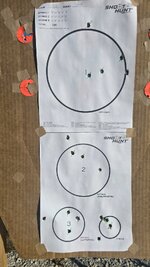

Man, I thought skis were going to be involved at first…been watching the Olympics too much.Carl Ross Drill Biathlon
I hopped on the bandwagon and added step ups into my workout schedule. I've always enjoyed creating my own "biathlon" courses of fire with friends and after doing step ups last night thought this would make for a simple and perfect pair with the Carl Ross drill.
I'm planning on shooting this sometime in the next week and I thought there might be some folks on here who enjoy this kind of masochism.
Here's how it works:
- Equipment In addition to the gear you would normally use for the Carl Ross drill, you'll need a 40lb weighted pack, a box for step ups (I use one of my coolers) and a tool to keep track of your steps (I use a handheld tally counter)
- Starting Position Shooter will have their rifle staged at the firing line fully unloaded with the bolt open and a full magazine sitting next to the rifle. At the start, shooter will do 100 step ups with a 40lbs pack then begin the first round of firing.
- Time Limit Time limits for each string are the same as the original drill. Record your time to complete the biathlon. If you’re competing with a buddy and there is a tie on the target score the fastest time wins.
- Drill This is the standard Carl Ross drill, but with weighted box/cooler step ups throughout to create an elevated heart rate. After completing each step up set, shooter must proceed IMMEDIATELY to their rifle, load and shoot. After firing, shooter will reload their mag, stage their unloaded rifle on the firing line with the magazine sitting adjacent to it and complete their next set of step ups. It’s a total of 500 step ups. Here’s the progression:
- 100 step ups > String 1 - offhand
- 50 step ups > String 1 - seated unsupported
- 50 step ups > String 1 - seated supported
- 50 step ups > String 1 - prone
- 50 step ups > String 2 - offhand
- 50 step ups > String 2 - seated unsupported
- 50 step ups > String 2 - seated supported
- 50 step ups > String 2 - prone
- 50 step ups > String 3
I'm curious to see what my biathlon score will be compared to my standard average on this drill. I used to shoot a lot of NRL22 competitions and we created a biathlon version. My biathlon scores were typically 80-85% of my standard scores, but I had a couple of friends whose biathlon scores averaged 50% of their standard scores.
Since 80% of those NRL22 stages were supported positions back then and only 50% of the Carl Ross drill is shot from a supported position, I'm fully expecting my biathlon to standard score ration to be worse.
If you try this out, I'd love to hear your feedback and what your "biathlon to standard score" ratio is.
Since 80% of those NRL22 stages were supported positions back then and only 50% of the Carl Ross drill is shot from a supported position, I'm fully expecting my biathlon to standard score ration to be worse.
If you try this out, I'd love to hear your feedback and what your "biathlon to standard score" ratio is.
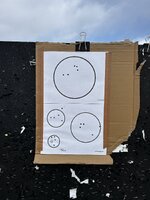
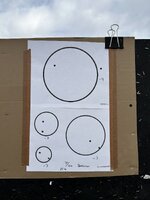
That offhand group is crazyView attachment 1025072
Shot it standard for a baseline, got 18. Didn't take the last shot in the prone, I had a misfeed in the medley that left me without enough time. 17-18 is probably about right though as an average, though I haven't kept close track.
View attachment 1025074
Started the biathlon, decided to call it after the untimed round. I dressed for being static @ 10F and exercising at 30F was not going well. Took tops off but wasn't committed enough to take my pants off. Based on how it went, I think best case I could get 50% on the timed portion had I continued. I could break OKAY shots (not great) but it took a fair amount more patience to do so.
Take it when you can get it, I wouldn't want to have to do it again.That offhand group is crazy