Elk Caliber with Particular Rifle Considerations

How many big game animals have YOU shot with a 22. Lets start there.
Deflection. Pretty much the only option you had….

But since you asked about MY 22 centerfire kills… I couldn’t even begin to guess on the total number of big game animals.
I’ve only killed wolves, whitetails, muleys, black bears, elk, and moose with 223/223AI/and 22 Creed. But only 1 whitetail with an AR15.

Your turn.

Oh wait, thats right, only some hogs and a whitetail.

Now to get back to the question, what exactly does it take for a bullet to be “ethical” for elk?
 
Folks
Deflection. Pretty much the only option you had….

But since you asked about MY 22 centerfire kills… I couldn’t even begin to guess on the total number of big game animals.
I’ve only killed wolves, whitetails, muleys, black bears, elk, and moose with 223/223AI/and 22 Creed. But only 1 whitetail with an AR15.

Your turn.
My favorite thing is to brag war witg one uppers about what ive done with rando’s on the net.

Folks we are off to a good start! Lets go for 1000 pages even!
 
To the OP, of your choices, I’d vote for the .308. Cheaper to shoot, light enough on recoil, lots of bullet choices to suit your flavor.

To the other conversation. Since the talk of shot placement has been universally decided as paramount to success regardless of caliber choice, how many rounds should someone plan to fire to become proficient in the use of their firearm? And what type of practice does each person pursue?
 
Not trying to be argumentative, what bullet or bullets? I can’t hunt with 22 or even 30 cal for deer, so I have no on game experience except yotes.
Where are you located that you can't use 30 cal for deer? Weird local game law or complete lack of deer to shoot or...?
EDIT TO ADD: Thought I saw in your reply to another comment that you are in Australia so that answers my question - but a red stag and an elk are a fair comparison for general size and toughness if I understand correctly. At least they certainly seemed so when I was chasing and guiding for them in Texas.
 
Thank you for sharing those details. With that in mind I’ll try to help you understand the difference between an arrow going 300 fps and a .22 caliber bullet going 3,000 fps and why one is superior to the other.

A broad head tipped arrow kills primarily by causing massive hemorrhage, causing the animal to bleed to death. Also, when an arrow pierces the thoracic cavity it allows outside air into that area causing the lungs to collapse. Both conditions are lethal. How an arrow accomplishes this is that as the relatively slow projectile impacts, the extremely sharp blades of the broad head slice through the hide and flesh, resulting in a relaxing of the tissues which reduces resistance to the penetration of the arrow. As the arrow continues to slice its way through the animal every blood vessel and organ encountered is cleanly sliced open, which results in massive and rapid blood loss. An arrow doesn’t expand (the blades of mechanical broadheads being the exception) so it slides easily through the hole created by the broad head, but momentum also plays a role as a heavier arrow will out penetrate a lighter arrow thus cutting deeper. The ideal result is a ‘pass-through’ where you get both entry and exit holes. Twice as much blood on the ground to follow, twice the amount of air that can deflate the lungs and death is usually very quick. That’s how an arrow kills.

In contrast, bullets kill by brute force. As an expanding bullet slams into an animal it rapidly expands and creates a hydrostatic wound channel that is much larger than the diameter of the actual bullet. As the bullet continues along its path, it destroys all organs it contacts, as well as blood vessels resulting in significant blood loss, deflation of the lungs if shot through the thoracic cavity and death is often quick, sometimes nearly instantaneous.

Where the problem presents itself with the small caliber bullets crowd is when the animal gets a lot bigger and tougher than the game the bullet is designed for. A given bullet that might be devastating on a coyote, or even a pronghorn antelope and many of our deer in the 100-200 pound range; may perform poorly on a 500-950 pound elk. When a bullet impacts an elk’s hide it begins expending energy. It takes more energy to penetrate a thicker heavier hide (elk) than it does a thinner, lighter hide (deer, antelope). After that, the muscles and bones of an elk are significantly larger and more difficult to damage by a tiny bullet, no matter how fast it’s going. Momentum again plays a role as a 225 grain .338 bullet at 2,900 fps has a lot more momentum than a 65 grain .22 bullet at 3,300 fps. A .338 bullet has a larger diameter un-expanded than a .22 caliber bullet does when fully expanded. When that bigger bullet expands it it dramatically bigger and has way more momentum, thus doing damage on a level that no tiny bullet can inflict in the best of circumstances. Bullet construction also matters as some bullets like Berger tend to disintegrate and do massive damage but with shallow penetration, while bullets such as a Nosler Partition, A Frame, Bearclaw and such retain much of their weight and thus penetrate deeply causing more organ damage. A large, heavy bullet that can smash thru and break heavy bones is superior to a small, light bullet that doesn’t have the energy and momentum to break through the same bones. And when that smaller bullet stops, it does no more damage

@Aussie Dan I hope this answers your question and helps you understand the difference in why a slow arrow can be more lethal than some fast bullets.

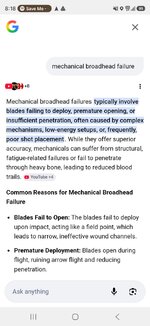
A quick google search suggests that mechanical broadheads suffer similar failures as you claim .22 cartridges do relating to breaking bone, penetration and minimal blood trails.

Does that render the use of mechanical broadheads unethical also?
Or is the logical approach to the discussion at hand for hunters to ensure effective shot placement, use of equipment that helps maximise accuracy in aid of shot placement and to only take shots that are within the capabilities of the individual hunter?

A bullet or arrow or a pointy stick through the vitals is a guaranteed kill, which we agree on.
Another thing I have no doubt we agree on is that throughout the entire history of hunting globally, animals big and small have been killed, wounded and missed by every cartridge, arrow or weapon ever created.
 

Attachments

  • Screenshot_20260407_081809_Samsung Browser.jpg
    Screenshot_20260407_081809_Samsung Browser.jpg
    144.1 KB · Views: 6
Hello. I am interested in purchasing a rifle for elk hunting. I have experience with shotguns, 5.56, and archery. I have been in the rabbit hole, both on rokslide and elsewhere. I prefer archery hunting but a group of us are planning a trip for rifle season. I’m between 3 or so choices and I just can’t make a decision.

Tikka T3x Lite in 308
Seekins Ph3 in 7 PRC
Bergara in 300WM.

My concerns are:
308- Pros- Lightweight/Shootability/ Concerns-“knockdown” power
7 PRC- Pros- Larger Seekins- Rifle cost, ammo quality/availability (I’m not a reloader)
300 WM-Bergara-Pros- 30 Cal, velocity, Cons- Weight, recoil

I have a max 300 yard range I shoot at. I really don’t think I’d take a shot further than that no matter the rifle. It wouldn’t be ethical without a lot of practice at those distances. I would imagine most elk are taken within that distance? Has anybody ever hunted with a 308 and wished for more? I don’t want to wound an animal. Is there a caliber I should consider outside of these? Should a 30.06 or 7 REM Mag be a consideration?
Of your choices stated, you would be hard pressed to go wrong with a 308 and a 180gr Fusion for your stated range of 300 and in. It will be the easiest to become proficient with, when it comes to maintaining sight picture and follow through.

Better yet would be a 6.5 Creed and 147 ELD m’s or a 7/08 and 162 ELD m though. Easier yet to shoot, and shoot a bunch. And will drive through the shoulders of any bull walking.
 
*sigh*… right back to insulting people and talking out of your ass again.

Here’s the thing, it isn’t the chambering that matters. It’s the bullet.
Guys, such as yourself, that crow about cartridges and don’t talk about the bullets merely show a lack of understanding of the mechanics of killing.
You’re partly correct and partly wrong. It most definitely IS the bullet. And, the chambering matters too. That said and sticking with your premise…. NO .22 caliber bullet is an elk bullet. Period.
 
Where are you located that you can't use 30 cal for deer? Weird local game law or complete lack of deer to shoot or...?
EDIT TO ADD: Thought I saw in your reply to another comment that you are in Australia so that answers my question - but a red stag and an elk are a fair comparison for general size and toughness if I understand correctly. At least they certainly seemed so when I was chasing and guiding for them in Texas.
Iowa. Yep deer is 35 cal or larger except for some late season leftover hunts in a few counties. Better than it used to be when it was shotgun only.
 
Can we take up a collection for BuckSmaser and DLSJR to attend a certain shooting class? I’m in for $100 if it includes a video of the action lol.
I’ll also be glad to place some bets on outcomes…😏
 
Starts with mot being 22
I admire your tenacity, although your inability to come up with anything other than “because I said so!” doesn’t really give your argument a lot of substance.


To the OP, the main point to take away from all this is that a heavy for caliber bullet (regardless of caliber) at a moderate impact velocity will break bones and penetrate to vitals.

Headstamps don’t matter, bullets do.
 
It’s UNethical to shoot elk with a .22 caliber bullet. And I’m pretty confident it’s also not legal in many states.

@43.6N since you’re a proponent of .22’s for elk, why don’t you educate the rest of us by telling us just how many elk you’ve killed with them? Or even just how many elk? You strike me as way more of a keyboard troll than an elk hunter.

Why don't you share some real terminal results?

All that you have cited is a (most likely) grossly inflated weight of one animal.

There are hundreds of animals in the .223 and 6mm kill threads with pictures of the damage. Dozens of elk are among them.

Rather that stating things are wrong because you said so, back it up. Pictures, ranges, bullet type, impact velocity. Actual data.
 
Back
Top