Not trying to be argumentative, what bullet or bullets? I can’t hunt with 22 or even 30 cal for deer, so I have no on game experience except yotes.All pigs and one 8 point whitetail.

Navigation
Install the app
How to install the app on iOS
Follow along with the video below to see how to install our site as a web app on your home screen.
Note: This feature may not be available in some browsers.
More options
Style variation
You are using an out of date browser. It may not display this or other websites correctly.
You should upgrade or use an alternative browser.
You should upgrade or use an alternative browser.
Elk Caliber with Particular Rifle Considerations
- Thread starter EdMN22
- Start date
BuckSmasher
WKR
55 hardball, 62 fusions and 62 ttsxNot trying to be argumentative, what bullet or bullets? I can’t hunt with 22 or even 30 cal for deer, so I have no on game experience except yotes.
BuckSmasher
WKR
No. I carry more.Do you only carry 1 round with you when hunting?

308 simply because you will shoot it more, can be nice and light without being punishing, tons of ammo options, fantastic suppressed, and packs more energy than necessary at 300 yards. If you want two holes, pick a tough bullet. Now if you ever get to regularly shoot farther and plan to hunt bulls exclusively, the others really start to shine if you get less than prime angles in that 400+ yard range.
Since everyone has there : oh you might also consider X, 280 ackley improved would be ideal
Since everyone has there : oh you might also consider X, 280 ackley improved would be ideal
Aussie Dan
Lil-Rokslider
- Joined
- Feb 12, 2026
- Messages
- 183
Does that not contradict your point of not needing follow up shots?No. I carry more.

SwiftShot
WKR
- Joined
- Nov 16, 2019
- Messages
- 600
If you are setting a limit of 300 yards. Well then a short barrel like 18 inch in 308 will be a great little rifle.

solarshooter
WKR
Well there's your problem!55 hardball, 62 fusions and 62 ttsx
solarshooter
WKR
Lol, wrongcan be nice and light without being punishing
Only need 1!tons of ammo options
So are a bunch of cartridges...fantastic suppressed
Lolpacks more energy than necessary at 300 yards
Lol, wrongIf you want two holes, pick a tough bullet
Lol, wrongNow if you ever get to regularly shoot farther and plan to hunt bulls exclusively
Seriously what is going on around here??
BuckSmasher
WKR
Well, I agree that a 22 Creedmoor with a 90 grain bullet would have been more effective. I didn't really have 'too much' of a problem. A 5.56 is 'about' enough gun for most Texas feral hogs. Occasionally I would have to pump two or three rounds in one but most of the time a single well placed round was enough. I eventually traded for an ar-10 but it was heavier, lost sight picture in recoil harming my ability to get doubles and triples out of the same sounder <--(a group of pigs is a sounder) but man, was there a HUGE difference in the quickness with which the pigs died AND having to shoot them again, AND wounding. Hit a smallish 100 or so pounder once in the guts and disembowled it with a 150 fusion. Eventually settled on a 6.5 Grendel for a balance of more power than the 223, faster target acquistion than the .308.Well there's your problem!
Fast forward a few years, and I live in Idaho, don't get to hunt pigs but every few years on Texas trips during the winter and I post on a forum that is overtaken with hysteria about hunting critters MUCH larger than Texas feral hogs with a gun I deemed marginal for that purpose after extensive experience. It perplexes and concerns me. Elk deserve better than to be hunted with a .22. They weigh OVER twice what the biggest pig I ever saw/shot weighed and shots are further. Most of my pigs were shot in East Texas swamps at less than 100 yards, majority of those less than 50.
I get the reaction to "magnumitus". Elk are not tanks and one doesn't need a field cannon to kill one. Also, bullet placement and accuracy IS more important than just shooting the biggest most powerful cartridge. The pendulum can swing the other way though. 22 Cals aren't enough. A 7mm-08 or a 270 is not a magnum heavy recoiling rifle. .308 ammo is not too expensive to practice with.
I can tell you are an opinionated guy. Me too. I don't post on the ".223 for elk, moose elephant" thread because that is an echo chamber of folks that are firm that they have found something new, edgy, controversial, and exciting. I think it is harmful and un-ethical. This is an opinion forum. I will share my opinion rationally and without anger or rudeness, hopefully just the same as if we were at a hunting camp and in person.
solarshooter
WKR
a 22 Creedmoor with a 90 grain bullet would have been more effective
I appreciate your measured, thoughtful response here. My main point, and the point of the .223 success thread, is that BULLET and BULLET CONSTRUCTION is what matters (and adequate impact velocity for that bullet). Your post here shows that you are thinking only about CALIBER and CARTRIDGE, but not BULLET. That's why I said I'd found your problem above - you were shooting light for caliber hard/bonded/mono bullets that do not kill well.Elk are not tanks and one doesn't need a field cannon to kill one. Also, bullet placement and accuracy IS more important than just shooting the biggest most powerful cartridge
I'm glad you acknowledge that more recoil is harder to shoot.I eventually traded for an ar-10 but it was heavier, lost sight picture in recoil harming my ability to get doubles and triples out of the same sounder
This is something you have wrong. That thread is full of DATA, NOT OPINIONS. Tons of photographic evidence and information on rifle, bullet, shot, situation, animal reaction to shot, time to death, etc. The OPINION is that "22cal is inadequate". The data does not support this opinion.I think it is harmful and un-ethical. This is an opinion forum.
I also think your theory on people shooting 22s at big game "just to be different and cool and edgy" is pretty weak and not really happening here. And the other explanation, that it's because they are more shootable and equally lethal and therefore result in higher kill rates and better outcomes, is supported by tons of evidence and testimony.
BuckSmasher
WKR
Bullet construction does matter. I prefer bonded and mono bullets. Even with those, on small Texas pigs, I had penetration issues from a 223.I appreciate your measured, thoughtful response here. My main point, and the point of the .223 success thread, is that BULLET and BULLET CONSTRUCTION is what matters (and adequate impact velocity for that bullet). Your post here shows that you are thinking only about CALIBER and CARTRIDGE, but not BULLET. That's why I said I'd found your problem above - you were shooting light for caliber hard/bonded/mono bullets that do not kill well.
I'm glad you acknowledge that more recoil is harder to shoot.
This is something you have wrong. That thread is full of DATA, NOT OPINIONS. Tons of photographic evidence and information on rifle, bullet, shot, situation, animal reaction to shot, time to death, etc. The OPINION is that "22cal is inadequate". The data does not support this opinion.
I also think your theory on people shooting 22s at big game "just to be different and cool and edgy" is pretty weak and not really happening here. And the other explanation, that it's because they are more shootable and equally lethal and therefore result in higher kill rates and better outcomes, is supported by tons of evidence and testimony.
Recoil is on a continuum. So is lethality. A .223 falls at the bottom on both categories. Who is wading into a herd of elk at close range and trying to get a double or triple? I have shot multiple animals more than once over the years. Never had a problem. Shot an elk in 2013 in The Weminuche wilderness at 290 yards with a .340 wby and 250 nosler partitions, first shot double lunged him, he hunched up, second shot took out the spine and both shoulders about a second later. Bullets are cheaper than hunts and I don't like trailing wounded animals.
That thread is full of CONFIRMATION BIAS and OPINIONS and BIASED DATA. The only thing that thread proves, is that a 223 can kill an elk. Which who didn't know that?
This is a literally a cut and paste:
During WWII, the U.S. military committed a classic error of survivorship bias by analyzing bullet holes only on returning B-17 bombers. They planned to reinforce areas with the most damage (wings/fuselage). Statistician Abraham Wald rightly argued to armor the undamaged areas (engines/cockpit), as planes hit there never r
Key Aspects of the B-17 Bullet Hole Study:
- The Flawed Data: Military analysts mapped hits on returning planes, finding high concentrations on the fuselage, wings, and tail, suggesting these areas needed more armor.
- The Misinterpretation: The initial, intuitive conclusion was to add armor where the damage was most frequent.
- Abraham Wald's Insight: Wald realized this data only represented planes that survived despite being hit. The areas without damage on returning planes were the critical spots; planes hit there were lost, creating "missing" data.
- Corrective Action: The military placed armor on the engines and cockpit, where the fewest holes were seen in the returned planes, significantly reducing combat losses
I am not a psychologist but there is a lot of talk about they are finding out better ways to do stuff and "Fudds" being a codeword for detractors, etc, etc. The truth is that they chose a 223 rightly understanding that it doesn't recoil very much, like that is the ONLY consideration for an elk rifle, or that it can kill one and cause tissue damage in the ones you are lucky enough to recover. What about the ones that aren't pictured? Those are the ones I care about.
Traditionally smallish bore rifles like the .270 and 7mm-08, 308, etc don't recoil too much for follow up shots. They don't have prohibitively expensive ammo, the guns themselves can be small and light, and they are much more lethal than a .223. Those are the facts.

solarshooter
WKR
I used to make this exact argument. But there's plenty of dissenters on the 22cal success thread, and essentially 0 examples I've seen where they go test it and come back and report a failure. Almost universally, once it's tested, they become completely converted and their whole arsenal and shooting practice changes (like me). There are a couple "small caliber failure" threads. Most of them lack concrete examples and end after a few pages. So while I understand your point about potential confirmation bias, I don't think it holds water.What about the ones that aren't pictured? Those are the ones I care about.
You should try a good 22cal or 6mm bullet on game. I did, and it blew me (and the poor elk) away:
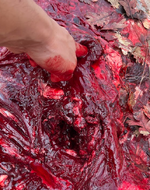
That's a 6mm 108gr bullet through an elk sternum. If anything, it did too much damage. Now do you think if you scaled that bullet down to 88gr and 5.56mm wide, it would do a whole lot different? I don't. Do you think I needed another 60grs and 0.060" of bullet to kill this elk? I don't.
And that's from a handy 18" barrel gun I could balance on my left nut and shoot without discomfort. 1/2 to 1/3 of 308 recoil. Same BC bullets, same wind performance, higher velocity and less drop. I can spot impacts better, make follow ups faster, and watch what the animal does and where it goes easier. How is this not an objectively better overall solution with no practical drawbacks?
solarshooter
WKR
This is how the battle is won. Foot by foot.

stan_wa
WKR
Get the Tikka—I have two Seekins and love them, but doing it again would get me two Tikkas. So much so that I bought my dad a Tikka in .243. His Tikka in .243 was an upgrade over his 7RM, which is basically the same as a 7PRC.
I’ve taken my dad on several outdoor shooting adventures with his 7RM, and shooting 20–40 rounds of practice in a day was way too much—it bruised his shoulder and caused many flinches. After some load development, he shot 80 rounds of .243 in 2 hours and achieved groups he’d never shot as a lifelong hunter.
So, to give you advice, I’d propose getting the Tikka paired with either a 6.5 Creed or 6.5 PRC. You can shoot these bare, with a can (suppressor), or with a muzzle brake.
The key question is: Can you spot your impacts? To know the answer, first ask yourself: Do I want a bare muzzle, a muzzle brake, or a suppressor?
30 cal does nothing for me, and if you’re shooting within 300 yards, there’s no reason to use a 30 cal.
For a one-and-done setup, you don’t need to go down to but could go .22 cal, and you really don’t need to go up to and should not get a .300 cal.
I’ve taken my dad on several outdoor shooting adventures with his 7RM, and shooting 20–40 rounds of practice in a day was way too much—it bruised his shoulder and caused many flinches. After some load development, he shot 80 rounds of .243 in 2 hours and achieved groups he’d never shot as a lifelong hunter.
So, to give you advice, I’d propose getting the Tikka paired with either a 6.5 Creed or 6.5 PRC. You can shoot these bare, with a can (suppressor), or with a muzzle brake.
The key question is: Can you spot your impacts? To know the answer, first ask yourself: Do I want a bare muzzle, a muzzle brake, or a suppressor?
- If bare muzzle: I would not advise anything larger than 6.5 Creed due to recoil. I dislike shooting my bare-muzzle .308, but I enjoy shooting my 28 Nosler with a 5-port SRS brake.
- If suppressor: Stick with 6.5 PRC and lighter in terms of recoil—though .243, 6mm, or 6.5 Creed would still be my preference.
- If a good 3–5 port muzzle brake (e.g., SRS, Fat Bastard, MBM): You can go up to 7 PRC and under.
30 cal does nothing for me, and if you’re shooting within 300 yards, there’s no reason to use a 30 cal.
For a one-and-done setup, you don’t need to go down to but could go .22 cal, and you really don’t need to go up to and should not get a .300 cal.
Yup, someone just lost several pounds of spectucular dinner fare. Give me really good bullets like the partitions, TSX, Accubonds or the Hornady GX coppers.I used to make this exact argument. But there's plenty of dissenters on the 22cal success thread, and essentially 0 examples I've seen where they go test it and come back and report a failure. Almost universally, once it's tested, they become completely converted and their whole arsenal and shooting practice changes (like me). There are a couple "small caliber failure" threads. Most of them lack concrete examples and end after a few pages. So while I understand your point about potential confirmation bias, I don't think it holds water.
You should try a good 22cal or 6mm bullet on game. I did, and it blew me (and the poor elk) away:
View attachment 1047046
That's a 6mm 108gr bullet through an elk sternum. If anything, it did too much damage. Now do you think if you scaled that bullet down to 88gr and 5.56mm wide, it would do a whole lot different? I don't. Do you think I needed another 60grs and 0.060" of bullet to kill this elk? I don't.
And that's from a handy 18" barrel gun I could balance on my left nut and shoot without discomfort. 1/2 to 1/3 of 308 recoil. Same BC bullets, same wind performance, higher velocity and less drop. I can spot impacts better, make follow ups faster, and watch what the animal does and where it goes easier. How is this not an objectively better overall solution with no practical drawbacks?

DLSJR
Lil-Rokslider
- Joined
- Mar 23, 2025
- Messages
- 105
If you really believe any .22 caliber cartridge is an elk cartridge, I pray you never draw an elk tag. To suggest any .22 as an elk cartridge is beyond responsible, it’s stupid and reckless.I appreciate your measured, thoughtful response here. My main point, and the point of the .223 success thread, is that BULLET and BULLET CONSTRUCTION is what matters (and adequate impact velocity for that bullet). Your post here shows that you are thinking only about CALIBER and CARTRIDGE, but not BULLET. That's why I said I'd found your problem above - you were shooting light for caliber hard/bonded/mono bullets that do not kill well.
I'm glad you acknowledge that more recoil is harder to shoot.
This is something you have wrong. That thread is full of DATA, NOT OPINIONS. Tons of photographic evidence and information on rifle, bullet, shot, situation, animal reaction to shot, time to death, etc. The OPINION is that "22cal is inadequate". The data does not support this opinion.
I also think your theory on people shooting 22s at big game "just to be different and cool and edgy" is pretty weak and not really happening here. And the other explanation, that it's because they are more shootable and equally lethal and therefore result in higher kill rates and better outcomes, is supported by tons of evidence and testimony.
If you really believe any .22 caliber cartridge is an elk cartridge, I pray you never draw an elk tag. To suggest any .22 as an elk cartridge is beyond responsible, it’s stupid and reckless.
Moose aren’t that tough. They’re still slab sided animals with huge vitals. And a 77tmk or 80+ ELDM / ELDX projectile in the vitals is doing more damage than any bonded bullet below 30 cal. The doubters never interact with that.
BuckSmasher
WKR
Yall have a thousand page thread.Moose aren’t that tough. They’re still slab sided animals with huge vitals. And a 77tmk or 80+ ELDM / ELDX projectile in the vitals is doing more damage than any bonded bullet below 30 cal. The doubters never interact with that.
Similar threads



Featured Video
Latest Articles
- Mule Deer Days Wildlife Conservation Mashup
- A Hidden Gem: Hunting Washington with Kari Thomas
- Prime Divide Bow Review
- Knowledge From Storms: Surviving and Thriving in the Backcountry with John Barklow
- DIY Wyoming Pronghorn Hunt
- Unlock Precision Shooting: Master Your Hunting Game with Competitive Insights
- Topo Topper Rincon Review
- Tony Trietch on Big Mule Deer, Desert Bulls & Western Hunting Evolution
- The Right to Hunt & Fish Colorado (and North America)
- Mastering New Zealand’s Mountain Hunts: Challenges and Rewards