Powder choice and how the bullet slugs up or what can be called "dwell time" as well as brass fit and throat finish all contribute to induce or reduce carbon. There's been some powders that claim to reduce copper fouling which may have an effect on carbon.

Navigation
Install the app
How to install the app on iOS
Follow along with the video below to see how to install our site as a web app on your home screen.
Note: This feature may not be available in some browsers.
More options
Style variation
You are using an out of date browser. It may not display this or other websites correctly.
You should upgrade or use an alternative browser.
You should upgrade or use an alternative browser.
Educate me on this infamous thing called a Carbon Ring.
- Thread starter mtnbound
- Start date

83cj-7
WKR
That’s exactly what happened to the guy I know. That was with RL26 as well.One interesting thing I noticed when re26 was going to be my last powder was that it built carbon but not in the throat, it did so halfway down the barrel.

I believe it's mainly a PRC thing. In other words, cartridges designed with tighter than average tolerances. I have a 7PRC and it builds up a carbon ring.
Carbon rings are far from "a PRC thing" as it was common and well known long before the PRC family was born.
Is it due to increased use of suppressors?
I've seen more carbon ring issues on rifles with no muzzle devices than I have on suppressed rifles. Not saying that on some rifles that might not be a contributing factor but the worst I've ever seen was a plain sporter rifle using factory ammo.
My wife had great results in her 7mm-08 with the factory Hornady Superformance load with the 129 SST. All of a sudden, she went from shooting sub MOA 5 round groups to shooting an 8" pattern with 0 consistently. Turns out that the particular load they were using in that ammo was causing carbon rings, inaccuracy, and stiff recoil for dozens of people on the internet when I looked into it. We got the carbon ring removed and tried some of the old ammo and some fresh ammo and that rifle would start showing carbon ring signs again in less than 20 rounds.
We swapped her to a 120 TTSX Barnes factory load and no more issues with that rifle. Unfortunately that rifle is an orphan due to Marlin shutting down and losing support for their bolt action rifles. The biggest issue with the Marlin X7 series was the lack of stock parts. The plastic trigger guard liked to crack and you would lose your action screw torque. I was able to find a metal replacement trigger guard for a different model and machine it so that it would work but it was a process to find that aftermarket piece. Support just doesn't exist anymore.
Jay

- Joined
- Jan 14, 2014
- Messages
- 580
I have a theory that I’d like to test one of these days. I wonder if the new “temperature insensitive” powders are more prone to forming a carbon ring. They use a variety of surface coatings on the powder granules to slow down or speed up ignition. These polymers may not completely combust and re-polymerize in the barrel. So, if anyone has a Gas Chromatography Mass Spectrometer or a Attenuated Total Reflection Fourier Transform Infrared Spectrophotometer laying around & a barrel you wouldn’t mind me sectioning, I’ll get right on it 
Sent from my iPhone using Tapatalk
Sent from my iPhone using Tapatalk

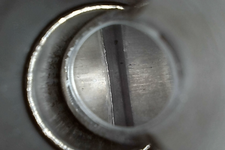
I borescoped my 223 after 3,000 rounds without cleaning (edit, over 2,000 with certainty, 3,000 is probably rounding up by a few hundred) and no carbon ring. So, no.If you're not cleaning your rifle you will have a carbon ring. It might not cause you any problems but it's there. Look in your barrel with a borescope and you'll see it.
Post the pictureI borescoped my 223 after 3,000 rounds without cleaning and no carbon ring. So, no.
Axlrod
WKR
Good luck? He shoots his rifles 10 rounds per year! It would take like 500 years to wear out a barrel.@270-300
I’m glad you have good luck with your barrels but believe me, you can shoot out a barrel in short order. There are a lot of factors. Powder, barrel steel, how hot you run it etc. I have shot out a .243 barrel in 600 rounds and a 6x45 barrel in 500 rounds. I believe both of them had something wrong with the steel itself which caused them to burn out quickly. When I say shot out, I’m talking about being able to push a bullet 3/4” up in the throat, like nothing left at all, and confirmed with a bore scope. In my 243 barrels I have found that H4350 was a major factor to killing them too quickly. Now that I have been running H1000, I’m past 2000 rounds with only minor throat wear and a tiny amount of checking.
Something special about a guy that doesn't shoot, giving advice to guys that do shoot.


Educate me here. Is that dark stripe the carbon ring? I just got a bore scope and I would like to know what I’m looking for.
Thanks
Correct, here's one in my 6.5 PRC that was actually causing pressure issues after about 40 rounds. Note to self, don't trim brass too short. I cleaned it and measured with a sinclair gauge so I'm only trimming .005" from max case length now. Also need to see if I can get my Hornady trimmer to leave less of a chamfer on the case. 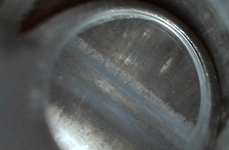
Sevens
WKR
Same, shoot my 6.5 PRC a lot. Didn’t clean the barrel ever, got some pierced primers, learned about carbon rings, cleaned, no issue since. While I don’t love cleaning barrels, I do make an effort to clean them every couple hundred rounds now and pay better attention to if bolt lift starts getting stiff.I was in the no-clean camp until I had my 6.5 PRC start popping primers and not even be able to chamber a round due to carbon fouling.
I don't care if it's there because it's not affecting anything for me, but I'm trying to understand what causes it and why it affects some but not others.If you're not cleaning your rifle you will have a carbon ring. It might not cause you any problems but it's there. Look in your barrel with a borescope and you'll see it.
I have had a 7PRC and a 6.5PRC and had no issues.I believe it's mainly a PRC thing. In other words, cartridges designed with tighter than average tolerances. I have a 7PRC and it builds up a carbon ring.
That's what I discovered when I was cleaning barrels. I have almost 400 rounds through my 6CM and have not had an issue. I agree, I would pitch a barrel if it was giving me that kinda issues so fast.Not every barrel gets a carbon ring because of not cleaning or being abused. My Krieger 8 twist .243 barrel wasn’t cleaned for 700+ rounds and there was no carbon ring at all. Oddly it didn’t change one thing after cleaning it.
I do know someone that has a 6 CM barrel that develops a carbon ring every 100 or so rounds and accuracy goes to crap. I told him that I’d unscrew that thing and use it as a tomato stake before going through all that BS.
That was one of my thoughts as well, but I have been using cans for 20 plus years.Is it due to increased use of suppressors?

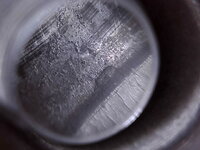
If you neglect removing it can grow causing pressure problems. Its caused from not cleaning the chamber, it builds up over time, slowly and once set is very difficult to remove. Theres a gap between the case rim and the chambers freebore, it forms there. Borescopes are cheap now, its really good to know how well we clean our chambers, not just the bores...I don't care if it's there because it's not affecting anything for me, but I'm trying to understand what causes it and why it affects some but not others.

DB29
WKR
- Joined
- Apr 4, 2020
- Messages
- 403
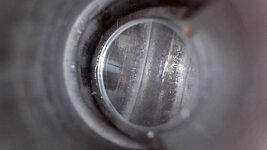
A sample of 1 but I think it was short brass that caused mine. Chamber kept shrinking on a new Tikka .223. Found the carbon ring after about 500 rounds. I was using new Nosler brass and reloading it. Seems Nosler likes to go short on brass. Trashed the Nosler brass and removed the ring about 200 rounds ago. I am interested to see if it shows back up using lapua and Norma brass that are longer.I don't care if it's there because it's not affecting anything for me, but I'm trying to understand what causes it and why it affects some but not others.
Hot handloads are one of my thoughts. While I have had some hot loads, I tend to keep my reloads in an area where accuracy is more important than speed.I was in the no-clean camp until I had my 6.5 PRC start popping primers and not even be able to chamber a round due to carbon fouling. Noticed it in my 243 as well as a 6.5 Creed. Couple factors I believe contribute:
I could probably fix the issue by backing down my handloads, but I'm OK just giving a good bore scrub every 100 rounds or so when the issues show up. Still don't clean other rifles but I'll watch for any issues and clean as needed.
- Overbore cartridges or hot handloads that have lots of powder being ejected
- Use of high back-pressure suppressors
- Cases trimmed too short leaving room between the case mouth and chamber edge
Factory ammo with 308 or 223? Doubt you'll ever see it.
I have been using cans longer than most with no issues, so I don't think that matters.
Had not considered a case trimmed too short.
Similar threads

- Replies
- 8
- Views
- 347



Featured Video
Latest Articles
- The Fundamentals of Scouting For Mule Deer & Elk | Hunt West Crossover
- Wiser Precision BA-7 Sparrow Binocular Adapter Review
- How to Kill Giant Bulls with Ryan Carter
- Kifaru Enters the Hunting Apparel Space: Review
- From Big Bucks to Bear Hunts: Catching Up with Jordan Budd
- Mule Deer Days Wildlife Conservation Mashup
- A Hidden Gem: Hunting Washington with Kari Thomas
- Prime Divide Bow Review
- Knowledge From Storms: Surviving and Thriving in the Backcountry with John Barklow
- DIY Wyoming Pronghorn Hunt