Dry winter impact on Elk

Waddi

FNG
Joined
Aug 9, 2024
Messages
74
Currently we’re hanging around 50% of median snowpack in Colorado. Another La Niña year most likely means a warm and dry spring as well.

What does this mean for the Elk herd? Obviously we can expect a bad summer for wildfires and water becomes more important. I also imagine this will diminish green up and good feed will become less available.

What are your thoughts?
 
Obviously we can expect a bad summer for wildfires...
Not necessarily. Some of the worst fire conditions start with a wet spring and then a dry summer. If there is not a lot of moisture in spring and we don't get a good green up then there is less light fuel for fires to start. Lots of parts to it but a dry spring doesn't just automatically mean a bad year for fires.
 
Not necessarily. Some of the worst fire conditions start with a wet spring and then a dry summer. If there is not a lot of moisture in spring and we don't get a good green up then there is less light fuel for fires to start. Lots of parts to it but a dry spring doesn't just automatically mean a bad year for fires.
Fair point and I’m familiar with the idea, I spent 4 years as a wildland firefighter. However, walking around in the woods right now everything is crunchy and seems like it’s trending towards a bad fire year.
 
Last year (2025) was almost as dry as this year where I hunt.
It continued into the spring, and the snow was gone early.
Not much in summer rains either.
Grass was short and there wasn't much.
Willows were browning before the frost in summer.
Few raspberries, currents or other berries. Forbs were dry.
They took the range maggots and cattle out early. Great!
Plenty of elk and some of the best bulls I've seen though.
 
Last year (2025) was almost as dry as this year where I hunt.
It continued into the spring, and the snow was gone early.
Not much in summer rains either.
Grass was short and there wasn't much.
Willows were browning before the frost in summer.
Few raspberries, currents or other berries. Forbs were dry.
They took the range maggots and cattle out early. Great!
Plenty of elk and some of the best bulls I've seen though.
That’s useful information, thanks!
 
Not intending to, more so just trying to become more educated on how a drier year could affect elk and elk hunting.
The elk are living the good life on a low snow year. Should have healthy calves at this rate. As for elk feed that water will come in the spring/summer. Snow is for groundwater and rivers for the most part.
 
Unfortunately, foothills front ranger here…
What I’ve notice as far as fire, is that since we had a ton of rain last summer and the grass grew high, and since we haven’t had any snow, all that tall grass and things are still standing, vs being knocked down from the snows.

As far as elk..we always see a 100 +\- cow heard like clockwork. This year zero cows.

The bulls cruise around separate from the cows.
Since there is zero snow, they’re not traveling in their normal patterns.
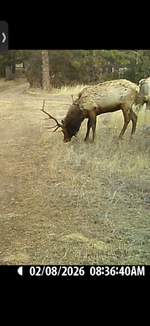
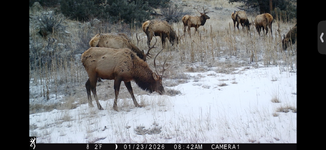
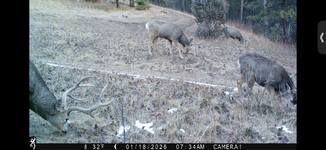
Cams that usually have a ton of bull pics, have almost zero and the trails that are usually pounded have almost zero tracks.
The bulls are around, just doing different things and I saw 18 bulls together on Monday and I’ve never seen that many in one group.
 
The elk are living the good life on a low snow year. Should have healthy calves at this rate. As for elk feed that water will come in the spring/summer. Snow is for groundwater and rivers for the most part.
That’s great to hear thank you
 
Grass doesn’t grow in the winter, a dry winter is great, they’re just chilling!

Also, 90 percent of the elk killed in CO are raghorns so even on a wet spring summer, they’re dead by age 3.
 
Unfortunately, foothills front ranger here…
What I’ve notice as far as fire, is that since we had a ton of rain last summer and the grass grew high, and since we haven’t had any snow, all that tall grass and things are still standing, vs being knocked down from the snows.

As far as elk..we always see a 100 +\- cow heard like clockwork. This year zero cows.

The bulls cruise around separate from the cows.
Since there is zero snow, they’re not traveling in their normal patterns.
Cams that usually have a ton of bull pics, have almost zero and the trails that are usually pounded have almost zero tracks.
The bulls are around, just doing different things and I saw 18 bulls together on Monday and I’ve never seen that many in one group.
That’s interesting I didn’t consider how the snow arranges fuels differently. I’m assuming the elk are most likely staying high since they’re not forced into their wintering grounds?
 
Back
Top