
HilltopHitman
Lil-Rokslider
He’s an engineer by trade, probably would be smart if one of these arrow manufacturers hired him as department manager of R&D.

Follow along with the video below to see how to install our site as a web app on your home screen.
Note: This feature may not be available in some browsers.

Is it possible to post that up to the board for us read? Even if it's outdated at this point I would be interested to see how this subject has evolved over timeI have been vocal on Ashby ever since he recommended a minimum of 30% FOC- which probably predates some here. I have his original white paper claiming EFOC arrows fly further where he used rubber bands instead of a bow for testing.
To Ashby's credit, in the recent past, he has come around with more reasonable arrow recommendations that make more sense.
Thats^ all irrelevant now that we have scientific data to draw from.
 . Seems nuts by todays standards but at the time that was the state of the art.

View attachment 1072862
This is the one i've been using for a long while

I don’t know if or why it’s controversial. Certainly seems to be the case for some guys.Still doesn't really explain why it is so controversial, if it groups better it groups better, everyone can decide which they prefer, accuracy or range forgiveness.
Nothing is free so you choose what you think works best.
If the lighter weight lower foc arrow wins everyone would be screaming from the top of their mountain I told you so!
I want a mix of accuracy penetration and speed, my Elk/whitetail arrow is 470 grains at 270 fps. Mule deer I would likely drop to 385 -400 grains and close to 300 fps.
Shot a Javelina with a 365 grain arrow well over 300, why? Why not, tipped with a 2 inch rage it worked perfectly.
I always advocated for people building an all around arrow to be around 400 grains, so your build sounds fantastic, but what if that 485 15% build just flat out shot better?
I literally have dozens of options to play with arrow builds, and let long range groups determine what I chose, the 470 grain arrow I choose for elk/whitetail has 175 grains up front, foc 16-17 percent and most importantly it is accurate and forgiving!
I actually wound up with the heavy weight up front trying to build a bullet proof front end, I made my own footers from aluminum arrow shafts to beef up the half outs I was using.
 Like I said I was kinda hoping FOC wouldn’t prove beneficial above 12-15% just because I already have 12.5 and 16% arrows and like a faster arrow, but data doesn’t care about my feelings or my wallet.
Yep, if you want a high FOC then losing weight in the back end becomes just as important.Like some of the posters said, this sure makes the very light GPI shafts super interesting. I will probably play with a couple 5.0 shafts and more point weight next year to see what I can achieve for accuracy and foforgiveness.

Two points.
First, we all benefit enormously from the bright light Yates et al are shining into the "black art" of modern archery equipment. You can be sure that there are about 25 companies in this industry scrambling right now to recalibrate how they sell their products since big claims and BS will no longer work for many of them.
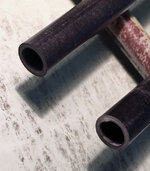
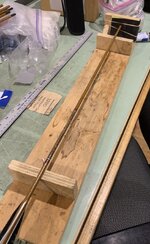
Second, I note the short segment in the latest report has on the importance of squaring arrows after cutting. I sure would like to avoid spending lots of $$$ and real estate on my workbench for a specialized arrow squaring rig or machine. Any ideas on practical but effective ways to achieve a really square result?

Two points.
First, we all benefit enormously from the bright light Yates et al are shining into the "black art" of modern archery equipment. You can be sure that there are about 25 companies in this industry scrambling right now to recalibrate how they sell their products since big claims and BS will no longer work for many of them.
Second, I note the short segment in the latest report has on the importance of squaring arrows after cutting. I sure would like to avoid spending lots of $$$ and real estate on my workbench for a specialized arrow squaring rig or machine. Any ideas on practical but effective ways to achieve a really square result?

My takeaway from the 2 videos was that there is a sweet spot for each component and each shooter. We all witnessed the extreme speed / lightweight craze as well as the extreme FOC / TAW fads. The extremes of arrow ballistics have pretty well been defined and at the far ends of both spectrums there are diminishing returns.
If you’re a whitetail hunter in a tree stand with a max shot distance of 30 yds you probably don’t care about the arc of your trajectory as much as a western hunter shooting antelope at 60-80 yds. And neither of those hunters cares about penetration as much as one who’s shooting water buffalo. If a guy only hunts one of those three scenarios then by all means, optimize your setup for that scenario. But if you’re like most hunters, you’re hunting different species of various sizes at various ranges and it doesn’t really make sense to optimize for an extreme instance. Hence, all the differences of opinion.
Seems like, anecdotally at least, that most western archery hunters (compound) have settled on a setup that’s in the neighborhood of 420-480 TAW, 13-18% FOC and about 260-280 fps, which I think is about the best “all around” setup, all things considered. Arrow component choices often vary based on how much a shooter prioritizes group size vs trajectory arc vs penetration vs quiet arrow flight vs durability. Everything is a compromise. For example, I know I could get better group size shooting mechs but I prioritize penetration and BH reliability over group size (to a point).
There’s one thing here that likely wouldn’t change these results, but it may be worth them considering to see if it changes or even strengthens some of their conclusions. Their data is gamma distributed (unless they rescaled the KFIs) rather than normally distributed. They assumed normality by using a t-distribution which is not technically correct. None of their metrics can ever go negative. I would assume that it likely won’t change anything but that was something I noticed while looking through this.I have been vocal on Ashby ever since he recommended a minimum of 30% FOC- which probably predates some here. I have his original white paper claiming EFOC arrows fly further where he used rubber bands instead of a bow for testing.
To Ashby's credit, in the recent past, he has come around with more reasonable arrow recommendations that make more sense.
Thats^ all irrelevant now that we have scientific data to draw from.
The FOC explanation is here- worth watching the explanation as according to Yates, the chart can be misleading
Thanks again to Mr Yates and Tristan Litke and all of the participants- that was a lot of detailed work.
Definitely some guys tuning and shooting 300fps successfully but to get there you either have to have long arms, 80# limbs or a light-ish TAW. That’s why I said most have settled in the 260-280 range. I’m also speaking mainly about hunting setups, not target rigs. Despite all the “advances” in bow technology, IBO speeds have remained pretty steady for many years now.Great insights here, HunterGatherer. I agree with you.
A small caveat though: Conventional wisdom lately has been that 280 fps or so was a top end speed beyond which tuning becomes difficult. This latest study may have raised that ceiling up a bit to the very low three hundreds. With more advances in arrow technology (gpi reduction, specifically), those numbers become easier to achieve.
Just thoughts....

I mentioned the same on the archery talk thread. Someone would have to sell me on the sound data. After reading all the issues with metering suppressors, I'm highly skeptical they're getting accurate readings measuring the differences in vanes.I would be curious to know how much weight the brain trust puts on the sound of the fletchings and broadheads. I have a hard time seeing the fletchings and broadheads making a huge difference since the sound of the bow is so much louder. Just standing down range I hear the bow and not the arrows. I think an animal is going to react to the initial shot noise of the bow. I have heard Bill Vanderheyden and others say similar things. Maybe a long shot, say 70 yards? Whitetails react as soon as the bow goes off. I have never had an opportunity to shoot a bow at anything else, but will be chasing elks again this fall hoping to change that.

I would be curious to know how much weight the brain trust puts on the sound of the fletchings and broadheads. I have a hard time seeing the fletchings and broadheads making a huge difference since the sound of the bow is so much louder. Just standing down range I hear the bow and not the arrows. I think an animal is going to react to the initial shot noise of the bow. I have heard Bill Vanderheyden and others say similar things. Maybe a long shot, say 70 yards? Whitetails react as soon as the bow goes off. I have never had an opportunity to shoot a bow at anything else, but will be chasing elks again this fall hoping to change that.
I mentioned the same on the archery talk thread. Someone would have to sell me on the sound data. After reading all the issues with metering suppressors, I'm highly skeptical they're getting accurate readings measuring the differences in vanes.
I'm not questing this. I've done this plenty of times. The arrow sounds cool.Put a target at 50 yards. Stand behind a tree, on the target side at 25 yards from the target and a shooter. Have the shooter shoot a field tip arrow and vented fixed blade arrow. Tell me what’s louder and what you hear. Hint: it’s not the bow.
Sent from my iPhone using Tapatalk



