First off - let me apologize if this is obnoxious, or tedious etc - HOWEVER - I have firm belief in discussing things we can disagree on. It broadens our aptitude.
I totally call your bluff on resistant deer! We will agree to disagree on that point! The same "fatal" attachment has been used to label CWD since time 0 without any backing. All papers refer to the same fatal reference without any scientific support. Anyone that has read CWD literature knows that there has been no way of determining if CWD exists in a particular deer until they are killed and samples are taken so there is no way to know when a deer contracts CWD, how long they have had it, and whether a deer would have died from CWD. Lots and lots of unknowns when the fatal label was issued to CWD 40+ years ago!
Don't call my bluff on resistant deer, call out the biologists. It appears, you're doubling down on your stance of CWD not being fatal, and even assert the term "fatal" is used to label CWD without any backing, there are too many studies that all cover the fatality rate of CWD.
Directly from the Wyoming study you highlighted above:
t
his population did not appear to decline as dramatically during the study as our estimate of λ would suggest based on WGFD population estimates (approximately a 4% decline from 2010 to 2014) [19]. While the 2010 and 2014 population size estimates were not strikingly different, the general trend over time suggests a declining population. From 2011 to 2012, WGFD estimated a 19% decline in mule deer numbers and a 15% decline the following year [19]. These declines observed during our study fall within our 95% CI for λ (0.72, 0.87). In 2013, greater spring precipitation ended a year-long drought and moderate winter conditions resulted in a 5% increase of the population estimate in 2014 [19]
"the general trend over time suggests a declining population" - in a 2014 study
Chronic wasting disease (CWD) is a fatal transmissible spongiform encephalopathy affecting white-tailed deer (Odocoileus virginianus), mule deer (Odocoileus hemionus), Rocky Mountain elk (Cervus elaphus nelsoni), and moose (Alces alces shirasi) in North America. In southeastern Wyoming average...

journals.plos.org
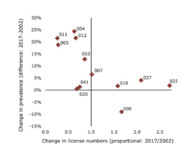
2017 study states Wyoming population would be stable if CWD were absent, but instead the herd is declining at 21% -seems pretty significant to me
I wouldn't exactly say the decline in the deer from CWD is anything out of the ordinary. Winterkill, road kill, and predators often kill a higher proportion of deer than CWD killed in that particular survey! They also need a lot more years of monitoring to firm up CWD death rates vs weather, winterkill, predators, etc. I see a lot of faults in a short-term study when you are talking about so many outside variables!
For the vast majority of deer herds, I absolutely agree. I would only clarify, I see value in continuing to study CWD, because other prion caused diseases, ie mad cow, scrapie, CJD, are not well understood, and we need to ensure we understand the transmutability to other species etc
I have a buddy that guides in Nebraska next door to Wyo. The muley population almost has been eliminated the past few years from blue-tongue in his area. Bluetongue has also put a major dent in the whitetail population. No one even raises an eyebrow about bluetongue and other diseases! How about EHD and blue tongue in Wyo?
Again, totally agree and again I would love to see more hunter support for studies of all zoonotic diseases for same reasoning mentioned above.
There is a lot more deer around today than after the CPW did the major culling projects in the areas where CWD first existed 40ish years ago. Some areas almost had 0 deer after the slaughter! Wouldn't you expect CWD prions to still be in infested areas and increasing every year to the extent of killing off all deer if CWD was so fatal? I'm pretty sure there would be a steep upward trend in CWD as more and more prions are added to the soil? That trend hasn't happened after 40 years in Colo! There is 0 doubt in my mind the CWD debate is blown way out of proportion!
You cannot assert what the effects were of their efforts. It would be just as dishonest for me to say that the culling worked and is the only reason CWD is not as prevalent in Colorado as it would have been if not for the culling.
From about 1980 through 2010 Colo was re-writing the B&C books for record book older age class bucks. How were the bucks able to age to reach B&C proportions with CWD being so detrimental and fatal the past 40 years in Colo? During those "golden CWD years of B&C bucks" in Colo mature bucks with the best genetics were the ones doing the breeding. We can all pat the CPW on the back for issuing more doe and buck tags and late rut rifle season dates to combat CWD and harvesting the remaining older age class bucks that spread CWD.
The "CWD management plan" at every state seems to be "Test and if the disease gets bad we'll just issue more tags and target rutting bucks and reduce overall herd population" which is not a plan at all... The only way I can see us getting a different plan is more studies of alternate methods to contain the disease.
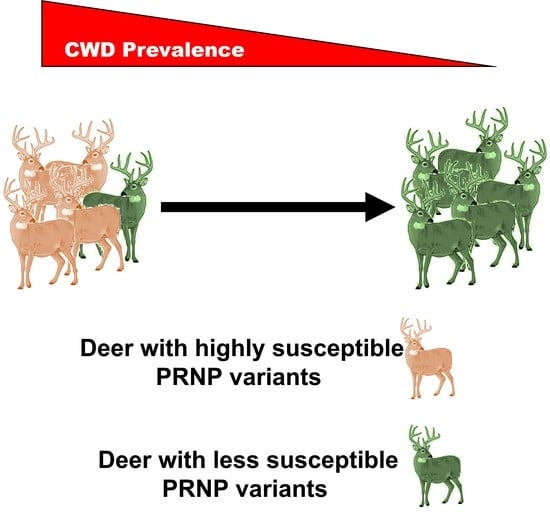
Could in fact, the older age class bucks that live long lives in CWD infected areas actually be resistant to CWD? No one knows and the best genetics in the entire herd that does the breeding may actually be currently be targeted in Colo with later season dates and higher tag quotas?
There is an often torted rhetoric that CWD can only be done on dead deer/ungulates, and that is simply false.
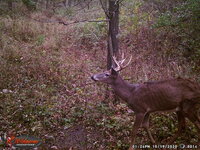
Tonsil biopsies can be used to diagnose CWD in live deer; although the procedure is minimally invasive, it requires general anesthesia and would not, therefore, be practical under field conditions. We have completed a study using this method, total deer 143 (small sample size, need more studies!). You can even download the raw data, filter it, and you get 65% of mule deer over 4.5 years old as CWD positive (17/26, bucks and does). There were only 4 bucks 4.5 years and older in this study, all bucks tested CWD positive,
75% of 4.5 year old bucks died of CWD within the first year of the study (within the first year of CWD test) with the fourth buck having a negative test at 4.5 years, positive 5.5 and no further tests allowed on bucks.
It's evident that in Colo the CPW has switched it's thinking to sell more tags and offer more hunter opportunity. Anyone that spends time in the hills in Colo has noticed that the number of doe and buck tags has increased even with the decline in deer population. Add on rut season dates, predators, winterkill, and other factors it doesn't take a rocket-scientist to figure out what is happening to mature bucks in Colo. CWD may be a minor part of the population decline...but come on....it isn't wiping out any deer herds in Colo after 40 years of prions being in the soil! Wouldn't the prions continue to increase every year if more and more CWD deer were present and adding additional contaminated CWD prions to the soil?
Colorado does CWD testing on 5 year intervals, with 2020 being the last testing year. Overall trends show rising rates of infection across the state. Some areas are around 14-15%. CPW wont release the full data until spring 2023. You can search it, but 25% CWD positive rate is associated with declining population due to CWD.
Many factors effect how fast CWD will spread. Yes, the prions persist in the environment and eventually will spread. We know the ending stages of CWD cause excessive thirst, drooling, urinating etc - and it has been hypothesized CWD spreads faster in areas with few water sources. Sick deer tend to stay near water, infect the area, and due to its frequent use by others, CWD spreads faster.
I say bull hockey that CWD is killing off herds of deer in Colo or elsewhere! For goodness sake, CWD prions have been present in Colo for 40 years without a single deer wipe out!
Not killing deer off elsewhere? C'mon you've cited studies that literally state the opposite. Why cite a source to only cherry pick what you want...
Let the predators kill the few truly sick CWD deer present and allow resistant deer to thrive!
Predators may be a key factor in reducing the rate CWD spreads, if they kill the deer in the early stages of sickness, the deer may not be able to infect the environment as much, and the prions may not have built up as much as a deer that dies due to CWD, fewer prions in the environment.
Humans are predators, so we should allow hunters to kill more deer in hopes they are killing the truly sick ones?
My general ideology regarding CWD is that we have the responsibility to ensuing generations to take a proactive stance on CWD. Worse case scenario, in a proactive approach, is we are wrong and mule deer will end up at the same population level regardless of our efforts. Worse case scenario in a reactive, "oh sh!t where did the deer go" approach is there will be little to no deer to manage, perhaps even ending up under EPA protection as an endangered species...