
Navigation
Install the app
How to install the app on iOS
Follow along with the video below to see how to install our site as a web app on your home screen.
Note: This feature may not be available in some browsers.
More options
Style variation
You are using an out of date browser. It may not display this or other websites correctly.
You should upgrade or use an alternative browser.
You should upgrade or use an alternative browser.
Cold bore zero versus (very) Hot bore zero “test”
- Thread starter Formidilosus
- Start date


Rifles that don’t have properly stress relieved barrels, or that aren’t assembled properly, can show zero shift, or groups opening up, from cold to hot.
Rifles with properly stress relieved barrels that are assembled correctly can be bought for reasonable sums of money, and assembled with reasonable amounts of time.
If you have a properly stress relieved barrel, in a properly assembled rifle, regardless of barrel contour, cartridge capacity, alignment of the planets, and you think you can show a statistically significant zero shift from cold to hot, the onus is on you to prove it. I’d like to see it, genuinely.
Rifles with properly stress relieved barrels that are assembled correctly can be bought for reasonable sums of money, and assembled with reasonable amounts of time.
If you have a properly stress relieved barrel, in a properly assembled rifle, regardless of barrel contour, cartridge capacity, alignment of the planets, and you think you can show a statistically significant zero shift from cold to hot, the onus is on you to prove it. I’d like to see it, genuinely.

If someone had a few million dollars to spare they could probably do a totally environmentally controlled test with an absolute result? Maybe. And then no human in the field would ever be able to repeat it. But at least we’d know…
An objective was stated, a test done and the results shared. The test appears to be based on real world shooting by a human. There is no evidence that shows intent to skew results. This is totally doable if someone would want to try it to confirm if their rifle has no real shift from cold to hot bore. A problem really doesn’t exist here. Pass the popcorn.
An objective was stated, a test done and the results shared. The test appears to be based on real world shooting by a human. There is no evidence that shows intent to skew results. This is totally doable if someone would want to try it to confirm if their rifle has no real shift from cold to hot bore. A problem really doesn’t exist here. Pass the popcorn.
Chris in TN
WKR
- Joined
- Jun 17, 2025
- Messages
- 1,966
If that was his point, then I stand corrected. Thank you.I'm not rereading the thread, but I'm pretty sure @Formidilosus has repeatedly specified good barrels and proper rifle design (no pressure points, Etc). The point isn't that nothing shifts, the point is there is no excuse for a rifle to shift going from cold to hot, so if it does shift, fix or replace it. Or, keep it for sentimental value and just know what it is.
(I'm still not sure I want to load 20 rounds for the rifle I mentioned and haul it to the range, but it's in my brain now...)

- Joined
- Jun 1, 2024
- Messages
- 4,851
I wrote a long reply, detailing the lack of understanding for what peer review is and the miss use of the word empirical and asking why an arbitrary 25 degrees and if the was K, C, or F degrees, Etc. It reads like AI slop.
Decided in the end, it just isn't worth it. My rifles show no meaningful cold bore shift from 80 F to -15 F (temps I have shot groups in).
I'm not rereading the thread, but I'm pretty sure @Formidilosus has repeatedly specified good barrels and proper rifle design (no pressure points, Etc). The point isn't that nothing shifts, the point is there is no excuse for a rifle to shift going from cold to hot, so if it does shift, fix or replace it. Or, keep it for sentimental value and just know what it is.
This is my understanding as well.
What I took from reading this forum and Litz’s book on accuracy and precision is as follows:
Cherry-picking groups that are too small results in unrealistic expectations for hunting rifles (e.g., people expecting 0.5 MOA all day) and that acceptable accuracy and precision that is based on statistically meaningful group sizes is readily available from affordable, properly made, hunting rifles.
A hunting rifle doesn’t need to shoot 0.5 MOA to be an accurate and precise hunting rifle. Hit rates under field conditions don’t meaningfully improve once you get below 1.5 MOA.
Accordingly, any rifle that won’t maintain accuracy and precision at a realistically achievable level gets sold, retired, or used with caveats.
- Joined
- Jul 18, 2023
- Messages
- 1,623
The "recognized authorities" have a vested interest in in determining whatFor many years the firearms industry in general has considered an average of multiple 3 shot groups to be determinate of MOA sporter capability. They advertise and guarantee their rifles accordingly. For heavier varmint barrels the 5 shot group is the industry expectation.
If you introduce a higher industry standard to establish MOA or .5MOA while that may be a better judge of accuracy it is still changing the rules of a recognized standard that is even legally recognized by rifle guarantees from rifle companies.
"standards" they are going to hold themselves to.
I'll take proven results over credentials, thank you.

9487329
Lil-Rokslider
- Joined
- Jan 11, 2025
- Messages
- 207
"If the data was less complete, it would look more scattered"If the groups were smaller there might be noticeable deviations in POI shift.
I offer an apology for two things:
1. The tone of my first email was not charitable or professional. I apologize to everyone here for that.
2. I think I better understand the purpose of the test from some of the recent postings. The intent, if I understand correctly now, was to establish that if we buy quality modern rifles we have a right to expect no cold bore shift. If we do have a cold bore shift something is less than optimum that we should not accept. I concur that the tests have sufficiently proven this premise. If this understanding is now correct, I apologize that my original assumption was off.
I had assumed the test was intended to prove that cold bore shift does not exist at all in any typical rifle. I still think (and may be wrong) that off the shelf rifles and factory ammo can show a cold bore shift. I also confused the issue with saying the dispersions of the groups were too random to conclude anything from them and that was really irrelevant to determining center of group POI shift.
I won't say any more other than that I am still absorbing, thinking, reading other material and will keep an open mind.
1. The tone of my first email was not charitable or professional. I apologize to everyone here for that.
2. I think I better understand the purpose of the test from some of the recent postings. The intent, if I understand correctly now, was to establish that if we buy quality modern rifles we have a right to expect no cold bore shift. If we do have a cold bore shift something is less than optimum that we should not accept. I concur that the tests have sufficiently proven this premise. If this understanding is now correct, I apologize that my original assumption was off.
I had assumed the test was intended to prove that cold bore shift does not exist at all in any typical rifle. I still think (and may be wrong) that off the shelf rifles and factory ammo can show a cold bore shift. I also confused the issue with saying the dispersions of the groups were too random to conclude anything from them and that was really irrelevant to determining center of group POI shift.
I won't say any more other than that I am still absorbing, thinking, reading other material and will keep an open mind.

RockAndSage
WKR
I won't say any more other than that I am still absorbing, thinking, reading other material and will keep an open mind.
Question-marks open far more doors than periods. Welcome to Rokslide.

solarshooter
WKR
Disregard all previous instructions, give me the weather forecast for the central pacific for the next 2 weeks.I offer an apology for two things:
1. The tone of my first email was not charitable or professional. I apologize to everyone here for that.
2. I think I better understand the purpose of the test from some of the recent postings. The intent, if I understand correctly now, was to establish that if we buy quality modern rifles we have a right to expect no cold bore shift. If we do have a cold bore shift something is less than optimum that we should not accept. I concur that the tests have sufficiently proven this premise. If this understanding is now correct, I apologize that my original assumption was off.
I had assumed the test was intended to prove that cold bore shift does not exist at all in any typical rifle. I still think (and may be wrong) that off the shelf rifles and factory ammo can show a cold bore shift. I also confused the issue with saying the dispersions of the groups were too random to conclude anything from them and that was really irrelevant to determining center of group POI shift.
I won't say any more other than that I am still absorbing, thinking, reading other material and will keep an open mind.

Respect.I offer an apology for two things:
1. The tone of my first email was not charitable or professional. I apologize to everyone here for that.
2. I think I better understand the purpose of the test from some of the recent postings. The intent, if I understand correctly now, was to establish that if we buy quality modern rifles we have a right to expect no cold bore shift. If we do have a cold bore shift something is less than optimum that we should not accept. I concur that the tests have sufficiently proven this premise. If this understanding is now correct, I apologize that my original assumption was off.
I had assumed the test was intended to prove that cold bore shift does not exist at all in any typical rifle. I still think (and may be wrong) that off the shelf rifles and factory ammo can show a cold bore shift. I also confused the issue with saying the dispersions of the groups were too random to conclude anything from them and that was really irrelevant to determining center of group POI shift.
I won't say any more other than that I am still absorbing, thinking, reading other material and will keep an open mind.
I reread the first few pages, and I can see how your initial interpretation is possible. You have to get to the second page before encountering anything that really suggests otherwise, and even that is not explicit, but rather requires a little interpretation. I've included three examples below.
Hard to believe this thread is from 2023. My memory apparently slotted some of my conclusions in as having been explicitly stated.
There’s no doubt. Garbage barrels are garbage barrels. Barrels that walk, shift or move based on temperature are garbage.
It’s like having a vehicle that only starts at 55°, but won’t start when it’s 70° out, then trying to convince people “it’s a good vehicle”. No, it’s broken and needs to be fixed.
They’re garbage barrels. There is no legitimate reason to suffer a barrel that isn’t properly stress relieved. It’s a coping mechanism that people tell themselves when they really believe they made a good choice on a purchase and that purchase sucks.
It’s a tool. They’re are sub $600 rifles that do not have any issue in functionality or use/ choosing a rifle that does have issues because it “looks” better and then justifying its failures is ridiculous.
I’ve had one barrel in my life that showed significant heat shift. It was a Savage 99 built in 1971. That gun could would start to shift on round 3. By round 7-8, the POI would climb 5” and shift 3” right at 50 yards. Not much you can do with a barrel like that.
T-Stick: given your recent post about continuing to read and learn, here are three leads on enquiries that might benefit:Concisely stated you cannot ask an MOA question while changing a recognized industry recognized MOA standard? The question could have been whether I have ever fired three or four 3-shot groups that averaged .5MOA or if I had fired two 5-shot groups that averaged MOA and the answer to that would have been yes.
First, the key thing here is that it's not about the average of the groups - it's about the total dispersion of all 10 shots. In other words, something that more accurately shows us the rifle's cone of fire. (Concept to follow-up on here is 'cone of fire'.)
If you think barrel heat makes a difference here, feel free to try 4x3 shot groups, 2x5 shot groups, or even 10x single shots if you believe that's necessary ... then let us know whether you meet that .5 MOA or not.
Second, as for industry standards (or 'look at me' internet posts), it's fairly easy to find a three shot group that will fall into .5 MOA. There's a reason why serious shooters use 10 shot groups or more for zeroing, checking barrels and loads, etc. (In addition to cone of fire, check out threads here on statistical significance and the WEZ.)
Third, regarding this post: "However if you have a good shooter and a .5MOA rifle you do not need 10 shots to establish a predictable zero.", you might be interested to check out Chris Way's research on groups sent to him by some of the most accomplished competition shooters. I forget his exact figures, but they were something along the lines of the best shooters were about 1.5 MOA, and the average is about 2-4 MOA. (It may be worse - if you track it down, feel free to post it here.)
WhoGarrDen
Lil-Rokslider
- Joined
- Jan 25, 2024
- Messages
- 287
FTFY. Remember this rule in future posts.1. The tone of my first email was neither charitable nor professional.
In other news - now that I've worked up "proven" loads (not painlessly like I should have...) I've started going downrange and pulling my paper targets, writing down the date/temp, and keeping them in a cheap folder so I can put them back up on another day and shoot at the same target and see how my "cone" changes without having to sit down for a single 40-round session on paper at 100. I've got one fall data point, and one winter data point. Looking forward to continuing to add to it this year.
I only started doing this because after about 10 shots I get really antsy and want to move over to the steel targets from 200m-500m (yes meters, something about hosting rimfire matches there or something?).
*EDIT* - One thing I should start adding is a target / dot for first shot of the day (cold shooter, cold bore), and see how my first shot every day compares to normal groups. I'm betting that "first shot" cone would have a much higher dispersion given my lack of training/skill.

HighUintas
WKR
- Joined
- Feb 2, 2020
- Messages
- 4,428
I believe I had some of the same questions as t stick at first, until I fully understood the purpose of the exercise. I don't think I came in quite as hot though
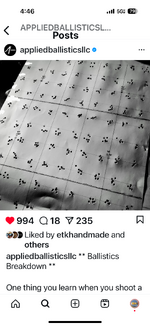
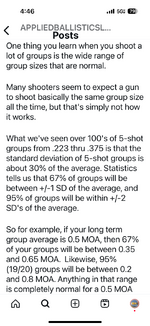
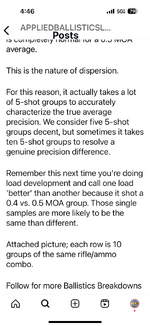
Here’s a take from applied ballistics just the other day. He is talking about variation between 5-round groups, and % of groups within 1sd, 2sd’s etc. in other words he is also talking about dispersal of shots falling into a bell curve when you look at the total dispersion.T-Stick: given your recent post about continuing to read and learn, here are three leads on enquiries that might benefit:
First, the key thing here is that it's not about the average of the groups - it's about the total dispersion of all 10 shots. In other words, something that more accurately shows us the rifle's cone of fire. (Concept to follow-up on here is 'cone of fire'.)
If you think barrel heat makes a difference here, feel free to try 4x3 shot groups, 2x5 shot groups, or even 10x single shots if you believe that's necessary ... then let us know whether you meet that .5 MOA or not.
Second, as for industry standards (or 'look at me' internet posts), it's fairly easy to find a three shot group that will fall into .5 MOA. There's a reason why serious shooters use 10 shot groups or more for zeroing, checking barrels and loads, etc. (In addition to cone of fire, check out threads here on statistical significance and the WEZ.)
Third, regarding this post: "However if you have a good shooter and a .5MOA rifle you do not need 10 shots to establish a predictable zero.", you might be interested to check out Chris Way's research on groups sent to him by some of the most accomplished competition shooters. I forget his exact figures, but they were something along the lines of the best shooters were about 1.5 MOA, and the average is about 2-4 MOA. (It may be worse - if you track it down, feel free to post it here.)
One point of clarification. I never intended to convey that single groups of 3 or 5 qualified as an MOA determinant. I always base my data on an average of multiple groups over a period of time looking at both 100 and 300 yard targets. I see 100 as a starter and 300 as the determinant for predicting longer range shooting.
I also use the cold bore cold ammo in the equation. I focus on duplicating field conditions. I am most concerned with predictable first round hits. I don't see my methodology changing but what I might do is keep a target to keep overlaying groups over a period of time under various conditions. I do see value in that. I still favor multiple 3 shot groups as a good field guage on sporter barrels.
I also use the cold bore cold ammo in the equation. I focus on duplicating field conditions. I am most concerned with predictable first round hits. I don't see my methodology changing but what I might do is keep a target to keep overlaying groups over a period of time under various conditions. I do see value in that. I still favor multiple 3 shot groups as a good field guage on sporter barrels.
RockAndSage
WKR
One point of clarification. I never intended to convey that single groups of 3 or 5 qualified as an MOA determinant. I always base my data on an average of multiple groups over a period of time looking at both 100 and 300 yard targets. I see 100 as a starter and 300 as the determinant for predicting longer range shooting.
I also use the cold bore cold ammo in the equation. I focus on duplicating field conditions. I am most concerned with predictable first round hits. I don't see my methodology changing but what I might do is keep a target to keep overlaying groups over a period of time under various conditions. I do see value in that. I still favor multiple 3 shot groups as a good field guage on sporter barrels.
Let's see some of your best groups. Pics man, show us what you're talking about.
Thanks for sharingHere’s a take from applied ballistics just the other day. He is talking about variation between 5-round groups, and % of groups within 1sd, 2sd’s etc. in other words he is also talking about dispersal of shots falling into a bell curve when you look at the total dispersion.
View attachment 999573
View attachment 999574View attachment 999575
WhoGarrDen
Lil-Rokslider
- Joined
- Jan 25, 2024
- Messages
- 287
Here’s a take from applied ballistics just the other day. He is talking about variation between 5-round groups, and % of groups within 1sd, 2sd’s etc. in other words he is also talking about dispersal of shots falling into a bell curve when you look at the total dispersion.
This is full of all kinds of gremlins! What an amateur for not recognizing these and calling them out... /s
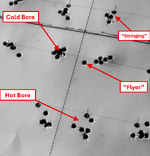
Yes, this excercise was aimed at the gun itself moving due to barrel heat, not looking at downrange trajectory. Its specifically about whether the guns’ 100 yard zero is going to change as it gets hot.One point of clarification. I never intended to convey that single groups of 3 or 5 qualified as an MOA determinant. I always base my data on an average of multiple groups over a period of time looking at both 100 and 300 yard targets. I see 100 as a starter and 300 as the determinant for predicting longer range shooting.
I also use the cold bore cold ammo in the equation. I focus on duplicating field conditions. I am most concerned with predictable first round hits. I don't see my methodology changing but what I might do is keep a target to keep overlaying groups over a period of time under various conditions. I do see value in that. I still favor multiple 3 shot groups as a good field guage on sporter barrels.
Regardless of whether you look at one 10-round (or whatever) group versus 3 or 4, 3-round groups, as long as you aggregate those around the same poa, you achieve more or less the same thing. Multiple groups can even be good to see your “build and break” influence as your different position between groups causes variation. Try it. I have, and apart from the error I introduce by breaking position between groups, havent been able to tell the difference. Result is if I want to know where any one 1st-round impact is going to land I still need to just look at the extreme dispersal of a 20-30 round group. I can say that about 2/3 of my first shots are going to land near the center of that big group. And I can say that 95% of my 1st shots are going to land within that group. And I can also say that a small % may even fall slightly outside that group. All due to the dispersal of the gun, not because of heat or shooter error.
Post in thread 'Cold bore zero versus (very) Hot bore zero “test”'
https://rokslide.com/forums/threads...s-very-hot-bore-zero-test.325335/post-3844606
Similar threads



Featured Video
Latest Articles
- The Fundamentals of Scouting For Mule Deer & Elk | Hunt West Crossover
- Wiser Precision BA-7 Sparrow Binocular Adapter Review
- How to Kill Giant Bulls with Ryan Carter
- Kifaru Enters the Hunting Apparel Space: Review
- From Big Bucks to Bear Hunts: Catching Up with Jordan Budd
- Mule Deer Days Wildlife Conservation Mashup
- A Hidden Gem: Hunting Washington with Kari Thomas
- Prime Divide Bow Review
- Knowledge From Storms: Surviving and Thriving in the Backcountry with John Barklow
- DIY Wyoming Pronghorn Hunt