Clarification of Dry Fire #'s

I'm just trying to get an understanding of wtf is happening, because it seems 120 would be way off.


I can put the incorrect inputs into a dyno, and get the wrong hp. I can setup my optical chrono wrong and get the wrong fps. Usually, I like to think I know enough to catch a mistake that makes something wildly off, and I wouldn't use that data.

120db on a dry fire seemed wildly off to me. I was asked if I was trolling for asking if that was incorrect? Or for an explanation of it I guess.

At this point I'm just going to conclude that I have figured this out for myself now.
Everyone with half a brain knows it’s wrong. You’d have to be pretty obtuse to believe it.
 
The question isn't really about comparing a can to a can. I can see some value in saying this can meters this, and this can meters this in these conditions. You aren't saying those numbers are actually accurate, its just under these conditions, this is what the difference of these two are.


But if the number on the on the meter is capturing something that is twice as close as what the meter is designed to be testing at, its gonna skew that in relation to what its measuring at the actual distance its supposed to measure.

I think most are intended to read at a M. So what, 39 1/3 inch? 40 inches makes that number easy to play with. Something that is 20" away for comparison will read 6db higher than what it should, 10" away is going to be 12db greater. So *if a firing pin is 15" away, it might be reading 9 db off. 5" would make it 18db louder.


This isn't making the readings correct. This is just comparison of readings taken at the same time.
Maybe this is for another thread, but what I am curious about, is if the variables in meter setup (location, orientation, environment, etc.) can cause invalid readings (i.e. a poor performing can metering lower than a high performing can). If not, do these same variables allow the meter to be sensitive enough to reliably pick up any differences between cans?
 
In my opinion, no. Certainly not by metering. Simply hearing them side by side has more value than a number on an instrument being used incorrectly and inconsistently in the wrong environment for an application that was never intended by someone who doesn't know how to use it in the first place.

They're all too loud to shoot safely without plugs/muffs.

They're all quiet enough to shoot safely with plugs/muffs.

The numbers are purely for marketing. They mean nothing. There's no standard, no accountability, no functional difference in actual sound suppression between the quality manufacturers.
This makes a ton of sense. Thanks!
 
Maybe this is for another thread, but what I am curious about, is if the variables in meter setup (location, orientation, environment, etc.) can cause invalid readings

Yes 1000%

I can influence the readings on a meter by 15+ db simply from where I put it and what I put around it, and 40+ db by changing settings in the meter itself.
 
In my opinion, no. Certainly not by metering. Simply hearing them side by side has more value than a number on an instrument being used incorrectly and inconsistently in the wrong environment for an application that was never intended by someone who doesn't know how to use it in the first place.

They're all too loud to shoot safely without plugs/muffs.

They're all quiet enough to shoot safely with plugs/muffs.

The numbers are purely for marketing. They mean nothing. There's no standard, no accountability, no functional difference in actual sound suppression between the quality manufacturers.
Exactly!!

Tone Matters. 😉
 
120db on a dry fire seemed wildly off to me. I was asked if I was trolling for asking if that was incorrect? Or for an explanation of it I guess.
I saw 2 things noted:

-The placement of a meter shows the firing pin reading low 120s when that same meter in that same placement shows a can reading low 120s. Its an observation that raises the question how good any of this data is and/or below a certain threshold.

-Firing pin can be heard over some suppressed shots, there was no statement of WHY just a statement of observation. WHY? I honestly don't know, is it the fact its fractions of a second sooner so it can be heard? Is it a different frequency or such that carries through more?

There was no statement that a firing pin truly IS 120db, just the observations to be sorted out.
 
There was no statement that a firing pin truly IS 120db, just the observations to be sorted out.

There have been statements outside of this thread saying the dry fire is.

Thats why I was asking the question.

Or to the casual reader, those statements are made, I guess without context, and it makes you go wtf.


It seems to me like a meter that is placed in the correct position from one item to measure, then using that same setup to measure something that is closer to it is kinda dumb.

Can say we can't accurately measure below this threshold, because we know this is part of the equation and with the "standard" placement of the pickup for a "shooter's ear" this creates a false reading that makes it difficult to get an accurate reading.

But that hasn't been said that I have seen. And would have been an easy explanation to the question I posed.
 
People just need to cool it with the DIY metering. It’s pretty much a pointless exercise that doesn’t prove anything. It’s kinda doing a disservice to “real” sound testing the way I see it. I can download a free app on my phone that’s about as accurate as the stuff I see taking place everyday but that doesn’t mean I should start metering cans and posting the results to be taken as facts.

I take the “shot these 10 cans side by side and everyone agreed the Xxxxxx was the quietest” testing as being more accurate then “133 at SE” testing.

I have been around sound studies conducted at ranges and it takes some pretty serious equipment. We sub it out to actual professionals, if it was as simple as buying a couple thousand $ meter and taking pics of the screen and calling those results facts then we would but that’s a dangerous game to play.
 
It seems to me like a meter that is placed in the correct position from one item to measure, then using that same setup to measure something that is closer to it is kinda dumb.
Just to make sure we are clear the meter isn't being moved around between a shot and the dry fire. I think you realize that and thus are saying using these meters at all for shooters ear is kinda dumb? That is sorta what issue was raised when that became apparent, I believe.
 
I take the “shot these 10 cans side by side and everyone agreed the Xxxxxx was the quietest” testing as being more accurate then “133 at SE” testing.
And truly side by side (same/comparable host), if not that is worthless too.

Last weekend there were a dozen different cans being shot, some of which are ones that seem popular to compare here. I mostly wore my ear pro in the background all day but did listen to some cans from a distance without, others listened more in the background. From 20' away X can was quitter than Y can, but X can was on a 223 and Y was on a 6creed so not really a side by side test at all in reality. The real observations of folks in the background were bolt 223 generally regardless of the can was quitter than medium cartridges (creedmor, etc) and those were quitter than magnums. Not really much shocker there. The only ones that caught my attention negatively were magnums and braked cans.

So as long as there is reasonable suppression then for hunting focus on the other aspects. Length added, weight, cost, do they have a history of blowing up lol, etc.
 
Just to make sure we are clear the meter isn't being moved around between a shot and the dry fire. I think you realize that and thus are saying using these meters at all for shooters ear is kinda dumb? That is sorta what issue was raised when that became apparent, I believe.

I'm saying its dumb to say something is this loud when its apparently not being metered correctly.

Like probably the meter should be 40" to the right of the shooters ear, so Port Pop, firing pin, etc are in a similar wave length.


In my mind, I posed a simple question, like is the dry fire actually 120 db?

I was thinking it was possibly something with the placement that the stock carried the sound weird, messed up the readings.

So yes, maybe I'm saying measurements at shooters ear is dumb if its to the point that they are actually in a realm of plus or minus 10 db at the shooters ear.


Maybe I'm just proving someone's point, but I don't understand why someone else couldn't explain this is. Seems like almost everyone has said no 120db for a dry fire is reforking stupid.
 
Like probably the meter should be 40" to the right of the shooters ear, so Port Pop, firing pin, etc are in a similar wave length.
Cans are routinely metered at the muzzle and shooters ear. A meter is designed to operate at both of these locations given proper setup. Distance from the sound obviously makes things quieter, but the meter is supposed to record the sound dbs at whatever location it is placed.

It makes no sense to measure sound 40” away from the rifle in a random direction when you are concerned with how loud it is at the ear. The firing pin would register lower with more distance as would the sound from the suppressor, but unless you are concerned with how loud it is 40” away, the number doesn’t really tell you anything.

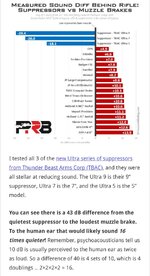
The whole point of 120 db was just to show that metering can be completely wrong. Don’t trust the meter numbers to a reflect the actual dbs. I still think there is value in metering on a comparison basis as most well done comparisons tend to agree with the TBAC summit and Pew, as far as rankings (not db).
 
Just out of curiosity, does anyone here in this conversation have more experience running decibel measurement readings with guns and suppressors than Form does?
 
Just out of curiosity, does anyone here in this conversation have more experience running decibel measurement readings with guns and suppressors than Form does?

Does anyone know what that experience is past a few YouTube videos?


I specifically asked if he believed a firing pin was 120db, and I got I don't know.
 
Experience and expertise are not interchangeable commodities.

Fair point. And at the same time, most of us have encountered someone with expertise who knew less than someone with either more or simply better, more applicable experience to a problem at hand.

The volume of a firing pin dropping is a perfect example - it doesn't make "sense" that it's registering as loud as a chainsaw or whatever...but people with experience do recognize that you can hear that firing pin drop with truly subsonic bullets with big, effective suppressors.

No amount of expertise can argue against that ground-truth experience.

The only thing that makes sense is to find out more.

Sincerely, I don't have a dog in this fight - frankly, weapons acoustics are somewhere between myth and wizardry to me. But I am very much inclined to first trust the person with the most experience, especially when that can be triangulated with wise expertise.

One thing I do feel very comfortable saying, is Form probably cares more about finding actual ground-truth on this issue than anyone on this forum, given how much personal money and time he's put into trying to determine it. And, that if anyone can find a legitimate point of how he can improve any measurements he's taking, he'd try them.

What more could be asked of him here?
 
Its goona be real tough to get a decisive answer there as cheek weld and beard loft are both going to be factors in the physical impulse at the ear drum. 🤓🤭

I think it possible for a firing pin fall to measure 120dB. Let one drop over a body of water in calm conditions. The echo is astounding.

Hand struck percussion instruments like a triangle or a wood block can exceed 120dB up close, so it seems reasonable enough to me for a metal block and a 25lb spring to be capable of same.

How can a dry fire be as loud as a rock concert or a chainsaw?

There is a significant difference between peak amplitude and 'average' or RMS (root mean square in engineering language) level.

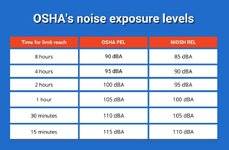
Impulses of 120dB are considered to be hearing safe by some, but we all pretty much agree that sustained exposure is not.

When it comes to hearing safety it's all about the energy of the curve.


Screenshot_20260506_152100_Firefox.jpg


Here is a good primer on sound as it relates to the discussion;


Screenshot_20260506_152548_Firefox.jpg
 
I specifically asked if he believed a firing pin was 120db, and I got I don't know.

So, I watched those exchanges unfold, wanting to know the same thing you do. My genuine take was that his "I don't know" answer was actually very fair.

Here's why:

What he essentially said is that you can hear the firing pin drop on a genuinely subsonic bullet with a big, effective suppressor. And, that those shots measure around 120dB.

What I interpreted from his statements, is that he's not really sure what's going on in why firing pins and suppressed subs are measuring around 120dB, and doesn't have deeper answers. But the observations are still what's being observed, objectively, repeatedly, and consistently. And, that he's open to the possibility that something's generally weird with measurement equipment, but that the observed effects seem to consistently occur.

Based on all this, I'm mystified by why firing pins and suppressed subs are registering in the same volume, while hours of dry-fire practice doesn't ring my ears like hours of subs would. But I am comfortable saying that I've seen and heard the same thing - even if it doesn't make a damn bit of sense.

So, I don't know what's going on, and that seems like a pretty fair thing for someone to say.

And, it would be important for their integrity to say that, if they're actually trying to do valid science.

 
Back
Top