roosiebull
WKR
I missed one and killed him the next day once, I have also bumped them and not seen their track in there againAll goona depend on that deer.
Years back, I kicked up the same 5point 3 days in a row before I was able to shoot it.

Follow along with the video below to see how to install our site as a web app on your home screen.
Note: This feature may not be available in some browsers.
I missed one and killed him the next day once, I have also bumped them and not seen their track in there againAll goona depend on that deer.
Years back, I kicked up the same 5point 3 days in a row before I was able to shoot it.
This is a good tip. I was looking for fresh sign near maple in a riparian area in a place most other people don't want to go and I stumbled into an area just as you described. Found a buck chasing a doe in late October and harvested my first BT.The ideal combo is a 2-10 year old clear-cut(or burn) depending on how fast it grows(elevation), a 10-20 year old cut that is thick, alder/evergreen/brush mix and a stand of mature timber that has fairly open ground. If these 3 habitats are in close proximity, there will be a bunch of deer and a few mature bucks hiding in the thick stuff.

the 3 dots to the right of report is a drop down with edit option.I'm going to use your "bedded uphill" trick this year.
P.S. how do I edit my previous post so I don't have to create two posts in a row? I only see report, delete, quote, and reply.

I never thought about that aspect of post logging and those specific deer that called it home.Bucks live in timber, but will daylight where does are during the rut. It actually take some pretty aggressive bumping to move a buck from his core area. If you bump a buck out thats away from his home, or bump him when he is getting ready to roam then odds are you won't see him again. If he is in his home in the timber, odds are high he will be back within 24 to 48 hours.
I see quite a few mature bucks get killed in logging country in brand new cuts, and often adjacent to landings. My theory is that buck likely spent the last 4 to 6 years on that ridge under the safety of the timber, and slips up when he cruises thru his old neighborhood.
That's a great point, I like the theory. It always seems weird to watch a buck cruise through a wide open clearcut where there's barely any growth yet.I see quite a few mature bucks get killed in logging country in brand new cuts, and often adjacent to landings. My theory is that buck likely spent the last 4 to 6 years on that ridge under the safety of the timber, and slips up when he cruises thru his old neighborhood.


For sure they do, they can safely observe and gauge their comfort zone. Big mulies are masters of this too, late pre rut.Love the thread.
Blacktail is definitely one of my favorite deer subs species to hunt. I’m primarily hunting the Washington peninsula.
This past year I was able to double up with a buddy. After I shot my buck, my buddy saw a larger 3 point stand up probably 25 yards past where my buck was and in the thicker treeline.
Question- has anyone noticed that larger more mature bucks sit back a little deeper generally? Newish to hunting blacktail so trying to absorb any info I can! Thank you!
Sent from my iPhone using Tapatalk

That was a good essay!I see only mountain goats have fewer threads than blacktails. I also see lots of "help, tips, blacktail question..." threads.
I thought I would post some of my experience and see if a few others would add to it in an effort to help some newer hunters and pass on some knowledge.
For reference, all my experience is western WA. The timber this concerns is relatively high from 3000-5500 ft elevation.
Still hunting and timber rarely get mentioned, that's my go to. Specifically big, open old growth timber. The tighter the canopy, the better. this shades out the under brush so visibility is good and deer use it at certain times because it's open. Some low salal or Oregon grape is good though, it's deer food!
The key to blacktails is habitat edges. The ideal combo is a 2-10 year old clear-cut(or burn) depending on how fast it grows(elevation), a 10-20 year old cut that is thick, alder/evergreen/brush mix and a stand of mature timber that has fairly open ground. If these 3 habitats are in close proximity, there will be a bunch of deer and a few mature bucks hiding in the thick stuff.
Quick side note, I've used tree stands to hunt the older brush patches. The elevation allows you to see into an otherwise impenetrable jungle. You have to force yourself to sit still and constantly glass because you may only get seconds. use a stand during the rut to find does, a buck WILL show up.
Back to the timber...
I love hunting the rut, in snow if possible. I actually wait for the right conditions before even trying timber. The best conditions make the deer move more. The day after a big snow or its just really cold. A big snow gets the deer to move down the mountain and into timber because the canopy initially holds about 50% of the snow.
If you know where the deer are going, you can intercept their movement. I have successfully hunted uphill to catch deer moving down after a big snow.
If it's just really cold, deer have to eat more to stay warm, thus they move more. During the rut, that means more buck movement.
I have also found 9am to noon is when deer get up and move when it's cold. I think they stay curled up and warm until either they have to eat or the air temp starts to rise.
Either way, ALL the mature bucks I've killed have been 9-noon.
I hit the timber once it's light enough I can see well. I go in with the mentality that I may only go half a mile all day if that's what it takes, or act like your life depends on seeing the deer first. I basically go tree to tree so slow my movement isn't fast enough to catch by a bedded deer. At each tree I glass as far as I can through all the openings. Don't assume because you looked there the last step, there's nothing to see one step later. You'll soon learn one step is all it takes!
Always keeping the wind in my face and listening for any noise that's out of place as well as looking behind me once in a while. Blacktails are surprisingly quiet in their environment.
One thing I've noticed with all deer, a buck tending a doe or actively herding a doe will try and keep the high ground. He'll stay above her pushing her down hill or will bed above her if she's bedded. obviously this is not a 100% guarantee like anything in hunting but I've seen it enough to know to look for it. Many times the buck is simply following on a string if the doe isn't hot and ready.
The buck I shot last November was bedded about 25 yards above the doe he was with. I saw her first and started looking uphill from her. There was a big tree between the buck and I, just as I was stepping around it to look, another doe came down through the trees towards the buck and 1st doe. The buck got up to check her, that's when he stepped out and I saw him. I later found his bed right where I expected it.
Deer seem to use the open timber often as a safe place because they can see anything moving as well as using the wind in decent weather. In nasty weather they seek the brush as shelter unless it's a full on wind storm, then they're back in the timber because they can see around them. it seems the high wind, commotion and noise has them on edge so being able to see their surroundings is important.
The other thing about timber is the size of the patch. Too big and it's a dead zone away from the edges. Too small and it's not useful. The right size seems to be a few hundred yards by a few hundred yards. big enough to serve a purpose and small enough to connect other habitats as a corridor as well.
One thing about timber is its a stable habitat in comparison to the Clear-cuts around it. Timber changes very slowly compared to how fast a clear-cut grows in the first 10 years. If you can find and figure out a patch of timber, you may have a spot for life. certainly the skills to hunt timber apply anywhere if your timber does change or get logged.
Elevation has a big part in late season success as well. You have to know when and where to find the deer or look until you find the elevation they're at. I hear "migrate" a lot. The area I hunt most isn't really a migration, the deer move up and down in elevation with the snow but they never really leave in a big migration.
Because the area is about 3000 feet top to bottom, I have a bunch of different patches of timber at different elevations according to snow depth and deer activity.
Often there are skid trails or grown up roads near any area you want to hunt. These usually grow up in Alder first. Check these for rub lines that indicate a mature buck in the area. If you find a rub up against the high bank, I've been able to see about how wide a buck is if the snow is deep enough he sweeps the off horn through it while rubbing. I've also hunted the same areas day after day/year after year and found most bucks rub right before it starts to get light. I've rarely seen a mature buck at first light during the rut.
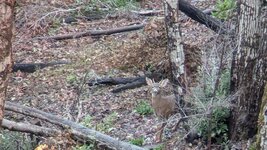
The attached pic is the doe I spotted bedded and a few minutes later killed the buck last November. It's not very good because I was trying to do it holding my binos steady. You can see how open the timber is though. I'll attach a pic from another part of the same timber that has a few acres of salal and Oregon grape.
Also attached are the three bucks I killed in the same patch of timber.
If anyone can add to this or add another seldom used tactic, I'd love to see this become a knowledge source thread for noob's and people looking to expand their skills.
- added 10-13-25 -
I spent YEARS crashing through deer country to cover as much ground as possible with the time I had. I started putting things together after repeatedly seeing deer in certain spots. That drove me to changing my tactics to where I am now.
That being said, for those looking for their own honey hole, not every patch of timber will hold deer so still hunting it blind may be a waste of time.
Looking back, condensing the knowledge I accumulated crashing around and covering ground pinpointed a few small areas.
To that end, covering ground fast isn't necessarily bad if it's intentional. My experience has been blacktails return to the spot 2 days after getting bumped.
So to find a spot of your own, covering lots of ground and paying attention to where and when you find deer can help zero in on a spot you can return to and hunt differently.
edited to include cleaned skulls of the two recent bucks.
'23 buck, 3 point 18" wide
'24 buck, 4 point 19" wideView attachment 949461
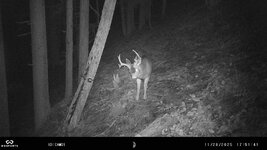
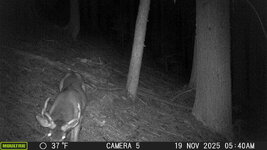

That third buck is a tank!View attachment 1094420View attachment 1094422View attachment 1094423View attachment 1094424
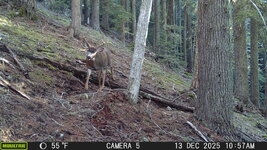
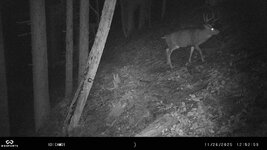
I finally got over and checked my timber cameras. As many of you know, the warm November we had squashed deer activity through late buck.
As soon as it got cold just days later, the bucks showed up in droves! No giants, but a couple mature shooters for that area.
I know, I got video of him following a doe. I feel sorry for the doe...That third buck is a tank!