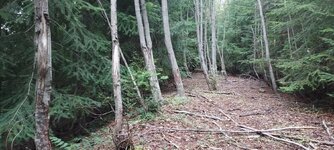
Blacktails in timber

Love the thread.

Blacktail is definitely one of my favorite deer subs species to hunt. I’m primarily hunting the Washington peninsula.

This past year I was able to double up with a buddy. After I shot my buck, my buddy saw a larger 3 point stand up probably 25 yards past where my buck was and in the thicker treeline.

Question- has anyone noticed that larger more mature bucks sit back a little deeper generally? Newish to hunting blacktail so trying to absorb any info I can! Thank you!


Sent from my iPhone using Tapatalk
I just saw this.
It may be coincidence at times that the hunter approached and the smaller buck was closer and got shot "and then the big one stood up" we hear so often.

I can't speak directly to this as far as blacktails other than I've seen mature bucks do things younger deer don't to evade people.

one instance with mule deer, I watched a mature buck and two younger bucks get spooked by a hunter. All 3 ran down a ridge, through a little basin, hung a left up a little canyon and stop on a small bench. The difference was the big buck looked around a few seconds and went up in some Rimrock and bedded to watch his back trail while the two younger bucks stood there, fed a little bit and ambled up to the head of the canyon. the big buck layer there like a statue watching his back trail.

I've seen mature muleys use younger bucks or does as decoys/sentries many occasions.

I don't see why a blacktail couldn't get just as smart.
 
I see only mountain goats have fewer threads than blacktails. I also see lots of "help, tips, blacktail question..." threads.

I thought I would post some of my experience and see if a few others would add to it in an effort to help some newer hunters and pass on some knowledge.
For reference, all my experience is western WA. The timber this concerns is relatively high from 3-5500 ft elevation.

Still hunting and timber rarely get mentioned, that's my go to. Specifically big, open old growth timber. The tighter the canopy, the better. this shades out the under brush so visibility is good and deer use it at certain times because it's open. Some low salal or Oregon grape is good though, it's deer food!
The key to blacktails is habitat edges. The ideal combo is a 2-10 year old clear-cut(or burn) depending on how fast it grows(elevation), a 10-20 year old cut that is thick, alder/evergreen/brush mix and a stand of mature timber that has fairly open ground. If these 3 habitats are in close proximity, there will be a bunch of deer and a few mature bucks hiding in the thick stuff.

Quick side note, I've used tree stands to hunt the older brush patches. The elevation allows you to see into an otherwise impenetrable jungle. You have to force yourself to sit still and constantly glass because you may only get seconds. use a stand during the rut to find does, a buck WILL show up.

Back to the timber...
I love hunting the rut, in snow if possible. I actually wait for the right conditions before even trying timber. The best conditions make the deer move more. The day after a big snow or its just really cold. A big snow gets the deer to move down the mountain and into timber because the canopy initially holds about 50% of the snow.
If you know where the deer are going, you can intercept their movement. I have successfully hunted uphill to catch deer moving down after a big snow.
If it's just really cold, deer have to eat more to stay warm, thus they move more. During the rut, that means more buck movement.
I have also found 9am to noon is when deer get up and move when it's cold. I think they stay curled up and warm until either they have to eat or the air temp starts to rise.

Either way, ALL the mature bucks I've killed have been 9-noon.

I hit the timber once it's light enough I can see well. I go in with the mentality that I may only go half a mile all day if that's what it takes, or act like your life depends on seeing the deer first. I basically go tree to tree so slow my movement isn't fast enough to catch by a bedded deer. At each tree I glass as far as I can through all the openings. Don't assume because you looked there the last step, there's nothing to see one step later. You'll soon learn one step is all it takes!
Always keeping the wind in my face and listening for any noise that's out of place as well as looking behind me once in a while. Blacktails are surprisingly quiet in their environment.
One thing I've noticed with all deer, a buck tending a doe or actively herding a doe will try and keep the high ground. He'll stay above her pushing her down hill or will bed above her if she's bedded. obviously this is not a 100% guarantee like anything in hunting but I've seen it enough to know to look for it. Many times the buck is simply following on a string if the doe isn't hot and ready.
The buck I shot last November was bedded about 25 yards above the doe he was with. I saw her first and started looking uphill from her. There was a big tree between the buck and I, just as I was stepping around it to look, another doe came down through the trees towards the buck and 1st doe. The buck got up to check her, that's when he stepped out and I saw him. I later found his bed right where I expected it.
Deer seem to use the open timber often as a safe place because they can see anything moving as well as using the wind in decent weather. In nasty weather they seek the brush as shelter unless it's a full on wind storm, then they're back in the timber because they can see around them. it seems the high wind, commotion and noise has them on edge so being able to see their surroundings is important.

The other thing about timber is the size of the patch. Too big and it's a dead zone away from the edges. Too small and it's not useful. The right size seems to be a few hundred yards by a few hundred yards. big enough to serve a purpose and small enough to connect other habitats as a corridor as well.

One thing about timber is its a stable habitat in comparison to the Clear-cuts around it. Timber changes very slowly compared to how fast a clear-cut grows in the first 10 years. If you can find and figure out a patch of timber, you may have a spot for life. certainly the skills to hunt timber apply anywhere if your timber does change or get logged.

Elevation has a big part in late season success as well. You have to know when and where to find the deer or look until you find the elevation they're at. I hear "migrate" a lot. The area I hunt most isn't really a migration, the deer move up and down in elevation with the snow but they never really leave in a big migration.
Because the area is about 3000 feet top to bottom, I have a bunch of different patches of timber at different elevations according to snow depth and deer activity.

Often there are skid trails or grown up roads near any area you want to hunt. These usually grow up in Alder first. Check these for rub lines that indicate a mature buck in the area. If you find a rub up against the high bank, I've been able to see about how wide a buck is if the snow is deep enough he sweeps the off horn through it while rubbing. I've also hunted the same areas day after day/year after year and found most bucks rub right before it starts to get light. I've rarely seen a mature buck at first light during the rut.

The attached pic is the doe I spotted bedded and a few minutes later killed the buck last November. It's not very good because I was trying to do it holding my binos steady. You can see how open the timber is though. I'll attach a pic from another part of the same timber that has a few acres of salal and Oregon grape.
Also attached are the three bucks I killed in the same patch of timber.

If anyone can add to this or add another seldom used tactic, I'd love to see this become a knowledge source thread for noob's and people looking to expand their skills.

That is super helpful - thanks! Just shot my first W WA blacktail doe last December with my bow. Do your strategies apply to bowhunting as well? I have had trouble closing to my effective shooting range of 20-40 yds when I have found blacktails.
 
That is super helpful - thanks! Just shot my first W WA blacktail doe last December with my bow. Do your strategies apply to bowhunting as well? I have had trouble closing to my effective shooting range of 20-40 yds when I have found blacktails.
I'm not a bow hunter but I don't see why it wouldn't work if you had enough cover to stalk within range.

Moving slow a few steps at a time makes the hunter sound more like how a deer moves. Two years ago I killed that buck at 40 feet! He came up behind me, the way he was looking at me, I think he heard me and thought I was another deer.
I had just reached the edge of the timber and started back around a sharp ridge. I heard something so I turned and looked over my shoulder not expecting a big buck. He had to have come out of the brush just outside the timber.

That's the only mature buck I've had at bow range, the rest have been 100yds +/- but then I haven't tried to get closer either.
 
Wondering if slope aspect has anything to do with where blacktails hang out in Oct/Nov. Seems like temperatures can go either way in that time period, from pretty hot on south facing slopes on the right day, to chilly especially if the winds moving. In the hunting trophy blacktails book, I don't recall if he ever brings that up and I don't have my copy anymore.
 
In W wa thick timber, aspect seems to play less of a role, IME. Its been more important to have food/water/bedding all in the right place than anything. Had a west side quality tag a handful of years ago and saw bucks all the way around a hill I hunted in one day.
 
The only thing I've noticed as far as aspect is brush. Too much North exposure and the brush gets BAD. The productive spots I hunt are West facing overall, that means South to North micro variations due to ridges within a given area.
North and East tend to be way brushier.
I've seen enough sign over the years to know deer seem to live on every slope. Not every slope is huntable though.
 
deer seem to live on every slope. Not every slope is huntable though.
When it comes to black tails this is about as matter of fact as it gets.

This has been a really good thread to read through. Has taken me through different stages of my own hunting through the year to where I balance out now.

Just slowing down in general when finding sign. Like WAY slow. I have a buddy who still hunts the “cover as much as ground in day as possible way” this is about how we all started when we were younger in our crew.

But as time has gone on and I’ve slowed down I’ve taken better and better bucks. Also just seeing way more bucks on average.

Living in Michigan for a short stint and learning to hunt whitetail made me pay much better attention to my habitat surroundings. Made me a better deer/blacktail hunter.
 
The Alder Grade.

I had a chance to visit one of my blacktail spots over the weekend. I haven't been on this road since it was drivable.
I suspected it might look like this and get plenty of animal travel. Almost every tree between 3" and 8" has either a buck or bull rub on it.
I'll be putting a couple cameras on it next time I'm there!
Screenshot_20250820_123853_Gallery.jpg
I've actually cultivated animal travel on trails like this. By clearing down trees and brushy spots, a path of least resistance becomes appealing to the animals in the area.
 
Those are the spots people just blow right by because they “can’t see anything”

Those spots are great especially when they are between food and cover
I’m the people you speak of. I pass a road like that and say “Not today Bigfoot. Not today.” while I’m hiking in the dark to go glass the cut.
 
I’m the people you speak of. I pass a road like that and say “Not today Bigfoot. Not today.” while I’m hiking in the dark to go glass the cut.
Well now in the dark and in the daylight, those are 2 very different beast. I’m walking past that in the dark as well.

But mid morning to early afternoon I’m looking for a cruiser.
 
This thread gives me hope. Thank you all for sharing. Been chasing black tails in western Oregon the past 4 years!
Went scouting some of the recent burn areas near me today with a buddy in western Oregon. We found a nice canyon to glass and the clouds came in from all direction and instantly got socked in. Then started raining! As we drove back down out of the clouds we started seeing some deer. A couple small bucks and a few does.
Was nice to get out and hike around! Good to see some life out there.
 
Thanks to all the contributions to this thread! I live in NW Oregon and hunt the coast for blacktails. Ive hunted them now for a couple years and have always struggled mightily finding bucks. I used to hunt public and private lands where driving is allowed but deer sightings were sporadic at best. Since I changed to exclusively hunting behind locked gates, I've had much more deer sightings, still very little buck sigjtings. I don't get out as often as I'd like and that's also a big contribution to me not being successful.

As my kids are getting older, I'm finally getting out a bit more. I'm drinking this timber hunting advice like cool-aid!

This past week I tried hunting the deeper timber but it was so dense, branch riddled and toppled trees/ branches that there's no way to hunt it from my perspective. You spend more time trying to make your way through the maze and not making noise than actually looking for deer.

Im guessing that this type of "deep timber" isn't old enough to hunt like everyone is talking about? I need to find higher tree canopy sections where you can glass and see for a distance. Unfortunately there not much of that in the area I'm hunting. Theresa multiple clear cuts of various stages, but not deep timber where you can still hunt effectively (at least that I can't).

Should I look for other areas to hunt all together or just hunt the clear cura and walk the old skid roads hoping to cross paths with a buck (which I've done plenty and never seem to cross paths with deer).

There deer sign around,but not a ton.
 
Back
Top