Bitcoin

I don’t know what your average is, but it sounds like you bought at the high end of the cycle???
If you look back at the charts for the midterm years you’ll see what you likely have to look forward to. That’s the bad news. The good news is you’ll have opportunities to keep buying and get your average down. Tune out all the narrative driven analysis, there is just so much BS to wade through trying to find anything useful. The charts have a pretty well defined road map. The latest top and our current prices were called by the better TA guys.
To quote the late Llewelyn Moss… “You’re in the jackpot and I’m trying to get you out of it”
I bought the BTC tracking ETF's. I think I am in around the $107,000-$109,000 range. I dont have it in me to average it down. I am not saying you are wrong. But I just cant pull the trigger. I would agree it would be nice if my average was $89,000 (thats about where I could average it down to). But I dont have the stones to do it
 
I bought the BTC tracking ETF's. I think I am in around the $107,000-$109,000 range. I dont have it in me to average it down. I am not saying you are wrong. But I just cant pull the trigger. I would agree it would be nice if my average was $89,000 (thats about where I could average it down to). But I dont have the stones to do it

All good, just as long as you don't sell.

It might take 2-3 years, but BTC's going to be triple what it is today, after the business cycle has a few quarters on its normal upswing. We just recently dipped into the downturn of the normal business cycle, and large holders are liquidating their holdings of it to cover trades, debts, and other investments, and it has a little further to go down. Probably down to about $55,000-ish range, as the business cycle bottoms. And it's going to bottom hard, probably around August-October. Just expect that, and don't sell at a loss. This time next year will be a very different story for the major cryptos, and 2-3 years from now people will look back at these prices like they look at 1995 Apple stock.

If the price of BTC is what has you gagging, especially with the idea of cost-averaging it down, it might be worth taking a look at XRP and HBAR. Those two are going to be absolutely foundational to the new global financial system, and especially AI-agent powered economic exchange - and they're almost at the cheapest they've ever been. Both today are somewhat like what buying into Bitcoin around 2014 would have been. XRP is about $1.29 this morning, and HBAR is about 8.6 cents per token. Both have a fixed amount that have been mined/minted, and both have foundational utility to how the financial system works.
 
I bought the BTC tracking ETF's. I think I am in around the $107,000-$109,000 range. I dont have it in me to average it down. I am not saying you are wrong. But I just cant pull the trigger. I would agree it would be nice if my average was $89,000 (thats about where I could average it down to). But I dont have the stones to do it
I totally understand where you’re at…which is exactly where I was 4 years ago. I FOMO’d in near the top of the last cycle, with my average being in the low 50s. Like you I didn’t have the stones to buy my average down when I had the opportunity…huge mistake.
I was talking with a friend a couple days ago about BTC. He’s been in since 2017 and has a very nice stack. I commented to him that the difference between now and 4 years ago for me is that I am completely comfortable with where we are and the current prices. In fact, I’m looking forward to adding during this bear market. I have 2 new grandsons and another on the way and I’ve decided I’ll make a buy for them during this time.
Like RockandSage said, you’re going to get your money back and plenty more.
Not to worry.
 
To add to what @Beaveralum shared, XRP and a couple of other systems are essentially going to replace what are antiquated payment systems, globally. It's happening so fast, and with such momentum, yet it's shocking just how little news coverage it's getting outside of crypto geeks. XRP and a couple of other systems are within a couple of years of completely restructuring the US and global financial system - it's that profound. Multiple orders of magnitude bigger in impact than Nixon taking us off the gold standard, the Bretton Woods system that was worked out after WWII, or the establishment of the Fed in 1913. It's an absolutely tectonic shift, and it's happening in almost a blink of an eye - with virtually zero mainstream coverage.

To give just one example of what they're doing, when you need to send money overseas it has to go through the SWIFT system - it's essentially both a highly-secure messaging system, and a network of banks and institutions. All working on bankers hours, in different time zones, few of which culturally operate with urgency. To get a payment posted from the US to, say, Saudi Arabia, it could easily require 3-5 days for the SWIFT system. In a way, monetary flows today are very similar to how information flowed before the internet - it's archaic and slow. XRP (the monetary unit) and it's parent company, Ripple, do that same transaction in seconds - they make money flow at the speed of the internet, both on the front end and the back end.

It's so incredibly hard to overstate the importance of this - not so much for rando individuals, but for institutions. That kind of instant responsiveness can take a trade and make it up to 30% more efficient/less expensive, from a number of different angles. When we're talking billion-dollar moves for things like real estate or commodities, that's tens of millions of dollars in profit over using SWIFT's network of banks and middlemen.

That's just one example, and there are dozens of angles to all of this. If you think of Bitcoin as digital gold, think of how cumbersome it is to move gold to make purchases (not knocking bitcoin). Bitcoin is to gold, what XRP is to an internet purchase with a credit card.

Now imagine all those global transactions, done on a fixed amount of digital currency. No more will ever be made, but the rate of its usage is expanding almost exponentially. The more it's used, the more valuable each XRP token becomes.

Institutions are the absolute tip of the iceberg with all of this.
Wow that’s a great in depth explanation thank you so much!
 
Soooo... Yes on XRP?
If you want to protect and grow your money over the long term with less wild price swings, Bitcoin is the better choice for the next 10 years. XRP can give much bigger gains if you believe strongly in its payment technology and you're okay with higher risk. It might beat Bitcoin during big bull runs, but for XRP to consistently outperform Bitcoin over the next 10 years, it would have to overcome many challenges that Bitcoin doesn’t have.
 
I've been toying with the idea of XPP for awhile now. I have this FOMO thing going on in my head that I should get in now when I can accumulate a lot of tokens at its $1.30 - $1.35 price, sit on it and look at it 10 years from now. I think XRP has too many maximum coins to ever do anything like Bitcoin did. But, I think most everyone thinks about where they'd be right now if they had, had a crystal ball 15-20 years ago and threw $5-10K at Bitcoin! Could XRP be that same thing, but on a smaller scale?
 
I've been toying with the idea of XPP for awhile now. I have this FOMO thing going on in my head that I should get in now when I can accumulate a lot of tokens at its $1.30 - $1.35 price, sit on it and look at 10 years from now. I think XRP has too many maximum coins to ever do anything like Bitcoin did. But, I think most everyone thinks about where they'd be right now if they had, had a crystal ball 15-20 years ago and threw $5-10K at Bitcoin! Could XRP be that same thing, but on a smaller scale?

You'd be surprised by how much personal philosophy, worldview, and even ideology go into people's answers to questions like yours here, separate entirely from fundamentals and technicals. @fmyth 's answer is pretty solid, but I'll add some more perspective here.

Short version yes or no with XRP?

YES.

When I look at cryptos, or any investment, the first and most important question I ask, is "What is the fundamental value this asset creates?", followed by, "Is that the same value-creation that is perceived by the majority of its investors?"

Bitcoin's primary value-creation is as a digital, encrypted store of value that can't be debased - it's a safe-haven, like gold. And its value is perceived in its price, directly. Either today's or future, expected prices. There are also a ton of different ideological camps within it, including ones that also value it for its "privacy", and governmental inability to fundamentally alter its nature. In terms of crypto though, it's also an older tech, and is limited in terms of speed and volume of transaction. Consequently, the majority of institutional investors aren't seeing it as a new currency, payment rail, or tool for tokenizing real-world assets - they're seeing it purely as a store of value, understood by its price. One that, year over year, also happens to trend over 70% in appreciation.

XRP's primary value creation is as an international bridge currency, a payment rail, and a tool for tokenizing real-world assets - all of which are fundamentally beyond what BTC can really do efficiently. XRP, like Bitcoin, also has a fixed amount that was produced, and no more will ever be produced. The only asterisk here, is not all of it has been released onto the market by Ripple - they're releasing tranches of it every month, for another 5-10 years or so, in theory. But the founders of Ripple intentionally designed XRP from the beginning to literally replace the existing international finance system's value flows, and to put all existing financial tools onto their electronic system. Everything from stocks and bonds and titles of any kind, to money itself, being "tokenized" onto the encrypted blockchain system that keeps track of all this nearly at the speed of light - decentralized and survivable across the global internet. Stuff that's in hard-copy and moved at bankers' hours now, trading M-F 9-5, will be tokenized online and flowing for commerce 24/7/365.

There are two additional, exceedingly important things to recognize about XRP in all this. First, is that the more it's worth per token, the more utility it has for cross-border payments, especially high-value ones by institutions. It's a bit of a complicated topic, but payments and commerce with it at that level get a lot more efficient across markets and moments as the price of each token goes up (have Chat GPT explain "slippage" in the trading context, if you want more detail).

The second key thing is that relatively little of it is held by retail investors, or is available at any given time on exchanges - it's a shallow pool of availability. Big institutions have been gobbling it up for the past year or so, at rates just below that which would cause price or supply shocks. They know they have a limited window to accumulate at relatively nearly-nothing prices, and they're all in a bit of a mexican standoff with each other, not wanting to be the first to suddenly dump $10billion USD into XRP yet, and cause that price and supply shock to hit. Because once it does, the price isn't coming back down appreciably - there will be too much utility in it as a high-value token. At the institutional level, their primary payoff isn't XRP going from $1.35 to $10,000 - their primary payoff is having large volumes of it that will save them and profit billions of additional dollars each year just by using it over the existing payments system.

The value of the token going up is just a nice side benefit - per-token value is just icing on the cake.

These factors affecting the global financial system are what make XRP different from BTC.

XRP has that compounding value of per-coin value plus systemic utility of it being a high-value token. It's orders of magnitude more leverage.

BTC is going to continue to behave more like a commodity - like gold, people and institutions will continue to dump into it, but at a more linear rate. A very steep line, yes, but probably not more than 100% per year. Which is still insane compared to equities. But it just does not have that leveraged, compounding utility that XRP does, as a monetary unit, as a payments system, or as a tokenized ledger for real-world assets.

What XRP has not had, has been realized utility - the Biden administration essentially waged lawfare against crypto, with XRP as its primary whipping-boy, going through the courts. That kept institutions wary of adopting it, though hundreds have run test cases with it in preparation and evaluation. That lawfare really only wrapped up with this new administration in the last year or so, which dropped all actions against it without prejudice, and essentially just named it an 15 other cryptos as legally safe and properly regulated assets. It went from being something of an investment gray area, to being certified and approved.

XRP is only now getting going, and if you google what Ripple (it's parent company) has been doing just in the last year, you can see they're moving forward at light speed. It's shocking just how fast and strategically brilliant their various acquisitions and partnerships have been.

Sometime within the next year or so, we're going to experience a liquidity crisis globally - once that happens, institutions (including central banks) will not be able to waste time and locked up resources by doing business the old way, with SWIFT. There will be far too many advantages for each of them in rapidly switching over to XRP and its instant global payments - and a significant majority of the major ones, including a number of central banks, have already done pilot projects with XRP to test just that. They've got a switch they can flip at any time. The only question on how fast it will happen and to what degree over SWIFT, is in how sudden and severe any liquidity shortage is. Once that happens though, XRP's value growth will not be linear.

I have no idea what its high-end value will be a few years from now - but what I do know, is that there are incomprehensible sums of wealth incentive aligned for institutions to hold it at as high of a price as possible, far beyond the value of each coin. And those are forces I would never, ever bet against.

 
Thanks for that Rock And Sage - that helps a lot.
The problem for a rookie like me is that if you spend enough time online researching this stuff, you end up reading articles on the other end of the spectrum with naysayers calling XRP just another trash token. To me XRP was designed with a particular utility/use in mind, the true trash coins do not seem to have any real value at all?
 
Thanks for that Rock And Sage - that helps a lot.
The problem for a rookie like me is that if you spend enough time online researching this stuff, you end up reading articles on the other end of the spectrum with naysayers calling XRP just another trash token. To me XRP was designed with a particular utility/use in mind, the true trash coins do not seem to have any real value at all?

Glad it was interesting. And you're right - there are literally millions of different token types that are nothing but flags of tribal affiliation, memes, and outright pump-and-dump scams. There are also a bunch of me-too copycats of successful tech that just aren't going anywhere.

Personally, the only coins I have any interest in at all are BTC, ETH, XRP, HBAR, TAO, and Hyperliquid, and the last two are more speculative than anything else for me. When you add in the AI-Agent economy, XRP and HBAR are what I see as having the most upside, especially beyond the next 2-3 years. BTC and ETH are the safer bets, XRP and HBAR the more longer-term bets with more shorter-term risk. Established assets + raw, volumetric utility. Tao has the possibility of being the AI-era's bitcoin, but again, much more speculative. And Hyperliquid is the currency of one of the most dynamic and growing futures exchanges out there, but it's by far the most speculative of the tokens I'm into. The first four though, I see that much more along the lines of buying chunks of the electrical grid or railways a century or so ago.

I might look into Solana and Cardano at some point, as they seem to have solid fundamentals and utility, but right now they don't strike me as being the most dynamic opportunities over the mid to long term. The thing is, it's not really necessary to be in a big bunch of cryptos, in my opinion - I don't think it should be the kind of thing where you diversify across a bunch of assets. The crypto market isn't like the stock market, where being on an exchange somehow means they have fundamental value, produce value, have their own assets, and have passed some sort of fundamental performance benchmarks over time, like most companies that have had an IPO would enjoy. A crypto either has fundamental utility that's rapidly being adopted and used for its utility, or it holds zero interest to me. And very few are interesting.

My best take on all of it, is that globally, institutions will probably settle on various mixes of about 10-15 tokens/systems that provide fundamental utility and value, and everything else will end up as trash, or small numbers of afterthought niche or meme tokens. Say, something like a gaming company using in-game cryptos that trade off-game, or some sort of niche regional token tied to a market or community or something.

BTW, one point about XRP that @fmyth mentioned that's definitely worth noting, is that while XRP behaves as though it's tied to Bitcoin in the market (as virtually all cryptos do right now), it's more volatile - if BTC moves up or down 10%, XRP will do the same at 15 or 20%.
 
In case anyone missed it Morgan Stanley launched their MSBT etf fund a few days ago, offering the lowest fees and bringing in over $34T in volume the first day. It is said to be in the top 1% of etf launches and most successful for MS ever.


Yes the 90 year old bank. The Bank who said btc value is zero. The Morgan Stanley who said just a year ago btc was not a core investment. The bank fined for silver manipulation. The bank with trillions of aum belonging to sovereign wealth funds, pension funds and….. yeah that Morgan Stanley.

Probably nothing.


Sent from my iPhone using Tapatalk
 
In case anyone missed it Morgan Stanley launched their MSBT etf fund a few days ago, offering the lowest fees and bringing in over $34T in volume the first day. It is said to be in the top 1% of etf launches and most successful for MS ever.


Yes the 90 year old bank. The Bank who said btc value is zero. The Morgan Stanley who said just a year ago btc was not a core investment. The bank fined for silver manipulation. The bank with trillions of aum belonging to sovereign wealth funds, pension funds and….. yeah that Morgan Stanley.

Probably nothing.


Sent from my iPhone using Tapatalk
Even BIG companies, who, one would hope, have a plethora of smart people, can get sucked into scams thanks to all people being humans :D. Seems like a dumb statement but it's true.
To wit: My former employer (I really mean the C-Suite) got sucked into the Theranos hawt mess a few years ago. We went all in and spent 10's of millions and I expect 100's of millions on a "partnership" with Theranos. The clinics in the 1,000+ store sit empty to this day.

I'm not saying BTC is a scam just yet, and I've hung my big toe on the BTC train with some investments, but I'm still trying to see how this can be a legitimate alternative to currency, specifically the dollar. I say the dollar as it's accepted everywhere and can only be used to purchase certain critical commodities like oil.

Again, not crapping on BTC, but just making sure I can gather as much info on it before I jump in with both feet. OTOH, if BTC drops below $50k, I will jump in nekkid as a jaybird.


Eddie
 
Even BIG companies, who, one would hope, have a plethora of smart people, can get sucked into scams thanks to all people being humans :D. Seems like a dumb statement but it's true.

To wit: My former employer (I really mean the C-Suite) got sucked into the Theranos hawt mess a few years ago. We went all in and spent 10's of millions and I expect 100's of millions on a "partnership" with Theranos. The clinics in the 1,000+ store sit empty to this day.

I'm not saying BTC is a scam just yet, and I've hung my big toe on the BTC train with some investments, but I'm still trying to see how this can be a legitimate alternative to currency, specifically the dollar. I say the dollar as it's accepted everywhere and can only be used to purchase certain critical commodities like oil.

Again, not crapping on BTC, but just making sure I can gather as much info on it before I jump in with both feet. OTOH, if BTC drops below $50k, I will jump in nekkid as a jaybird.


Eddie

100%, I used to think BTC was a scam that only libertarian computer dorks would be stupid enough to buy into.

The problem is, if you get enough people to agree on anything, that "social consensus" can build enough critical mass to have its own gravity.

Take those libertarian computer dorks, conspiracy theorists, and cryptology enthusiasts, and add in private and state-sponsored illicit activity seeing the utility of crypto, and that's what built that gravity well for BTC in it's first and second cycles.

Fast forward a bit, and you see the Canadian truckers and the Trump family en-masse get de-banked. From there, people can see a very clear and very present danger for anyone whose opinions or values are "unapproved" by governments of the day in relying solely on traditional banks. Toss in the BRICS countries actively, by national policy, trying to de-dollarize the world, along with COVID and a crap-ton of inflation over the recent years in the US and elsewhere, and you have all the kindling necessary to create a crypto-bonfire of raging demand.

The Trump family and the Trump Administration's actively pro-crypto lobbying and national policy of the last 2 years, along with the impending global liquidity crisis from the Iran war and oil-supply shocks, are the road flare being tossed on that global pile of kindling.

At this point, I genuinely do not see how the dollar remains the global reserve currency - at best, we'll have 3 or 4 global reserve currencies, with the USD being one, and several cryptos being the others that business is just done in. And only the cryptos will be assets not being manipulated by governments into devaluation.

Which means, the only safe place for money itself to sit, will be in crypto money - that's how the global poor, all 7 billion of them with smartphones, will start seeing things.

Just in the last year or so, I've basically come to the belief that as exchanges and crypto go mainstream, and the global financial system completes its process of moving to blockchain ledgers and crypto for cross-border payments, most people outside of the developed world will start banking in crypto via smartphone. Someone in Bangladesh or Botswana may get paid in local fiat, but they'll covert it to BTC, ETH, XRP and maybe at most only 2 or 3 others, and let their cash sit there in it like a savings account, with several different approaches to appreciation (inherent market value of the crypto and staking being two). Most peer-to-peer payments will be made in crypto via phone, with crypto only being pulled back out and converted to local fiat if it's a requirement for a more traditional transaction, like paying taxes or getting a license of some kind.

That angle alone causes me to believe that the value of BTC will continue on an increasing, and accelerating rate, for at least the next 50-80 years. It will take a different, as yet unimagined change in the nature of money and financial flows to change that eventually. But at this moment, the train is just firing up, and is about to leave the station.

The profundity of this global financial transformation is absolutely jaw-dropping to me. We're at the utter beginnings of it, and I genuinely am shocked that I've been born into an era to take advantage of it.
 
Even BIG companies, who, one would hope, have a plethora of smart people, can get sucked into scams thanks to all people being humans :D. Seems like a dumb statement but it's true.

To wit: My former employer (I really mean the C-Suite) got sucked into the Theranos hawt mess a few years ago. We went all in and spent 10's of millions and I expect 100's of millions on a "partnership" with Theranos. The clinics in the 1,000+ store sit empty to this day.

I'm not saying BTC is a scam just yet, and I've hung my big toe on the BTC train with some investments, but I'm still trying to see how this can be a legitimate alternative to currency, specifically the dollar. I say the dollar as it's accepted everywhere and can only be used to purchase certain critical commodities like oil.

Again, not crapping on BTC, but just making sure I can gather as much info on it before I jump in with both feet. OTOH, if BTC drops below $50k, I will jump in nekkid as a jaybird.


Eddie

I appreciate your comments. I would encourage everyone to have a good understanding of any investment before they ever consider putting any funds into it. My original comment did have attitude to it bc I find it funny how things are changing rapidly. The timing of the MS etf release had nothing to do with the fact the clarity act is getting a lot of pressure to be put through??

As far as oil only being bought in USD I think we are starting to see that change. Without getting too deep into the issue we can see what is happening right now and that one side is asking for a toll payment in BTC. Why? They can’t do USD bc they will be locked out, they can’t do the yuan for the same reason. Both are too centralized. Other nations will take note and add it to the playbook.

Japan just approved a bill that regulates btc and crypto as a financial instrument. Why? Well they get 90% of their oil from the place asking for btc toll payments. That may be one reason. Could be they see the US moving in that direction.

Even if the toll payment in btc doesn’t happen that’s not the point. It’s the idea that there are other options available, which is what people/nations will start to consider.


Sent from my iPhone using Tapatalk
 
Iran’s Strait of Hormuz Management Plan mandates Bitcoin toll payments.

Each fully laden tanker carrying 2 million barrels faces a Bitcoin toll of up to $2 million.

Bitcoin surges toward $73,000 as shipping firms face the prospect of stockpiling BTC for tolls.

Stablecoins were rejected due to freeze functions and GENIUS framework compliance requirements.
 
Iran’s Strait of Hormuz Management Plan mandates Bitcoin toll payments.

Each fully laden tanker carrying 2 million barrels faces a Bitcoin toll of up to $2 million.

Bitcoin surges toward $73,000 as shipping firms face the prospect of stockpiling BTC for tolls.

Stablecoins were rejected due to freeze functions and GENIUS framework compliance requirements.

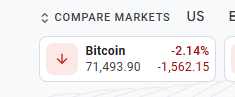
Just now and this is the opposite of surging.

Iran using it in this fashion only supports those that say BTC is ideal for those that deal in illicit activities.

IMHO, this is hardly is good for BTC, but time will tell.


Eddie


1775998484693.png
 
Just now and this is the opposite of surging.

Iran using it in this fashion only supports those that say BTC is ideal for those that deal in illicit activities.

IMHO, this is hardly is good for BTC, but time will tell.


Eddie


View attachment 1050992


I should clarify. I'm merely posting this as Bitcoin related news. I do not necessarily think its good news overall and, like you, unsure if it is good news for Bitcoin or not. At the same time, I suppose the use of Bitcoin here is better for the US than the use of Chinese currency. And, to counter that, the precedent being set here may have long term ramifications where every country with a shipping bottleneck in their territorial waters doesn't start doing the same. There has been a kickoff for a chain of events that will potentially keep unfolding for years or even decades to come and, for better or worse, Bitcoin is an established factor in these events.
 
Back
Top