Are African trackers really that good?

Will_m

WKR
Joined
Jul 7, 2015
Messages
1,064
Had a quasi colleague tell me about a safari he went on a few years ago and he went on and on about African trackers ability. According to him, they can basically track the memory of a ghost over hard rock.

Seriously he claims that a tracker could follow an animal (not blood trail) a mile or more. I don’t consider this guy to be a woodsman, so I’m pretty skeptical. On one hand I could see such a large animal leaving a lot of sign which would make a better track, but on the other, I’m still dubious about following a specific animal a mile or more in forested/grasslans. I’m more inclined to believe they make a best guess and follow some animal’s sign, so when they strike one up, it looks to the uninitiated like he tracked it down. All this guy did from what I could tell was follow a bunch of other folks around so it’s kind of hard to take him seriously.

(Not an African bashing thread but memes welcome)
 
Watch the recent MeatEater episode series on hunting in Tanzania. Its probably the most insight into tracker skills that I've seen. I'm not a guy who's at all interested in African Hunting, but that series is really good. I believe its 3 parts, maybe 4.


I was amazed at how well the trackers followed game. But remember, they do this every day for a living
 
I know some pretty good trackers, seen them follow sign on hard pan for much longer than you would think possible. They weren’t from Africa.


Sent from my iPhone using Tapatalk
 
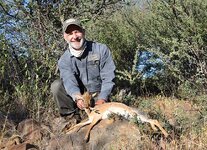
You ever see a Damara Dikdik?

Pic for example......
Makadi-Safaris-Damara-dik-dik-02.jpg

They have hooves roughly the size of your pinky fingernail.
A buddy of mine bow shot one in Namibia in '08 & we had to call in some San trackers. They tracked it by footprint alone for about 200yds across a mix of hardpan & rock through scrub you couldn't see 20 feet in. They literally tracked straight to it, first go. No backing up, no returning to the past spoor, just methodically took a step, looked, pointed & took another step.

It was honestly spectacular to see.

The PH told me (and I don't know the truth of it) that they start learning to track pretty much as soon as they can walk. Their father makes a mark in a tortoise's shell & releases it at dark. The kid has to track & return with their own tortoise before they get to eat. Apparently, they're pretty much experts by the time they're 5.
 
While they aren’t all trackers, anyone with better than 20/20 vision see things the rest of us just don’t. Here they may go into a field that doesn’t even require good sight. I worked with a dude who could see things across a room I’d have to walk within 10’ to see. Sort of his super hero skill and he was amazingly good at fine finish work. Since him I’ve met one other person with really spot on vision like that. Maybe 1 out of 100 people I’ve been around. The biggest hassle of tracking is getting down low enough to see the subtle clues, and someone who sees them farther away is miles ahead of everyone else. In those remote villages I have no doubt kids grow up knowing who sees well and tracks well, and the best get the few well paying tracking jobs.

Knowing how the visitor trades work, there’s going to be a good amount of puffery, especially to the tourists, because who is going to question it when they are the only ones focused carefully on the sign. lol
 
You ever see a Damara Dikdik?

Pic for example......
View attachment 978790

They have hooves roughly the size of your pinky fingernail.
A buddy of mine bow shot one in Namibia in '08 & we had to call in some San trackers. They tracked it by footprint alone for about 200yds across a mix of hardpan & rock through scrub you couldn't see 20 feet in. They literally tracked straight to it, first go. No backing up, no returning to the past spoor, just methodically took a step, looked, pointed & took another step.

It was honestly spectacular to see.

The PH told me (and I don't know the truth of it) that they start learning to track pretty much as soon as they can walk. Their father makes a mark in a tortoise's shell & releases it at dark. The kid has to track & return with their own tortoise before they get to eat. Apparently, they're pretty much experts by the time they're 5.
My two teenage sons can't find a hat if it were sitting on their damn heads! One of them swore they lost their school notebook after 20min of looking, which was sitting in plain sight on the counter.

I may employ this can't eat methodology into my parenting style.... Thanks for the tip.
 
I lived in Swaziland for 3 years and spent most weekends hunting in the bush or exploring other areas like the Kruger, Kalahari, Kgalagadi and other areas. I met and worked with some incredible trackers during that time. That said, tracking ability is one of those things that often gets romanticized and pushed out of proportion. Most Africans that are employed in the safari tourism industry are not trackers. Every tourist camp has their "expert tracker" which often means the guy can distinguish between a kudu and waterbuck track. But most of them can't track an animal for kilometers except in very soft substrate. But it is not a problem since most of the people that they are driving around in the land rover don't know the difference between a kudu and a waterbuck anyway.

There are some excellent trackers to be found at some safari tourism camps as well as working for hunting companies and ranger/anti-poaching units. Organizations like the Field Guides Association of South Africa (FGASA) specifically test for both track identification knowledge as well as tracking/trailing ability. Usually, those safari camps will state that their trackers are certified with the Tracker Academy's 1-year tracking course or something similar. Some of the best trackers are former poachers. Most come from the local area and grew up taking care of the family's goats or cattle.

The best trackers know everything about their local area, vegetation, wildlife habits, etc. But when they go to a new area, a lot of them have a tougher time. A ranger in the Kruger told me about bringing San Bushman trackers from the Kalahari in Botswana to help with some cat conservation project. But they ended up not being as efficient trackers as the local Shangaan trackers since they had never tracked in rocky areas. I have tracked with some San Bushman living in the Kalahari and they are incredible trackers but if you brought them to the Congo and asked them to track gorillas in the Rwenzori Mountains, it would be like taking them to Alaska. Many of the PHs are also excellent trackers and because they have often traveled and lived in other areas, they would likely be better all-round trackers and be able to use their tracking knowledge and apply it in a new environment than a guy who has never been more than 100 miles from his homestead.

The most impressive tracking I saw was watching a Shangaan tracker and Zimbabwean white PH follow a leopard trail in a rocky, forested area for almost a kilometer until we caught up with the cat. I could see some of the sign but there was a lot that the Shangaan pointed out on the ground that I would never have picked up by myself. I also saw the same guys track a specific elephant for 5 km even though the track mixed in and out of 2 other elephant herds by seeing the unique creases that each elephant has on their feet (like a human's fingerprints). Elephants are harder to track than a medium-sized antelope in a lot of environments.
 
Back
Top