1. My buddy did the barrel / barrel nut and I trust his work. He stretches his personal built AR’s out to 700-1k without issues.
I don't shoot out to 700 to 1,000 yards without issues like your buddy who did your barrel, but I do shoot out to 600 under CMP "Service Rifle" rules with my AR-15. The target we use in slow-fire prone at 600 yards has a 36" aiming black with a 12" 10-ring. My rifle needs to be mechanically accurate enough so that a shot landing outside the 10-ring isn't due to equipment, but down to me as the operator of it.
My rifle doesn't have some of the high-grade parts yours does. Mine is "Poverty Pony meets Poverty Plant" bargain-bin stuff; a PSA 20" Freedom Classic Nitride rifle kit applied to an Anderson Mfg stripped lower, with a few key exceptions: an RRA 2 stage National Match trigger and high speed hammer kit, a WOA oversized barrel extension, a titanium barrel nut, titanium fasteners for the forged "carry handle" that came in my kit, and a Merit 1/4 MOA conversion to the A2 back sight. That's it for wazoo parts and even those aren't as wazoo as they could be.
My barrel is a button-rifled, nitride coasted, NATO chambered stock government-profile PSA barrel with a 1:7 twist and I'm not running a free-float handguard or a float tube under A2 style guards.
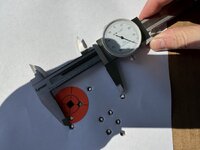
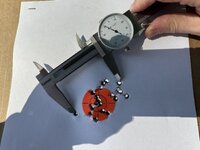
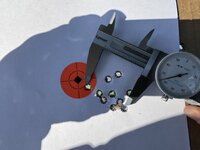
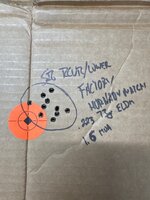
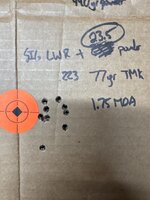
But it is, never the less, a solid one-minute rifle with the ammo I shoot out of it. It's not the parts, but how they were assembled.
I didn't just run the upper as PSA pre-assembled it. I stripped it and started over again, measuring stuff in between. Had I not done that, I would not have known how sloppy the fit of the barrel extension into the upper receiver was, or known that PSA over-torqued the barrel nut by 15 ft/lbs beyond the specified maximum.
The sloppy fit of the barrel extension to the upper isn't a "PSA Problem". It is a "Mil Spec" problem. Both the supplied barrel extension and the bore in the upper receiver that it slides into were of Mil Spec dimensions that combine to yield a sloppy Mil Spec result.
WOA market championship-winning barrels. A great barrel can't overcome a sloppy fit to the upper.
WOA sells oversized barrel extensions for this reason, but unless you specify otherwise, most WOA barrels, including SPR, Varmint, and Service Rifle profiles, ship with a Mil-Spec barrel extension that winds up being .001" to .002" undersized relative to most Mil-Spec uppers. In Service Rifle, the top competitors use oversized barrel extensions that are then cut on a lathe to achieve a tight, precise fit with the upper. We pretty much all used to go one step beyond that and "bed" the barrel to the upper with green Loc-Tite. I still do.
The AR-15 doesn't have a specific torque value for the barrel nut. On an AR-15, "correct" barrel nut torque spans a range of values from 35 ft/lbs to 80 ft/lbs. Back in the days when a "Service Rifle" actually had something in common with a service rifle, most military marksmanship units found that somewhere around 45 ft/lb was the "baseline" and some tuning of barrel harmonics could be achieved by going up a little or down a little on barrel nut torque. That trick doesn't work so well when the fit of the barrel extension to the upper receiver is sloppy. It can, and in my case did, cut a half-minute off the group size of the ammunition I intended to shoot across the course with it.
Using the barrel nut torque to influence barrel harmonics is, as you might imagine, a very tedious process., and is probably less beneficial for barrels that are .920" under the handguards than my weenie little government profile barrel.
I do believe that all AR-15 rifles would benefit from a precise fit of the barrel extension to the upper, however, and also believe that most AR-15s, whether commercially assembled or home assembled, have a barrel to upper-fit that is too sloppy to let the barrel perform to its full potential. Most commercially assembled AR-15s will self-demonstrate a sloppy fit of the barrel to the upper receiver, without having to do any measuring. All you have to do is wet the chamber end of your upper with solvent or gun oil and have someone wiggle the muzzle of the barrel. In a lot of cases, you'll see bubbles of air in whatever fluid you've used. A properly fitted and bedded barrel won't display that evidence because it can't.
Mine is not a one-minute rifle with every kind of ammo a person could run through it. I can quickly convert it to a three-minute rifle by shooting crappy surplus M-855 out of it, but I don't habitually waste my time or money shooting that stuff.