Any woodworkers in here?

Joined
Jun 17, 2025
Messages
1,056
So my son (age 9) was absolutely fascinated with a woodworking video we watched back in the fall. We ended up getting him(?) a cheap lathe for Christmas. It was used, a HF 1/2hp model, 5 speed, that'll hold about a 20" length of wood. It came with a really nice table the prior owned had built for it and a handful of various tools. I ordered a set of chisels(?) and am now waiting on a drill-chuck for the tailstock so we can bore holes for candlestick holders - maybe.

We have a handful of dry cedar logs in the firewood pile that have no major splits in them. I have an old section of persimmon I set back a couple years ago - maybe 6" long and 5" diameter - with an eye toward having some pistol grips built. That project hasn't happened yet, so I've used it, despite the splits, as a test piece to smooth up a bit in the lathe. I'd really like to fill the splits with colored epoxy then consider having a set of grips made from it. And persimmon is a HARD wood so I don't think it'll be the best wood for a first project.

I had some wet peach limbs, cut about a month ago. I used two of them to play with and they both split after drying a few days. I could epoxy-fill them and still make candlestick holders, I guess, but they still need to dry for a while.

I have some sections of peach we cut and stacked the other day. I figure they need at least six months to dry. We have a peach orchard and had a couple of trees that needed to be removed, so they'll eventually, possibly, make a nice rolling pin or bowl.

There's a male persimmon tree on the farm I don't mind cutting, as there's another right next to it, so I wouldn't be losing a pollinator for my female trees. We've also identified one medium-sized red maple and one honey locust we can cut, after deer season. I might have one black walnut big enough to consider cutting. I'll have to go check on those after deer season, but I can definitely cut the one persimmon and one red maple and one honey locust.

I have tons of shagbark hickories. I have tons of American Elm and I'd love to use it for woodworking because it's a bear to split for firewood and not good for much else, from my standpoint.

But all of those require drying for a long time. And I think the only firewood we have in decent enough shape for woodworking, is eastern red cedar.

So....I see wood blanks for sale all over the internet and I'll likely buy one blank to destroy as a learning tool, and one to attempt to make a bowl from.
First question:

Do you have any suggestions on where to buy good blanks, and what species to start with for a simple bowl?

I have enough tools, and I've already figured out I have plenty of sandpaper for the time being, from 60 to 400 grit. We have eyewear. We have a good work environment (the apron of my barn).

Second question:

I can easily put up persimmon, peach, eastern red cedar, american elm, hickory, honey locust, and red maple for drying for future projects. I have assorted oaks but if they're big enough for woodwork they're big enough to make acorns, so I won't cut them. What species would you prioritize for future use?
 
Lots of wood work, but no turning. A buddies dad is into turning stuff though. He has stuff made from all sorts of wood, including glue-ups of a variety of woods. I do recall him saying something about working green wood sometimes?
Anyway, Ive seen a lot of turned cherry and yellow birch burls. Plenty of ash. Some maple. But those are also all of the common hardwoods around me. If you want some small pieces of dried wood I probably have some cool hardwood scraps I’ll never use, I just dont have a sense of how small is too small. I bet if you drive around with a chainsaw after a wind or ice storm and help clear a few driveways, you have a pretty good supply of wood.

Also, yes, I still get a twitch thinking about a big elm my dad made me split like 40 years ago.
 
Lots of wood work, but no turning. A buddies dad is into turning stuff though. He has stuff made from all sorts of wood, including glue-ups of a variety of woods. I do recall him saying something about working green wood sometimes?
Anyway, Ive seen a lot of turned cherry and yellow birch burls. Plenty of ash. Some maple. But those are also all of the common hardwoods around me. If you want some small pieces of dried wood I probably have some cool hardwood scraps I’ll never use, I just dont have a sense of how small is too small. I bet if you drive around with a chainsaw after a wind or ice storm and help clear a few driveways, you have a pretty good supply of wood.

Also, yes, I still get a twitch thinking about a big elm my dad made me split like 40 years ago.
Thanks! I've been thinking it over and there may be some maple in the very back of the woodshed from 2 years ago and there's almost certainly a piece or two of honey locust, so I'm going to plan on digging them out once I get past the current stack of mixed and unknown firewood. If I see the honey locust it'll be immediately obvious.
 
Don't you get standing dead trees?

I get piles of them, all types.
The wood preference is around what the end product will be, but usually not too hard to find some standing dead timber to cut up and use.
 
Is honey locust like black locust? If it is, that stuff is way hard and very chippy, way worse than elm. Cool tidbit, its also the most rot-resistant wood around, its not native here where I live but it grows all over because people planted it for a supply of fence posts and rails. Not sure if honey locust is similar. No harm in finding out, but if it is it may not be the easy-button for turning stuff.
 
You can find lots of amazing work pieces in firewood and rotting logs laying around.

Check out the book “turning green wood”.

I haven’t messed with it in several years, But it’ll keep your kid occupied for sure!

Lathes are obviously dangerous. No jewelry or hair or loose clothes for him. Wood explodes unexpectedly, metal doesn’t. And wood dust real bad for you too - get him a good respirator if he’s gonna have his face in it all the time.

Rough turn your green blanks and let em dry then come back for finish work once they stop moving.
 
Don't you get standing dead trees?

I get piles of them, all types.
The wood preference is around what the end product will be, but usually not too hard to find some standing dead timber to cut up and use.
Most of our standing dead trees are Ash that died from the Emerald Ash Borer. I've burned tons of it in the last few years and there's very little left. What's left, I'm afraid to cut, afraid the tree will snap while I'm cutting it down.
 
Is honey locust like black locust? If it is, that stuff is way hard and very chippy, way worse than elm. Cool tidbit, its also the most rot-resistant wood around, its not native here where I live but it grows all over because people planted it for a supply of fence posts and rails. Not sure if honey locust is similar. No harm in finding out, but if it is it may not be the easy-button for turning stuff.
As I understand it, they're very similar woods to each other.
 
You can find lots of amazing work pieces in firewood and rotting logs laying around.

Check out the book “turning green wood”.

I haven’t messed with it in several years, But it’ll keep your kid occupied for sure!

Lathes are obviously dangerous. No jewelry or hair or loose clothes for him. Wood explodes unexpectedly, metal doesn’t. And wood dust real bad for you too - get him a good respirator if he’s gonna have his face in it all the time.

Rough turn your green blanks and let em dry then come back for finish work once they stop moving.
I hadn't thought about the respirator, so thank you. It's been windy every time we've touched it in the last week and I haven't even considered that.

ETA: After deer season we will look around carefully for any long dead stuff that might be salvageable, but over the last few years a lot of that has been turned into firewood.
 
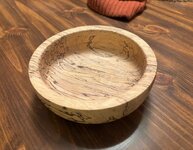
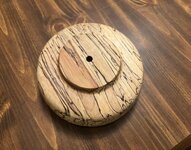
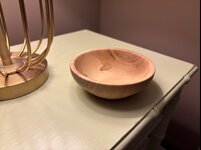
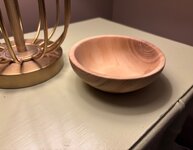
IMG_0300.jpegIMG_0301.jpegIMG_0302.jpegIMG_0303.jpeg

Spalted (rotting) pecan and cotton wood.

Both from downed trees in suburbia, that were just destined for the wood chipper.

Turned both green. The pecan I let sit for a while to dry before smoothing it out a little.

I stuck the cotton wood in the microwave after rough turning hahah! I was impatient.

The best part about turning is your media is cheap or free, the best looking stuff is ugly to everyone else, and messing up usually turns out great.
 
View attachment 995637View attachment 995638View attachment 995639View attachment 995640

Spalted (rotting) pecan and cotton wood.

Both from downed trees in suburbia, that were just destined for the wood chipper.

Turned both green. The pecan I let sit for a while to dry before smoothing it out a little.

I stuck the cotton wood in the microwave after rough turning hahah! I was impatient.

The best part about turning is your media is cheap or free, the best looking stuff is ugly to everyone else, and messing up usually turns out great.
Those are gorgeous. No pecans here but it's entirely possible that I can find a hickory with some spalting. A couple years ago I cut one for firewood thinking it was dying because of a big injury on the side of the tree. Once I got it cut down I realized the injury was only on the surface, but it was a bit too late to matter then. I'm pretty sure there are others in similar condition.
 
Those are gorgeous. No pecans here but it's entirely possible that I can find a hickory with some spalting. A couple years ago I cut one for firewood thinking it was dying because of a big injury on the side of the tree. Once I got it cut down I realized the injury was only on the surface, but it was a bit too late to matter then. I'm pretty sure there are others in similar condition.

Spalting is the battle line between fungi trying to eat wood. You can leave wood on the ground in wet shady spot and get all different kinds of trees to develop cool patterns.

Find old firewood piles - bound to be good stuff for turning in there
 
Kinda, except black locust hasn't ever been the same since the blight.

Honey locust is invasive, and I hate to admit not knowing exactly if its native or not.


I think honey locust might have brought the blight, but I might be 100% wrong there too.
Wikipedia's range map shows it as native, but I certainly don't know that either way.

It's native here. My little boy loves picking the pods up when we find them in the woods. He'll bring them home, show them to his mom, and throw them away a few days later.

We actually have very little black locust here, but it was really common when I lived in west TN.
 
Spalting is the battle line between fungi trying to eat wood. You can leave wood on the ground in wet shady spot and get all different kinds of trees to develop cool patterns.

Find old firewood piles - bound to be good stuff for turning in there
A lot of that hickory is still laying on the ground. It was a huge tree and parts of it made firewood and other parts got left there. I know a damp hickory can rot pretty quickly but I think most of this one is in a fairly dry spot, so I'll cut into a few spots and see if it's still good.
 
Wikipedia's range map shows it as native, but I certainly don't know that either way.

It's native here. My little boy loves picking the pods up when we find them in the woods. He'll bring them home, show them to his mom, and throw them away a few days later.

We actually have very little black locust here, but it was really common when I lived in west TN.

The pods can rival corn for calorie production per acre on a really good year. Really hard to predict tho. Some work on hybrids has been done for silvo pastures, totally different subject tho.

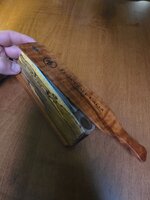
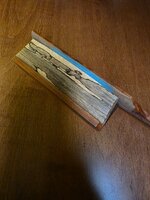
Here's a spalted sycamore box call. Hard to show it all, top is curly cherry.
20260101_210546.jpg20260101_210518.jpg
 
Back
Top