American Prairie loses grazing rights

What in the actual heck. Is the internet not internetting today? Totally didnt see this turn out like it did.


Question, my Google algorithm doesnt help either. What is AUM? I cant for the life of me get what it stands for.

Sincerely some dude on the internet.
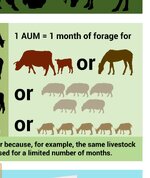
It gives the number of animals that can be supported by the land (though its definition has some variation and is not 1 to 1 comparable all the time). Important as you need a lot less land in say east Texas per bovine than in a place like west Texas.

From a BLM infographic
Screenshot_20260218_180402_Chrome.jpg
 
What in the actual heck. Is the internet not internetting today? Totally didnt see this turn out like it did.


Question, my Google algorithm doesnt help either. What is AUM? I cant for the life of me get what it stands for.

Sincerely some dude on the internet.

@Sandhills seems like a good guy. I was wrong and so an apology was in order. Besides that as we’ve seen on this thread doubling down on stupid isn’t a good look and nor is it honest or authentic.
 
There is a valid reason for our skepticism regarding livestock out here in the arid west. The attached map has in red allotments that don’t meet health standards with livestock identified as the primary cause. It’s bad out here. That’s why some might be slow to blindly praise the rancher.

With conditions like this as the status quo it’s little doubt how we could be open to trying something different.

 
The entire premise of conservation is that it has a value that is realized by the public. It’s the principle of why it’s worth doing. The idea that to conserve has inherent value is a core indispensable tenant of wildlife conservation.

You don’t see that. You only see value in extraction and growth of individual wealth and consumption. You’ve shown that in example after example. You’re posting in the wrong thread and I wish you weren’t associated with the same lifestyle that I love.
You are about as far away as could be about what I think or who I am, or even what I have accomplished in conservation. If It wasn’t for people like me and what we have accomplished, you wouldn’t be fishing, hunting or trapping today! Agriculture is not the ogre. The 4th and fifth generation family ranches and farms are a way of life. They determine their own economy. They help each other out to survive. Most work hard and struggle to put their kids through school. They seldom go beyond the local town.

Ranchers like Clarence Mortensen have made a huge impact on the landscape. Their contributions have returned a good amount of the short grass prairie to its original state. Simply because they realized that a natural prairie can graze more cattle. Their enriched lands have benefitted wildlife. You want to blame the fat cats for a reason to grab that land and put it all into a reserve for your own piece of mind. The reality is the family rancher, who has been the good steward of that land, is being displaced. That is not the democratic way to have a park.

Montana is roughly one third public lands. Some other Western states don’t have that much public land. They need to recruit private lands for hunting access or they can’t do very much hunting.

AI here gives a good synopsis of why hunters like me….are against American Prairie Reserve. What is missing is the impact that grizzlies and wolves will have on our hunting. I have already delivered my own talking points ad nauseam:
—————————————————————————————————————————————
Some hunters oppose the American Prairie Reserve due to concerns that its land acquisitions limit public hunting opportunities and favor wealthy individuals through high-end safari experiences. Critics argue that the organization's practices may not align with the interests of the hunting community, leading to a perception of exclusivity and reduced access to hunting lands.

rokslide.com hunttalk.com

Concerns Among Hunters Regarding American Prairie Reserve​

Limited Hunting Opportunities​

Many hunters express concerns that American Prairie Reserve (APR) limits hunting opportunities. Initially, APR did not allow hunting on its properties, which raised suspicions among the hunting community. Although APR has since introduced some hunting tags, the extent of hunting allowed remains unclear. This uncertainty leads to frustration among hunters who feel their interests are not adequately represented.

Perception of Land Ownership​

Some hunters view APR's acquisition of large tracts of land as a threat to public access. The organization has been involved in significant land purchases, which some believe could restrict traditional hunting grounds. This sentiment echoes historical concerns about wealthy landowners controlling access to resources, leading to feelings of disenfranchisement among local hunters.

Legal and Environmental Issues​

APR is currently involved in legal disputes over grazing permits for bison, which some hunters believe could further complicate hunting regulations. The ongoing litigation with the Montana Department of Natural Resources and Conservation has raised questions about the organization's commitment to balancing conservation with hunting rights. Hunters worry that these legal challenges may hinder their ability to hunt in the future.

Community Sentiment​

The local hunting community is divided. While some support APR's conservation efforts, others feel that the organization prioritizes wealthy clientele and high-end experiences over traditional hunting practices. This division reflects broader concerns about the impact of large land acquisitions on local culture and hunting traditions.

Overall, the apprehension among hunters regarding American Prairie Reserve stems from a combination of limited access, legal uncertainties, and the perception of prioritizing affluent interests over community needs.
rokslide.com wlj.net
 
You are about as far away as could be about what I think or who I am, or even what I have accomplished in conservation. If It wasn’t for people like me and what we have accomplished, you wouldn’t be fishing, hunting or trapping today! Agriculture is not the ogre. The 4th and fifth generation family ranches and farms are a way of life. They determine their own economy. They help each other out to survive. Most work hard and struggle to put their kids through school. They seldom go beyond the local town.

Ranchers like Clarence Mortensen have made a huge impact on the landscape. Their contributions have returned a good amount of the short grass prairie to its original state. Simply because they realized that a natural prairie can graze more cattle. Their enriched lands have benefitted wildlife. You want to blame the fat cats for a reason to grab that land and put it all into a reserve for your own piece of mind. The reality is the family rancher, who has been the good steward of that land, is being displaced. That is not the democratic way to have a park.

Montana is roughly one third public lands. Some other Western states don’t have that much public land. They need to recruit private lands for hunting access or they can’t do very much hunting.

AI here gives a good synopsis of why hunters like me….are against American Prairie Reserve. What is missing is the impact that grizzlies and wolves will have on our hunting. I have already delivered my own talking points ad nauseam:
—————————————————————————————————————————————
Some hunters oppose the American Prairie Reserve due to concerns that its land acquisitions limit public hunting opportunities and favor wealthy individuals through high-end safari experiences. Critics argue that the organization's practices may not align with the interests of the hunting community, leading to a perception of exclusivity and reduced access to hunting lands.

rokslide.com hunttalk.com

Concerns Among Hunters Regarding American Prairie Reserve​

Limited Hunting Opportunities​

Many hunters express concerns that American Prairie Reserve (APR) limits hunting opportunities. Initially, APR did not allow hunting on its properties, which raised suspicions among the hunting community. Although APR has since introduced some hunting tags, the extent of hunting allowed remains unclear. This uncertainty leads to frustration among hunters who feel their interests are not adequately represented.

Perception of Land Ownership​

Some hunters view APR's acquisition of large tracts of land as a threat to public access. The organization has been involved in significant land purchases, which some believe could restrict traditional hunting grounds. This sentiment echoes historical concerns about wealthy landowners controlling access to resources, leading to feelings of disenfranchisement among local hunters.

Legal and Environmental Issues​

APR is currently involved in legal disputes over grazing permits for bison, which some hunters believe could further complicate hunting regulations. The ongoing litigation with the Montana Department of Natural Resources and Conservation has raised questions about the organization's commitment to balancing conservation with hunting rights. Hunters worry that these legal challenges may hinder their ability to hunt in the future.

Community Sentiment​

The local hunting community is divided. While some support APR's conservation efforts, others feel that the organization prioritizes wealthy clientele and high-end experiences over traditional hunting practices. This division reflects broader concerns about the impact of large land acquisitions on local culture and hunting traditions.

Overall, the apprehension among hunters regarding American Prairie Reserve stems from a combination of limited access, legal uncertainties, and the perception of prioritizing affluent interests over community needs.
rokslide.com wlj.net
You using AI to cite to yourself to support your claim is an absolute illogical masterpiece.
 
Back
Top