All things .308 Win

I posted this in another thread, but found the results really interesting.
I have always heard the 308 is an efficient cartridge, so I calculated it out compared to the 6 most common 308 based cartridges (and 6.5 Creedmoor and 300 Win Mag for fun). This is how much energy at the muzzle is produced per the grains of a common powder. The more efficient the cartridge, the more energy generated by a grain of powder.

I used VARGET for all 8 cartridges (it's the only powder that has data for all 8)
Max load of VARGET for each cartridge. All data is from Hodgdon's website.
I tried to pick a common medium-heavy weight bullet for each cartridge (300 Win Mag Varget data maxes at 168gr):

  • 243: 100gr bullet, 33.7gr Varget, 2838 FPS, 1788 Ft-Lbs: 53.1 Ft-Lbs/Powder Grain
  • 260 Remington: 140gr bullet, 36gr Varget, 2578 FPS, 2066 Ft-Lbs: 57.4 Ft-Lbs/Powder Grain
  • 7mm-08: 140gr bullet, 42.2gr Varget, 2819 FPS, 2470 Ft-Lbs: 58.5 Ft-Lbs/Powder Grain
  • 308: 168gr bullet, 45gr Varget, 2737 FPS, 2794 Ft-Lbs: 62.1 Ft-Lbs/Powder Grain
  • 338 Federal: 200gr bullet, 47gr Varget, 2510 FPS, 2798 Ft-Lbs: 59.5 Ft-Lbs/Powder Grain
  • 358 Winchester: 220gr bullet, 50gr Varget, 2445 FPS, 2920 Ft-Lbs: 58.4 Ft-Lbs/Powder Grain

  • 6.5 Creedmoor: 140gr bullet, 35.8gr Varget, 2598 FPS, 2098 Ft-Lbs: 58.6 Ft-Lbs/Powder Grain
  • 300 Win Mag: 168gr bullet, 58.2gr Varget, 2964 FPS, 3277 Ft-Lbs: 56.3 Ft-Lbs/Powder Grain

As you can see, 308 generates 17% more energy per powder used than the 243 and 6% more than the 6.5 Creedmoor. The 308 is an incredibly efficient round.

What surprised me was I assumed the data would show increasing efficiency as the bore diameter increased, but it doesn't. I first made this chart stopping at .308 as I forgot about the variants with larger bores. When I added the 338 and 358 cartridges I was shocked to see them less efficient. Efficiency tops out at the 308 then goes back down!

Love seeing this sort of thing! Guys data mining and then interpreting via their own processing of information to their own conclusions, and then sharing in views to present to the herd. Perfect for the all things 308 thread. The discussion afterwards is inevitable and will derail for awhile but the thread can afford it so...
 
Pretty interesting! I think another way to look at it, and a more interesting way for me personally, would be to look at the powder burned to efficiency in yards. It would definitely be more “rifle system efficiency” vs cartridge in general, and a lot more work/calculating.
For example,
308-168gr tmk, using the fastest load data from Sierra is 2800 fps from two powders avg of 46.2gr. Hits 1800fps at sea level at 650 yards. Which is 14 yards per grain.

6mm arc-95gr tmk same load data source and barrel length. 3000fps at 30.8gr gets to 700 yards. 22.7 yards per grain.

Your way is a very neat concept and a cool way to think about it though!
bc would play a pretty big part in this view, would be best to compare like bc's between cartridges, like the view though, as another layer....as soon as impact happens though it's a whole different discussion but these views are cool to look at in terms of the inflight efficiencies
 
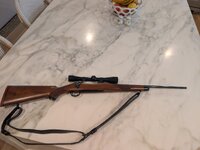
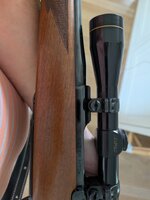
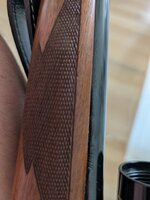
A couple of my hunting buddies recently acquired .308s. Out of jealousy I retrieved my mother's old .308 out of the family safe.It hasn't been fired since the late 90s if I had to guess. I was surprised to find that it's a Ruger M77. I hadn't put eyes on it in at least 20 years. I actually thought it was a Remington. I was kind of let down at first because I had some dreams of rebarreling, adding a trigger, but keep everything else the same (accurate retro mod style). After staring art it for a bit, I'm kind of excited to keep it original. Doing some serial number research it looks to be from '89 just before they stopped making the tang safety version. It still has the Leupold M8-6x that came with it attached. Amazingly clear glass.

Super excited to get it out to the range.
 

Attachments

  • PXL_20260529_223645268.MP.jpg
    PXL_20260529_223645268.MP.jpg
    161.4 KB · Views: 16
  • PXL_20260529_172748142.MP~2.jpg
    PXL_20260529_172748142.MP~2.jpg
    169.3 KB · Views: 15
  • PXL_20260529_172753384.MP.jpg
    PXL_20260529_172753384.MP.jpg
    162.4 KB · Views: 15
I can't actually think of a practical way to do that, just an interesting idea in passing. I guess gel blocks might approximate the idea.

I suppose even if it could be measured, the next questions would be the "so what"? E.g., how much wound volume is necessary, and what wound shape is optimal, for which animals? There really are just too many variables for these "hypotheticals" to be very useful IMO.
totally agree, terminal performance we try our best to measure 'result of work' through/in animals and gel, and yup on the 'so what' part, if a .2 sd 223 73 gr eldm does enough work to have a very short average recovery distance, what does a .25 sd 168 gr eldm with 25% more ass offer over that and would the average recovery distance be any shorter and if so 25% shorter?, or does it just allow that more consistent average recovery distance to be applied to critters about 25% bigger? or 25% more angle choices?

so possibly the wound volume would be an indicator at best, only if total distance travelled is included, in that it's either a rapid expansion type bullet or a delayed controlled type bullet where the latter leaves much of it's work potential(volume) in the hillside on most broadside type shots

and one way my brain has thought about how could the oh so irrelevant 'energy' play a role in these nonstandard views 'simply' is ft/lbs per inch, again, it won't correlate to much in way of benefit to time to incapacitation as we know very little is required and that rapid expansion style are the most efficient at delivery for shortest average recovery distances so long as you have enough ass to meet the penetration for given animal sizes, and most if not all the proven bullets loved here do have the ass

just picking on the .2 sd 73 gr eldm in 223 (potentially the lowest end of spectrum of considered reliable short recovery killers) hypothetical example at 16" at 49 ft/lbs per inch at 2200 fps impact vs a .25 sd 168 gr 308 eldm at 20"(25% more sd-ass) and same impact fps and doing 90 ft/lbs per inch....and Form has shown examples here of what ~240 ft/lbs per inch over ~14" looks like on deer size game...and I'm guessing the average recovery distance of that combo on deer size game would be noticeable over the the 50-150 ft/lbs per inch combos most normal humans are shooting lol

so after moving from most efficient inflight to then finding most efficient terminally discussion makes so all cake can be eaten lol, but a lot of layers in that cake

y'all know my thoughts on how to figure out the terminal end and focusing on studying the work vs the result of work if to make more easily comparable for those looking for enough, or, the most efficient there too, for game intended of course ;)
 
A couple of my hunting buddies recently acquired .308s. Out of jealousy I retrieved my mother's old .308 out of the family safe.It hasn't been fired since the late 90s if I had to guess. I was surprised to find that it's a Ruger M77. I hadn't put eyes on it in at least 20 years. I actually thought it was a Remington. I was kind of let down at first because I had some dreams of rebarreling, adding a trigger, but keep everything else the same (accurate retro mod style). After staring art it for a bit, I'm kind of excited to keep it original. Doing some serial number research it looks to be from '89 just before they stopped making the tang safety version. It still has the Leupold M8-6x that came with it attached. Amazingly clear glass.

Super excited to get it out to the range.
'kind of excited'? wow, I would be more than that...I'd be out finding out what it can do and not change anything, do let us know!
 
Personally, I've standardized on the .308 over the last decade. It does exactly what it's designed to do closely replicating the behavior of the 30-06 with better firearm compatibility, lower recoil, and lower muzzle blast.

I've used four .308 barrels in three rifles, only one of them aftermarket. All were capable of one moa accuracy for reasonable count groups. It's an inherently accurate cartridge that doesn't need any special brand or fancy equipment to get results with.

I learned a lot with experimentation. But lately I've found that shooting 175 gr Sierra in front of 43.5 grains of Staball Match, tuned somewhat close to the lands seems to do great. I've tried those bullets with impressive BC only to find their Frankenstein proportions lead to inconsistent accuracy.

Finally, I've found that a .30 cal pill traveling at moderate velocity always kills the game it hits. I've found that a 220 grain bullet works great as a short range woods round. More standard weights work great further. As well as premium bonded bullets worked, I've grown weary of their price and availability.

All and all, it's hard to see an issue with the .308. Sure is nice to use the same equipment and components to load three rifles only to experience great enough results that further experimentation just isn't worth it. I would say that for sub 16 short barrels, the .300 AAC is probably the better choice. Other than that, I'm good.
 
Back
Top