
A real wolf article

For you guys wanting to see wolves on public lands, keep in mind the key thing you have to watch out for: That it is a trojan horse to ban hunting.

Follow the bouncing ball here:

1) The underlying ideology and root, implicit assumption of the left in general is this: "The only good land is 'intact' ecosystems that are untouched by human hands". If this state doesn't exist, they see the state of the land and ecology as wrong and molested.

2) The natural extension of this is that it is critical for them, as good people, to "restore" it to an "intact" state.

3) Re-introduction of wolves and other apex predators is part of making that ecosystem "intact" again. Watch out for this key-word, especially in scientific papers. "Intact", like "re-wilding", is dog-whistle code for banning hunting and all human activity not on-foot.

4) Re-introduction of wolves (and banning mountain lion hunting) dramatically reduces big-game populations available for human hunting. The mandate of state wildlife biologists is NOT protecting game for human hunting - it is maintaining "healthy herds". The more "natural predation", the less human hunting opportunity. It is that simple, and it is categorically unavoidable in every way on public lands.

5) By the very laws of nature, the predator-prey cycle over years means predators will reach population points that exceed the carrying capacity of the land of their prey species, resulting in over-predation, then starvation, sickness, and death of those predators, after which prey populations rebound, and the cycle continues. But once that tipping point is hit, human hunting of those game animals WILL be halted. It will start with pauses for a season or two on hunting game animals in specific zones "to maintain the health of the herds". Re-introduction of apex predators and bans on hunting them "naturally" sets a precedent of reducing human hunting opportunity, leading to complete halts in it.

6) Once "natural predation" hits hard enough, do you really think the "public" will want a bunch of hunters out killing wolves and mountain lions that are just doing what is natural? Do you think that the "public" will want humans killing off wolves so we can selfishly hunt deer and elk for ourselves?

7) What happens when "the long march through the institutions" (google it) leads to state game agencies being taken over by people whose ideology is anti-hunting general? Will there be any support by these "neutral experts" in these agencies for the "public" to hunt? Idaho and Wyoming's game agencies may still be populated by people who value hunting, but can the same be said by those in charge of California's, Oregon's, Washington's, or even Colorado's?

This is exactly where bans on hunting apex predators and re-introduction of them leads. It's literally a force of nature pushing out human opportunity, magnified by anti-hunting ideology.
What get's me, is that these are the same people referencing the infamous "Yellowstone Study" while also not understanding the hypocrisy they display. The study has also been proven inconclusive/wrong and still quoted as gospel.

For background, Denver and the Front Range would literally not exist in its current state if trans-basin water diversions over the Continental Divide did not occur. Let me say again, the Front Range is not a sustainable system for humans in its natural state. Hundreds of thousands of acre-ft destined for the Colorado River are diverted FOREVER to the Front Range. Many more acre-ft are pulled from the Arkansas Basin.

Guess what? The Yellowstone study used streams and rivers to develop feedback loops from wolves. So, in order to "fix" the areas west of the Continental Divide, we need wolves? Well, how about you put the water back, we could start there! We don't need wolves. too bad the people voting for this don't care about anyone but themselves, and sacrifices should only be made by the rural people. The places you pull water from to live comfortable lives are also where you are dumping wolves!
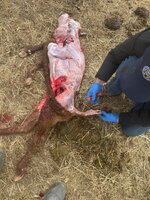
 
Good article, and sums up a lot of how we feel in CO. I would love to go a week without dealing with the wolves around here.

Calves are definitely prime targets for any predator this time of year, not many ranchers getting a full nights' sleep.

View attachment 871196
Is there much to be done? I think of LGDs mostly for sheep and smaller livestock. Do folks use them with cattle ?
 
I whole heartedly agree that the introduction and/or ban on hunting carnivorous apex type predators are not about the animals themselves, but to harm huntable animals to the point where hunting is banned, limited, or move that direction to where they think we will just give up. You never see those type of people advocating for reintroduction of huntable animals like sheep, elk, deer, etc. But let it be an apex predator, or a woodpecker, or an amphibian or a fish that can halt all hunting or fishing and they are all over it.
 
Good article, and sums up a lot of how we feel in CO. I would love to go a week without dealing with the wolves around here.

Calves are definitely prime targets for any predator this time of year, not many ranchers getting a full nights' sleep.

View attachment 871196

Man, that has got to be so frustrating and angering to deal with. Thanks for sharing.

If you don't mind sharing, what kind of financial damage is this costing the average rancher? Not just the value of the calf at the time, but lost value from them not growing to full size, stressed herds, security measures, etc. I can't imagine anyone can lose too many calves or AUs before a ranch just becomes unprofitable that year.
 
Is there much to be done? I think of LGDs mostly for sheep and smaller livestock. Do folks use them with cattle ?

Some people have started to raise LGDs. Jury is still out on long term effectiveness as they take time to train/grow/learn the country; I know of more than one that has gotten pretty torn up. The problem I have with most LGDs is they roam at night (double digit miles at times). Not so great if you're trying to keep other wildlife around.

Man, that has got to be so frustrating and angering to deal with. Thanks for sharing.

If you don't mind sharing, what kind of financial damage is this costing the average rancher? Not just the value of the calf at the time, but lost value from them not growing to full size, stressed herds, security measures, etc. I can't imagine anyone can lose too many calves or AUs before a ranch just becomes unprofitable that year.

Exact costs are only easy to quantify in terms of "Calf A234 died from a wolf". The complete compensation program does have things like low weaning weights, preg rates, etc... but it only kicks in once you have lost (& had confirmed) an animal to a wolf. So if your neighbor has lost something but you haven't, even if you have the same metrics (in terms of weaning weight losses, preg rates, etc...), you can't file for compensation like they can. And you have to have your records to show your losses relative to historical averages. Hard to do for new operations getting started and sustaining losses, or even old ones that relied on Grandpa's kitchen drawer filing system for old record books.

The program was seeded with $350,000 last year. Over $580,000 in claims were submitted, over $380,000 paid out. And that was just from 10 wolves.

There is a cost as well even if the calf wasn't depredated by a wolf, as CPW will typically dispatch a DWM and at least one game damage specialist to each suspected depredation. Add in the cost of the ranchers time, and I know of some calves that 'cost' $5000.
 
Man, that has got to be so frustrating and angering to deal with. Thanks for sharing.

If you don't mind sharing, what kind of financial damage is this costing the average rancher? Not just the value of the calf at the time, but lost value from them not growing to full size, stressed herds, security measures, etc. I can't imagine anyone can lose too many calves or AUs before a ranch just becomes unprofitable that year.

As a followup/more detailed reply -

This post from @Sandbrew in the Conservation forum shows one of the claims from this year, along with the relevant rules around compensation. There are a lot of people suffering losses, but without incontrovertible evidence they have no recourse to be able to file claims.

From the screen shot from this news story
@ 00:52 about the ballooning costs of wolves it looks to me like claimants filed an itemized claim form. It looks like most of the money owed is not from actual confirmed wolf depredation deaths but lost productivity from open cow dues to lower than 3 year average conception rates and reduced weight on calves sold due to stress and pressure from the wolves. The top line of "Calves" is interesting to me as it shows a 3 year average loss of 23 calves an this year it is 88. That is eye opening to me.

View attachment 818893

The itemized claim requirements for production losses are spelled out on page 34 of the Colorado Wolf Plan. https://cpw.widencollective.com/assets/share/asset/wixcpz0wez

For livestock owners who choose to itemize production losses
claiming missing livestock the following apply (this option is only
applicable for calves, yearlings, and all classes of sheep):
• Missing calves, yearlings, and sheep can be claimed if two
conditions are met:
° 1) Livestock owners must have a confirmed depreda-
tion event (injury or death) due to wolves to qualify
for the itemized production losses
° 2) The livestock owner must reasonably believe that
livestock reported as missing were lost to wolves and
not to other predators (i e , bears, lions, or coyotes),
disease, or other factors
• For missing calves, yearlings, and all classes of sheep, a live-
stock owner must submit the following information, included
but not limited to:
° Tangible evidence (photos, scat, tracks, etc ) that
wolves were present in the area where livestock are
missing
° Baseline death loss (predators, poisoning, disease, etc )
with percentages over a minimum of 3 years (preced-
ing wolf presence in the area) using production re-
cords
° A self-certification or documentation (e g , ranch re-
cords) for the current year that demonstrate vaccina-
tion status
° Written records to justify current year losses will be
provided to CPW with the following information:
■ The number of livestock (head counts) at the be-
ginning of the grazing season and at the end of
the grazing season
■ The number of animals that died as a result of
other predators (bears, lions, or coyotes), disease,
or other factors during the grazing season
• Eligibility for missing calves, yearlings, and all age classes of
sheep is limited to losses above the previous 3-year baseline
death loss and cannot exceed the actual number of docu-
mented livestock missing
• Livestock owners who cannot provide this written documen-
tation described above are not eligible to claim missing ani-
mals under Option 2
For decreased weight gains (only applicable for sheep and cattle), a
livestock owner must submit the following information, including,
but not limited to:
• Baseline weights over a minimum of 3 years (pre-wolf pres-
ence) along with current year weights (i e , weight tickets,
production records, or sales records)
• To qualify, documentation must show that weights of cattle or
sheep have decreased below the pre-wolf 3-year average
weights
• Livestock owners must provide documentation for average
3-year (pre-wolves) weights to qualify for decreased weight
gains
For decreased conception rates, a livestock owner must submit the
following information, including, but not limited to:
• Baseline conception rates over a minimum of 3 years (pre-
wolf presence) along with current year rates (i e , production
records);
• A self-certification or ranch records with body condition
scores and pregnancy rate information of livestock and a
statement from the livestock owner affirming no known is-
sues existed;
• Documentation must show a decrease in annual conception
rates below the pre-wolf average 3-year rate to qualify for de-
creased conception rate compensation;
• Livestock owners must provide documentation for average
3-year (pre-wolves) conception rates to qualify for conception
rate losses
Additional losses can be considered on a case-by-case basis by
CPW and CPW will consider the role of drought and other environ-
mental factors when evaluating context specific eligibility
 

Here is an article from today in The Fence Post on this issue in CA and CO. @RockAndSage

Lots more in the article to read through.

A team of interdisciplinary researchers at University of California, Davis have used research to quantify the cost of wolves shouldered by ranchers. Tina Saitone, a University of California, Davis, professor and Cooperative Extension specialist in livestock and rangeland economics centered her research on three California wolf packs to put a number on both direct and indirect losses after the California Department of Fish and Wildlife launched a pilot program to compensate ranchers for wolf-related losses. She said it became quickly apparent that there is little research on the costs of indirect losses to livestock producers, especially in states like California and Colorado, where wolves haven’t been present for centuries.
 

Here is an article from today in The Fence Post on this issue in CA and CO. @RockAndSage

Lots more in the article to read through.

Good stuff, thank you.
 
The book The Real Wolf by Ted B. Lyon is an interesting read for those interested. He talks about the bad/fraudulent studies 6sed to justify the Yellowstone wolf introduction and the insane amount of money the whack environmental, tree hugging types pull in.
 
The book The Real Wolf by Ted B. Lyon is an interesting read for those interested. He talks about the bad/fraudulent studies 6sed to justify the Yellowstone wolf introduction and the insane amount of money the whack environmental, tree hugging types pull in.

Just looked into that, great tip. Much appreciated.
 
It's mind boggling that with the info available to the CA DFG they released these wolves anyway.
It is only mind boggling if one is of the faulty assumption that

a) they are primarily interested in sound scientific
and logical game management

or

b) that there's validity in having the State ( aka government)
as the sole arbiter of "expert" status.
 
What get's me, is that these are the same people referencing the infamous "Yellowstone Study" while also not understanding the hypocrisy they display. The study has also been proven inconclusive/wrong and still quoted as gospel.

For background, Denver and the Front Range would literally not exist in its current state if trans-basin water diversions over the Continental Divide did not occur. Let me say again, the Front Range is not a sustainable system for humans in its natural state. Hundreds of thousands of acre-ft destined for the Colorado River are diverted FOREVER to the Front Range. Many more acre-ft are pulled from the Arkansas Basin.

Guess what? The Yellowstone study used streams and rivers to develop feedback loops from wolves. So, in order to "fix" the areas west of the Continental Divide, we need wolves? Well, how about you put the water back, we could start there! We don't need wolves. too bad the people voting for this don't care about anyone but themselves, and sacrifices should only be made by the rural people. The places you pull water from to live comfortable lives are also where you are dumping wolves!
Do you have any peer reviewed data citing the hypocrisy of the Yellowstone study? I did a brief search through journal articles and couldn’t find much. I saw the book reference above which I will check out. Thanks!
 
Do you have any peer reviewed data citing the hypocrisy of the Yellowstone study? I did a brief search through journal articles and couldn’t find much. I saw the book reference above which I will check out. Thanks!
The only thing you will find is stuff from CSU.

The hypocrisy comes from not understanding the basics of the ecosystem while living in a metropolis that utilizes that same ecosystem to its detriment. I'm not sure how I can provide data to an observation, like reading a book and coming to a conclusion. You might find some articles but that's all.
 
Back
Top