7 Backcountry Ballistics Data

Joined
Jun 4, 2025
Messages
26
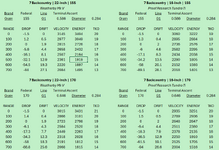
For those interested, I compiled data from one of the YouTube videos (link at bottom) where they shot all types of Federal ammo from both a 22-inch barreled Weatherby and a 16-inch barreled PROOF rifle. Let's keep the discussion away from "bash backcountry" and take the data for it is. If you spot any errors, please let me know and I will correct the dataset.

My wife and I have two 7 Backcountry rifles on order, which we should be receiving shortly after Thanksgiving. In turn, one of them is going to spend ~6 days in Prince William Sound, Alaska shortly afterwards on a Sitka Blacktail hunt.

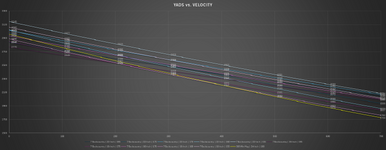
The yellow line is from Hornady's website for a 24-inch barreled 300 Winchester Magnum firing 180 grain CX bullets with a G1 of .469 and muzzle velocity of 2960.
1764024706005.png

Blue lines are 22-inch barrel and purple lines are 16-inch.

Source
youtube.com/watch?time_continue=766&v=7O_l5KZZ4JI&embeds_referring_euri=https%3A%2F%2Frokslide.com%2F&source_ve_path=MTM5MTE3LDI4NjYzLDI4NjYzLDEzOTExNywyODY2Ng

Edit #1 - Added pictures for the charts, as copy & paste didn't get the Excel formatting right.
 
7 Backcountry | 22-Inch | 1757 Backcountry | 16-Inch | 175
Weatherby Mk VProof Research Tundra Ti
BrandFederalLineFusion TippedBrandFederalLineFusion Tipped
Grain175G10.575Diameter0.284Grain175G10.575Diameter0.284
RANGEDROPDRIFTVELOCITYENERGYTKORANGEDROPDRIFTVELOCITYENERGYTKO
0-1.5029803450210-1.502850315620
1001.50.528153078201001.70.62690281119
20002.1265627401920002.32535249618
300-6.34.82502243218300-75.22385221017
400-18.28.82353215217400-20.29.52241195116
500-36.514.42210189816500-40.415.42101171515
600-61.921.42072166715600-68.322.81966150214
700-9529.81938145914700-10531.91837131113
7 Backcountry | 22-Inch | 1687 Backcountry | 16-Inch | 168
Weatherby Mk VProof Research Tundra Ti
BrandFederalLineBarnes LRXBrandFederalLineBarnes LRX
Grain168G10.513Diameter0.284Grain168G10.513Diameter0.284
RANGEDROPDRIFTVELOCITYENERGYTKORANGEDROPDRIFTVELOCITYENERGYTKO
0-1.5030203402210-1.502890311520
1001.40.528342995191001.60.62709273718
20002.4265526291820002.52535239717
300-6.35.42483230017300-75.72368209116
400-18.39.92317200316400-20.310.72207181615
500-36.916.12159173815500-40.717.22052157114
600-62.723.92006150014600-6925.41903135113
700-9733.61859128913700-107.636.11762115812
1764024907295.png
 
7 Backcountry | 22-Inch | 1557 Backcountry | 16-Inch | 155
Weatherby Mk VProof Research Tundra Ti
BrandFederalLineTerminal AscentBrandFederalLineTerminal Ascent
Grain155G10.586Diameter0.284Grain155G10.586Diameter0.284
RANGEDROPDRIFTVELOCITYENERGYTKORANGEDROPDRIFTVELOCITYENERGYTKO
0-1.5031453404200-1.503060322219
1001.20.529773049191001.30.42895288418
20001.92815272618200022736257617
300-5.64.42658243217300-64.62582229516
400-16.18.12507216416400-17.18.32434203815
500-32.112.92361191915500-34.213.52290180514
600-54.519.32220169714600-5820.12152159314
700-8427.12084149513700-89.128.12018140113
7 Backcountry | 22-Inch | 1707 Backcountry | 16-Inch | 170
Weatherby Mk VProof Research Tundra Ti
BrandFederalLineTerminal AscentBrandFederalLineTerminal Ascent
Grain170G10.646Diameter0.284Grain170G10.646Diameter0.284
RANGEDROPDRIFTVELOCITYENERGYTKORANGEDROPDRIFTVELOCITYENERGYTKO
0-1.5030153431210-1.502935325120
1001.40.428663101201001.50.52789293619
20001.92723279819200022648264718
300-6.14.32584252018300-6.44.42511238017
400-17.37.72449226317400-18.37.92378213516
500-34.312.32318202816500-36.512.92250191016
600-5818.32191181215600-61.519.12125170515
700-88.825.62068161514700-9426.62004151614
7 Backcountry | 22-Inch | 1957 Backcountry | 16-Inch | 195
Weatherby Mk VProof Research Tundra Ti
BrandFederalLineBerger Elite HunterBrandFederalLineBerger Elite Hunter
Grain195G10.755Diameter0.284Grain195G10.755Diameter0.284
RANGEDROPDRIFTVELOCITYENERGYTKORANGEDROPDRIFTVELOCITYENERGYTKO
0-1.5028403492220-1.502770332222
1001.60.527183197221001.70.52649303921
20001.8259829232120001.82532277620
300-6.742482266820300-7.142418253119
400-1972369243019400-20.27.32306230318
500-37.711.32259221018500-39.911.82198209217
600-63.216.82152200517600-66.817.42092189517
700-9623.32048181516700-101.724.21990171416

1764025022629.png

1764025042544.png
 
For those interested, I compiled data from one of the YouTube videos (link at bottom) where they shot all types of Federal ammo from both a 22-inch barreled Weatherby and a 16-inch barreled PROOF rifle. Let's keep the discussion away from "bash backcountry" and take the data for it is. If you spot any errors, please let me know and I will correct the dataset.

The yellow line is from Hornady's website for a 24-inch barreled 300 Winchester Magnum firing 180 grain CX bullets with a G1 of .469 and muzzle velocity of 2960.
View attachment 972660

Source
youtube.com/watch?time_continue=766&v=7O_l5KZZ4JI&embeds_referring_euri=https%3A%2F%2Frokslide.com%2F&source_ve_path=MTM5MTE3LDI4NjYzLDI4NjYzLDEzOTExNywyODY2Ng
Why the graph for yards vs energy when energy has nothing to do with killing.
 
Great data. Thanks for taking the time to share and so clearly as well. I’m debating a 16” vs 20” 7mm bc setup. This is very helpful.
 
A graph of yds vs velocity might be more helpful. Either way thanks for the breakdown of information.

Energy is useful for understanding the amount of work a bullet can do at impact. It certainly isn't the be-all end all, but it a useful data point.
 
Great data. Thanks for taking the time to share and so clearly as well. I’m debating a 16” vs 20” 7mm bc setup. This is very helpful.

Looking at the data I’m thinking. 18” would get most loadings to 600yds with good velocities. 500yds is more then enough for me. Interesting cartridge.
 
Great data. Thanks for taking the time to share and so clearly as well. I’m debating a 16” vs 20” 7mm bc setup. This is very helpful.
I'll be running suppressed in somewhat dense Alaskan islands, so I went with 16-inches to give a total effective barrel length of around ~22-inches. If you went with a 20-inch barrel, you'd be reaching out to around 26-inches suppressed. I found the velocities to be not that much different; I really don't think the animal is going to notice (as long as you're hunting with good bullets, shot placement, and critters this caliber is designed for).
 
So... range went well... sorta.

The Christensen Arms Titanium Ridgeline FFT was a little sticky on each ejection, with some worse than others. About round 7 or 8 the action seized and I had to get creative to open it. Once running again, I got another 3-4 shots off before it seized again. At this point, I put the rifle back in the truck. I will contact Federal to see if I can get a batch of the revamped ammo, which I have heard solves this. If that fails, I'll most likely re-barrel this action.

The Christensen Arms Evoke performed without issue, cycling through 7 or 8 shots without ever getting a sticky lift. In honesty, it felt about the same as my Christensen Arms Ridgeline 300 Win Mag. I plan to run more rounds through the Evoke to see how it performs. If I can get ~100 rounds off without any issues, I'll carry it.
 
Update to range…

Christensen confirmed that Federal changed the ammo spec and even the chamber spec. Initial advise, as I expected, was to inform Federal of the bad ammo lot and request the new stuff. If the new stuff failed to perform, they’d like the rifle back for diagnosis.

Federal Update: No new specs exist. They changed the load data, but stayed within original specs. No new chamber exists, however, some manufacturers may be cutting chambers too low on the spec sheet. They have shipped over 2 million rounds and only have a handful of complaints coming in. Federal advised sending it back regardless of how the new lot performs as the chamber (or other variable) is not right. The rep was awesome and immediately offered to replace the ammo with a new batch.

Interestingly, the CA rep mentioned that the 195 Bergers have the least issues. With that new info, I sent 18 down range yesterday with zero issues, outside of typical 7 BC sticky bolt issue (but NOT seizing). Final 3 shots average around 1/3-1/2 MOA at 100 yards.

As a WAG, I’m curious if a suppressor makes a difference? The 175 tipped were shot suppressed, while the 195s were not.
 
Update: Federal has already replaced my 170‑grain Terminal Ascent, though I’m still waiting on the 175‑grain Fusion Tipped. Since I never had the chance to run the original 170‑grain load before receiving the updated batch, I can’t offer a true before‑and‑after comparison. What I can say is that the 170‑grain rounds showed no noticeable increase in bolt lift or extraction effort compared to an empty chamber.

Once I get in the 175g, I'll report back (keep in mind the CA Evoke shot this stuff fine, only the Ti had an issue).
 
Kinda a crap shoot, honestly. When I arrived, a windstorm was already hammering the area, so we had to delay for three days while the waves sat at 8–12 feet. Three days after that storm finally passed, another one was projected to roll in with 8–10 foot waves. That basically cut our actual hunting window down to about two and a half days.

We managed to tag one doe between the two of us, which is about all you can ask for under the conditions we were dealing with. The deer weren’t responding to calls, daylight was limited to about six hours, and the weather kept cutting into our time. Pending our tag draws in February, the plan is to head to Kodiak next for a proper 7–10‑day stretch.

Next up is a hunter‑safety story. Interpret it however you want—pick it apart, analyze it, critique it. I’m sharing it as a cautionary tale for the next hunter who might find themselves in a similar situation.

As for the rifle—did it perform? Well, I never fired a single intentional shot. Yes… I meant intentional.

A bit of background: three years ago on Hinchinbrook Island, I carried a Remington 700 Dangerous Game in .375 H&H for a brown bear hunt. That trip taught me that nearly every branch in Alaska seems determined to disengage the safety or pop the bolt open for free. It’s one of the reasons I don’t carry R700‑style rifles chambered in the field—the safety design just isn’t ideal for the kind of brush and terrain we move through.

Fast‑forward to this hunt. It’s the last day, the storm has already pushed into the Sound, and we’ve got maybe 30 minutes of light left. The waves are stacking, and even the beach had little one‑foot rollers—just enough to make launching the dinghy “interesting.” We loaded our packs, checked safeties, and started hauling gear down to the waterline. I knew the rifle was loaded—we’d just finished calling and I’d forgotten to unload in the rush to beat the weather—but it was sitting on the dinghy with the safety engaged. I’d double‑checked it, and it was only a hundred yards to the main boat.

Once we reached the shoreline, I noticed the rifle starting to tip. With the dinghy’s ripped bottom letting in water, I didn’t want it getting soaked. I reached in and lightly grabbed the stock to reposition it… and bang. A round went off at an angle over the bow. No one was anywhere near the muzzle—I’d checked that before touching it—but it was still one hell of a wake‑up call. Somewhere in the span of a minute or two, something had managed to both disengage the safety and depress the trigger.

Long story short: I’m converting the Christensen Arms 7 Backcountry rifles to a three‑position Mauser‑style safety for an extra layer of insurance, and I’ll continue carrying on an empty chamber—aside from this very specific lessons‑learned scenario. I’m also phasing out the side‑safety designs (Tikka, Christensen, etc.) and moving my inventory over to Browning's with the thumb safeties.

And yes, this was a negligent discharge. It was 100% preventable, and that’s on me. If something can happen once, it can happen again, and I’d rather stack the odds in my favor.
 
Back
Top