6mm /.243 hunting success on Big Game

Not the numbers of other guys. This year I personally witnessed or shot.

1 Mule deer 22CM 77TMK - devastating at 150 ish yards, cantaloupe size wound channel, bullet base found off side hide.

2 Caribou 22CM 80 ELDM 500-550 yards, each received a couple rounds, neither travelled more than 10 yards, baseball size wound channels

1 cow elk 22CM 80 ELDM - not my best shooting 500 yards , heart shot immediately dropped her. Base ball through chest cavity

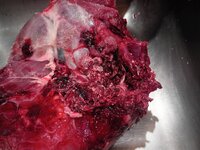
1 cow elk 300ish yards 6CM 108eldm. I didn’t spend much time w this one, hard to find entrance wound, liquified chest cavity except heart (I’m thinking pulmonary veins/arteries and onside lung) , maybe 30 yards travelled.

1 small bull elk 6CM 109 ELDM 225 yards 4 impacts (fast), it made a mess, I have no concerns.

1 caribou, 1 cow elk, 1 bull elk sitting shooting off vertical standing pack (not ideal) , to me no appreciable difference in maintaining sight picture between 6CM and 22CM.

I agree w @MX, no concerns w either. That being said if it was one or the other I’d absolutely go 6CM. More factory ammo choices, seems less picky on bullet choice, almost interchangeable ballistics, and double the barrel life.
I’m gonna have a hard time not grabbing the 6 Creed with 115 Bergers for killing.

Got a couple more big game kills on the agenda here soon and it’s getting the call again.
 
Jacket thickness mostly. Eldx should mushroom, somewhat stay together, and have much better weight retention. Eldm or the like violently expands shedding much of it's weight as it dumps massive energy several inches into the game. The shock and sheer trauma from the eldm is too much to take.... with proper shot placement.

It's a matter of do you want a possible pass through with deeper penetration and a relatively small permanent would cavity. Or do you want to dump all the energy at once with a massive permanent wound cavity?
Okay because the front half of those two bullets that actually does the expansion and shedding are pretty dang close, and the eld-m is closer to being a traditional cup and core bullet1765216811344.png
 
I finally have one small data point for this thread

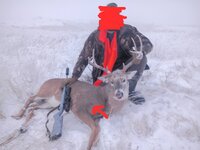
My lady killed her first deer this weekend, a button buck about the size of large dog.

.243 100gr Norma softpoint. 50yd shot, deer traveled about 50yd after the shot. The deer appeared broadside, but was quartered away.

Shot entered behind the near side shoulder and exited forward of the offside shoulder.

Caliber size entry, pingpong ball size exit. Lung material was blown out of the exit. She took out the top of the heart, but I didn't do much of a necropsy. No fragments were found during butchery.

 
Made a not so great shot on a buck that turned out ok and is a data point for the performance of the TMKs on heavy bone.

95gr TMK @ 2400 fps impact velocity. Shot taken broadside at ~150m leaned up against a fence.

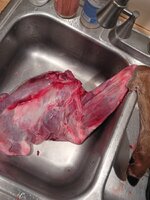
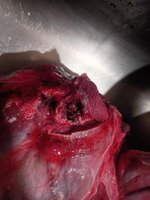
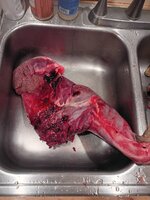
Impact low forward on the shoulder, ended up centered right on the joint. Blew right through it and and caused quite a bit of meat loss on the opposite quarter. He stood up on his back legs and flopped over with both front legs inoperable. Needed a second shot through the lungs to finish off.

IMG_20251126_075324493_HDR-EDIT.jpg

Impact side

IMG_20251201_215424032_HDR.jpg
IMG_20251201_215427587_HDR.jpg

Exit side

IMG_20251201_215257746_HDR.jpg
IMG_20251201_215309954_HDR.jpg
IMG_20251201_220806453_HDR.jpg
 
Any of you guys using the 80gr CX or GMX lead free option? I picked up some seconds and started playing with load development. They shoot lights out and my daughter is crushing deer with them. Usually bang/flop full pass throughs. I need to chrono them and see what they are doing out of the 243.
 
Shot a WT doe with the .243 at my parents farm over Thanksgiving, first kill with a 109 ELDM. Impact velocity around 2560.


Hit the humerus on entrance.
IMG_0991.jpegIMG_0993.jpeg


Exit side
IMG_0994.jpeg


She dropped in her tracks. There was a group of 6-7 does and fawns, the closest one probably 20 feet from her. They all all picked their heads up and looked uneasy at the shot, the closest doe walked over and sniffed at her, and then they went back to eating. Hunting suppressed is awesome 😎
 
Jacket thickness mostly. Eldx should mushroom, somewhat stay together, and have much better weight retention. Eldm or the like violently expands shedding much of it's weight as it dumps massive energy several inches into the game. The shock and sheer trauma from the eldm is too much to take.... with proper shot placement.

It's a matter of do you want a possible pass through with deeper penetration and a relatively small permanent would cavity. Or do you want to dump all the energy at once with a massive permanent wound cavity?

In theory yes. But I’ve actually seen the opposite. Seems like the 108 eldms stick together and have a smaller wound channel and penetrate more than the 103 eldx. Eldx is more explosive. Just what I’ve seen
 
In theory yes. But I’ve actually seen the opposite. Seems like the 108 eldms stick together and have a smaller wound channel and penetrate more than the 103 eldx. Just what I’ve seen
I believe it was @Formidilosus that had indicated that the ELDx is more expansive in the bullets that are 6mm and smaller. But the 6.5mm and up, you tend to see more expansion / devistation from the ELDm...
I could be wrong so I tagged him to make sure I have my poop in a pile!
 
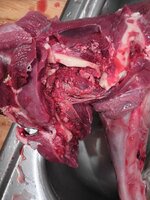
Cow elk. 243 win. 108 Eldm. 274 yards. Impact velocity around 2475 fps. She appeared broadside when I pulled the trigger. I hit further back than I intended but it worked out because she was quartering away when it hit her. The bullet entered the stomach. You could see green poop grass coming out of the bullet hole in the stomach. Parts of the bullet made into one lung. Definitely not lung soup like a lot of the other pictures in this thread. She traveled six yards and then dropped 5-10 seconds after the shot. She did have a little blood coming out her mouth so clearly some lung trauma. Still, I’m a little perplexed as to why she dropped so fast with such a poor shot. Thoughts? Also, those grayish/maroon spots on the lungs I’m assuming is just hemorrhage right? Not indicative of a disease process? Thanks.View attachment 981248View attachment 981249
Another reason the cow could have dropped so quickly is you also probably got a piece of the liver and then clearly perforated the diaphragm. A perforated diaphragm ultimately leads to 2 collapsed lungs and the stop working. If you take out a potential artery, perforated the diaphragm, nick or hit the liver and take out a lung... I would not make it long either!
 
I believe it was @formthat had indicated that the ELDx is more expansive in the bullets that are 6mm and smaller. But the 6.5mm and up, you tend to see more expansion / devistation from the ELDm...
I could be wrong so I tagged him to make sure I have my poop in a pile!

Yea that’s what I have seen. I believe it
 
Question for Rokslide: this was my first season exclusively using a 6mm (.243/103) felt that animals ran further, but were dead on their feet making tracking more necessary than when I used a 308.

This is completely anecdotal and a very small data set. Do you have any input on this theory?
I've used and seen mostly 243, with some 7 mag, 270, 300 WM, and 223 on many mule deer, and when taken as a whole the distance to incapacitation was more dependent on shot placement than caliber. Spine/neck shots dropped them where they stood, lung/heart shots made them run 20-60 yards before passing out from lack of oxygen, and bad shots (guts/lower leg) would do anything from go 5 yards and bed down to tracking up to a mile.

Only used/seen 243 on a handful of elk, with more shot with 7 mag, 30-06, 300 win mag, and once again shot placement seems to be more indicative of the animals response than caliber. Elk differ in that they sometimes stand and hunch up when hit.

On this topic, shooting suppressed makes a big difference in animal response, as animals tend to run less often, run shorter distances when they do (before stopping to look back), and run in directions other than away from you with a suppressor regardless of caliber.
 
I believe it was @Formidilosus that had indicated that the ELDx is more expansive in the bullets that are 6mm and smaller. But the 6.5mm and up, you tend to see more expansion / devistation from the ELDm...
I could be wrong so I tagged him to make sure I have my poop in a pile!

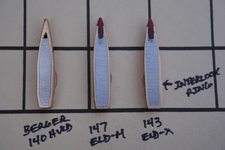
Most of the time like-ELD-M and X’s are nearly indistinguishable. However, it is all a bell curve. And where that bell curve on the left is “below the average expected upset range”- that is where you see a bit of advantage to ELD-X’s… and where some ELD-M’s show the issue.

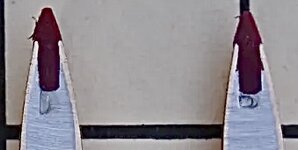
The main reason can be seen in @CJ_BG picture. 147gr ELD-M on left, 143gr X on right.

1765251205636.jpeg


The nose opening is much larger (relatively) on ELD-X’s than ELD-M’s. Notice the stem (shaft) of the tip is larger diameter on the X. Also, notice have the lead does not go all the way to the tip on the ELD-X, but does fill the entire nose cavity of the ELD-M. Also, look very close to the very tip of the jacket at the tip in the ELD-M- you can see it is ever so slightly thicker right at the end than it is below it-

IMG_2147.jpeg


This view shows it much better. .308 168gr ELD-M and AMAX in left, 178gr ELD-X in right. No comparison in the nose opening.

1765251716537.jpeg


All combined, this means when seen in large numbers of animals, ELD-M’s and X’s are similar. But, if there is one that produces a narrower wound than expected, it will almost always be the ELD-M. As well, often- depending on which model; the ELD-M will exit as much or maybe even a tiny bit more often than X’s.
 
I finally have one small data point for this thread

My lady killed her first deer this weekend, a button buck about the size of large dog.

.243 100gr Norma softpoint. 50yd shot, deer traveled about 50yd after the shot. The deer appeared broadside, but was quartered away.

Shot entered behind the near side shoulder and exited forward of the offside shoulder.

Caliber size entry, pingpong ball size exit. Lung material was blown out of the exit. She took out the top of the heart, but I didn't do much of a necropsy. No fragments were found during butchery.
Congrats to you and your lady, any first deer is great!
 
All combined, this means when seen in large numbers of animals, ELD-M’s and X’s are similar. But, if there is one that produces a narrower wound than expected, it will almost always be the ELD-M. As well, often- depending on which model; the ELD-M will exit as much or maybe even a tiny bit more often than X’s.

This seems counterintuitive given the relatively thinner jacket on ELD-Ms…thanks for the explanation
 
Back
Top