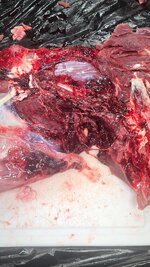
Yes. But with the deflection causing the nose to close up or slightly fold over generally.
Yes- but with angle causing the nose to close up or slightly fold over generally.
No, not usually.
All pointed bullets yaw in tissue unless they expand and create a relatively wide and flat front to stabilize themselves. The CG is past midpoint on the bullet (rear end weighs more), so they want to yaw and travel base forward. Yawing bullets generally create excellent wounds, however yawing is unpredictable at times. Rapid fragmentation from the front is about the most consistent and repeatable way for a bullet to upset.
It happens with all bullets at some point. Monos like Barnes TSX/TTSX, and Hornady CX this happens relatively often to. Most don’t see it when it happens because those bullets don’t fragment so they tend to exit. That’s generally where the larger than thumb size wounds from standard monos come from.
As for why with the ELD-X- again, it just seems to be tied back to the material the tip in Hornady ELD-M and X are made from. It’s brittle and seems to every once in a while break off creating what is functionally a FMJ… sort of. Now most of the time even when that happens, the bullet still upsets or yaws and good damage is created; sometimes not though.
Again this happens with all bullets at some point. The only reason this is being discussed more in this forum recently, is because tipped match bullets did not historically show the behavior. ELD-M’s do show it once in a while, and it appears that if everything goes right (wrong), then ELD-X too.
For those reading: don’t think your -insert whatever- “hunting” bullet doesn’t do it; the vast majority of “hunting bullets” are far worse in this behavior. Which is why those shooting at distance tend to favor “non hunting bullets”. When you actually see legitimate terminal ballistics testing conducted with large sample sizes, bullet failures are nearly always a failure to upset at all- not “blow up” and fail to penetrate.