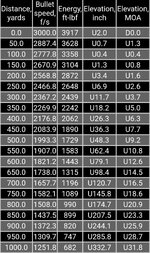
35 Whelen Max Effective Range

I'd wager that you could get a 196gr HHT bullet to 3000 fps with a number of powders.

The this is the ballistics chart for a 196HHT with 3000fps muzzle velocity @ 1,000' elevation.
 

Attachments

  • Screenshot_20260126_132120_Strelok Pro.jpg
    Screenshot_20260126_132120_Strelok Pro.jpg
    272.2 KB · Views: 6
My current 35 Whelen load in a 22" Bartlein barrel is a 225gr Accubond on top of Varget at 2,775. That gets me a little over 2,000fps, 2 mil drop at 400 yards and 1,875fps, 3 mil drop at 500 yards. 2,500ft of elevation. So I would say effective range is out to 500 yards.
 
It looks like the accubond and partition both have pretty good BC so it makes sense that they would hold on to velocity better. Similar in ballistic performance to the HHT but with more weight.
 
My current 35 Whelen load in a 22" Bartlein barrel is a 225gr Accubond on top of Varget at 2,775. That gets me a little over 2,000fps, 2 mil drop at 400 yards and 1,875fps, 3 mil drop at 500 yards. 2,500ft of elevation. So I would say effective range is out to 500 yards.
That is one stout load. About 1/2 mil less drop than my load, but 50% more recoil. 23”, 160g CE Raptor .335g1, 48g rl 7, 2850 MV. Could easily run it 3k if I wanted more speed/recoil, but minimum upset is 1500 and I am usually inside 250.
 
That is one stout load. About 1/2 mil less drop than my load, but 50% more recoil. 23”, 160g CE Raptor .335g1, 48g rl 7, 2850 MV. Could easily run it 3k if I wanted more speed/recoil, but minimum upset is 1500 and I am usually inside 250.
The interesting thing I have found with the recoil on the Whelen is that it is an elongated "push" recoil and not a sharp recoil like say my 300PRC. I also moved the rifle into a Foundation Gideon stock and shoot it suppressed.


It looks like the accubond and partition both have pretty good BC so it makes sense that they would hold on to velocity better. Similar in ballistic performance to the HHT but with more weight.

I would sure like to get my hands on some 225gr Partitions. They seem to be unobtainium.
 
That is one stout load. About 1/2 mil less drop than my load, but 50% more recoil. 23”, 160g CE Raptor .335g1, 48g rl 7, 2850 MV. Could easily run it 3k if I wanted more speed/recoil, but minimum upset is 1500 and I am usually inside 250.
That 160 CE Raptor is a bullet I've looked at extensively. Are you finding that the BC matches published info? I'm not calling them out, just curious if its as good as advertised.
 
That 160 CE Raptor is a bullet I've looked at extensively. Are you finding that the BC matches published info? I'm not calling them out, just curious if it’s as good as advertised.
I tested it once and I don’t remember which rifle, but I did not get the advertised bc. Could be twist dependent. I need to test it again as they are longer than the 200g ftx which I have tested and verified it is .3. It is possible that the 160 is as good as they say. I have 3 different twist barrels and speeds where I use this bullet, so I need to test BC in all 3. Just need it to warm up a little.

I do have to load it to a shorter oal than the 200g hornadys and 180g Speer. So in some cases (357 max) it’s actually hard to get it going faster as you run out of powder room. This is what drove me to try RL7 in the whelen. I wasn’t getting the speed I wanted in QL and thought, I need a faster powder. Looked at what I had and the RL7 seemed to fit. I was within 25 fps of the QL velocity and pressure is well below max. Then I ran the numbers in the recoil calculator and found the 35 whelen load is 100-150 fps faster and less recoil than the 358 jdj load I had been using. Sort of having your cake and eating it too. The 358 jdj uses 7 grains more powder for less velocity due to being limited to lower pressure, hence the increase in speed and reduction in velocity. I could up the speed more, but I don’t think it is needed at the ranges I hunt. Under 300 yards.

I have used the 160 on 5 deer so far and it’s worked well. I usually wait until they run a sale and then stock up. It’s quickly becoming my go to 35 cal bullet. It has shot well in all my rifles.
 
If the goal is maximum hunting range in 35 whelen, the CE raptor 160 gr doesn't strike me as optimal on paper, since it's both lighter and worse BC than other bullets we've just talked about. Or am I missing something? I'm sure it's a matter of choosing between many great solutions and determining what works in a given rifle, but it hadn't really even been on my radar. Not trying to knock the choice, just thinking out loud.
 
If the goal is maximum hunting range in 35 whelen, the CE raptor 160 gr doesn't strike me as optimal on paper, since it's both lighter and worse BC than other bullets we've just talked about. Or am I missing something? I'm sure it's a matter of choosing between many great solutions and determining what works in a given rifle, but it hadn't really even been on my radar. Not trying to knock the choice, just thinking out loud.
No offense taken. I agree it’s probably not maximum effective range, but it may be close since its minimum upset velocity is lower (1500) and can be pushed faster (3k+) due to being lighter. Its main advantage I see is less recoil. The 225’s do have better bc, by a bit, but that comes at the price of recoil. As I am sure many are doing now, suppressors are becoming common, so barrels will be getting shorter. I know I am looking at cutting down a couple 22” barrels to 18” as they are too long with a can. I think this will put a premium on slower upset velocity.

There is also the 175 bcb which has a little lower bc (.3), but even lower minimum upset (1200). That might even have a longer effective range as published load data is 3000+. That gives 1800 fps you can lose and still upset. Better than a typical cup/core.

Using published BC’s and assuming max range is limited by tof or range at minimum upset velocity, the 175 bcb is 725 yards to 1200, and 1/2 sec tof is 400 yards and 1 sec is 600. The 160 is 600 yards to 1500, 1/2 sec is 400, 1 sec is 675 yards. The 225 load at 2775 is 500 yards to 1800, 1/2 sec is just under 400 yards and 1 sec is 675 yards. All 3 loads should easily be good to 500 yards. The big difference is recoil. Assuming an 8 lb rifle, 175 bcb is 25.8 ftlbs, 160 is 20.4, 225 is 32.7. Maybe recoil doesn’t affect you, but I find I shoot better with less recoil.
 
Thanks for the thoughtful reply. I hadn't really considered low minimum upsets combined with higher muzzle velocity having that big of an impact on effective range but it does make sense once you lay it all out. I would not want to portray myself as a recoil-loving masochist by any stretch, but I do find my 25 whelen with a brake to be completely shootable if a bit kicky with the load I'm shooting now. If I didn't live in a state that outlawed suppressors, I'd have them on every rifle I owned. But a load that gets the range and has good performance at a lower recoil is certainly compelling.

You said it's worked well on 5 deer - what were those shots like and what was the result in terms of entrance/exit and blood trail?
 
Thanks for the thoughtful reply. I hadn't really considered low minimum upsets combined with higher muzzle velocity having that big of an impact on effective range but it does make sense once you lay it all out. I would not want to portray myself as a recoil-loving masochist by any stretch, but I do find my 25 whelen with a brake to be completely shootable if a bit kicky with the load I'm shooting now. If I didn't live in a state that outlawed suppressors, I'd have them on every rifle I owned. But a load that gets the range and has good performance at a lower recoil is certainly compelling.

You said it's worked well on 5 deer - what were those shots like and what was the result in terms of entrance/exit and blood trail?
Here goes. In all the cases we never found the bullet. All but the first one were two holes. Deer 1, broadside with 150g brass, 70 yards broadside, MV 2800, ran 100 yards, entry wound was the size of a Red Bull can, lungs were soup. Blood trail a blind man could follow, painted a tree red with blood. No exit. Deer 2 15 yards 160g, 15 yards, MV 1900 (357 max pistol), double lung, ran 20 yards, no blood trail. Deer 3, MV 2700, 175 yards, spine hit, dropped on the spot, never moved. Deer 4, 75 yards broadside, 2700 MV, double lung, ran 50 yards, nice blood trail. Deer 5, 2700 MV, 80 yard frontal shot, entered chest and exited through the femur, deer ran 50 yards with a non functional leg, no blood trail. That one was the only one we processed ourselves and the bullet entered the chest, then hit the femur, removing 3-4” of it before exiting. Only found a single petal left in the body. Lungs were soup and front leg was destroyed, not sure how it made it as far as it did.
As an adult onset hunter in my 50’s, that first deer surprised me when it wasn’t a bang flop like everyone talks about. That started my journey that eventually lead to Rokslide.

 
Thanks for the thoughtful reply. I hadn't really considered low minimum upsets combined with higher muzzle velocity having that big of an impact on effective range but it does make sense once you lay it all out. I would not want to portray myself as a recoil-loving masochist by any stretch, but I do find my 25 whelen with a brake to be completely shootable if a bit kicky with the load I'm shooting now. If I didn't live in a state that outlawed suppressors, I'd have them on every rifle I owned. But a load that gets the range and has good performance at a lower recoil is certainly compelling.
It’s been an interesting journey and unfortunately with only a few deer per year it’s hard to get real on deer performance data. This year was not so good. Our group got 2 deer, first one had two hits, but not sure which was which hit. So no real data. I was trying a 358 socom with the 200g ftx, still don’t know how that will work.

Second deer was a 360 bh pistol with 205g subs. That worked great. 10 yards and huge blood trail. Also stupid quiet. Sorry you can’t use cans, they really are nice.
 
Back
Top