243 Fury and 243 Fury AI

Joined
Aug 20, 2025
Messages
9
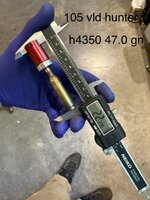
Ive been hot Roding the 277 fury sig brass for going on 3 years, from 22 creed to 8.6 and 308 and I can say hands down the easiest and best performance im getting is with 243. It's incredible easy to get to shoot well. All you need is a full length 260 sizing die and a full length 243 die and an annealer. For a barrel im using a factory 1/8 twist 243 tikka barrel. Here's some load data and results with a 105 Berger and h4350. obviously find the pressure your comfortable with. I started at 43 grains and went to 47.5 before backing off to 47 grains and seating it a CH off the lands.
 

Attachments

  • R0016793 copy.jpg
    R0016793 copy.jpg
    423.4 KB · Views: 69
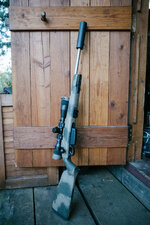
here's the rifle im using. with a 20 inch barrel its doing 3260. after getting it zero'ed. we plugged the data into AB and went to 741 on a zone steel and got a first round impact. I've shot this target a lot, with a lot of accurate and efficient set ups and never have gotten a first round impact on it. theres something magic about getting a 106mm going above 3200 FPS. I call this the 6 UM we have at home.

R0016797 copy.jpg
 
here's the load data if you anyone wants to give it a go. I currently have another factory barrel at UM getting chopped to 16 and rechambered to 243aI and throated a little bit. the hope is to match, or exceed this velocity, say around 3300 out of a 16 inch. IMG_1445.jpeg
 
You're not getting chamber etching? Or youre just going through cheap tikka barrels and dont care?
 
at this velocity and cost of barrels, im not super concerned with barrel life or the etching in the chamber. as the saying goes, im here for a good time not a long time, especially with hunting rifle barrels.
I dont think throat erosion is possible to be a problem with this cartridge. I did 2 barrels, neither chamber lasted 100 rounds.
Barrels have to be quite cheap at that rate.

I actually have another unfired and I'm still debating spinning it on and running non hybrid cases.
 
I dont think throat erosion is possible to be a problem with this cartridge. I did 2 barrels, neither chamber lasted 100 rounds.
Barrels have to be quite cheap at that rate.

I actually have another unfired and I'm still debating spinning it on and running non hybrid cases.
what were you loading? was the issue that you were having issues with extracting? do you know what case head stamp your brass had? ive shot thousands of rounds with the sig brass over the last few years, and haven't had issues with the chamber cutting.
 
what were you loading? was the issue that you were having issues with extracting? do you know what case head stamp your brass had? ive shot thousands of rounds with the sig brass over the last few years, and haven't had issues with the chamber cutting.
277 fury. With the hybrid brass from American reloading. Yes the chamber would etch, creat a line you can feel with a pick and you couldn't extract a case without a lot of effort.
Run the all brass case in the same barrel woth the etched chamber and it runs fine.
 
Honest question, and I'm not asking to be critical - the numbers you're posting here are fascinating.

I'm not afraid of 80kPSI. What I'm afraid of is 80kPSI in a rifle designed for 65k.

From a metallurgical standpoint - I am not an engineer but I kinda worked in that world for a while and there was a very common rule of thumb that a part or gadget that would fail catastrophically at, say, value X, would likely run forever at value 1/2X and the engineers I worked with would spec things to run at that 'forever' load point but in reality they often exceeded it and always got away with it, until they didn't, which usually occurred after the original engineer had retired and it was someone else's problem. If we apply that to rifle actions we would want to design a rifle action that would hold together up to perhaps 130kPSI in order for it to 'run forever' with 65kPSI ammo. Or, in terms I used to play with a lot, my old Ruger Blackhawk was, per John Linebaugh, good for about 65kPSI before the cylinder failed, so in theory we could run 32kPSI loads in it forever, and when I went through a phase of being enamored with big bore handguns that's what I did. And, yes, I exceeded that a few times, likely pushed it to nearly 40kPSI a very few times, but stopped that because there's nothing I could really do with a handgun at 40kPSI that I couldn't really also do just as well at 23kPSI. But I digress.

So, to apply the above to your project here: If it's true that the Tikka is a true 65kpsi action, then what you're doing is somewhere on a sliding scale between 'run forever' and 'suddenly gernade on you'. It's also possible that the Tikkas have been failure tested and are stronger than I assume. If they'd hold together up to 160kPSI then I'd be fine with the 80kPSI figure, assuming primers held and you don't get gas in your face.

So....either a) the rifle is rated to handle the pressures you're seeing, or b) you're at pressures that won't create instant failures but you're turning the receiver into a consumable with a finite life. My question is, do you know which it is, and if the latter, how many rounds before you cease to trust the receiver and retire it?

I'm not asking to be critical and I'm not asking from the standpoint of looking down my nose like I'm smarter than you. I think the project you're working on is incredibly neat. I'm simply wondering what the long-term implications are for the integrity of your rifle action.

 
in an industry like as dogmatic and content with status quo, innovation is only going to come if we force it.

as for the etching, in a chamber, I do believe that happens but with rejected brass from American Reloading, ive had crazy differences in case weight, sometimes as much as 20% differences. The first thing I do when I open up a box from American reloading is sort all the brass from by case head stamps. once I throwout all the weird looking stuff, I sort it by weight and throw out the outliers. Ive had good luck with the stuff marked 23 and 24. Then I size it. Ive shot it in Tikkas, Q fixes, Aero Solus and other r700 clones and haven't had issues.

I've also loaded thousands of NAS3 and had great results too. By staying with conventional rifle powders and just upping the charge, like with what I did here, youre not going to be at 120k psi. With sustained 80k psi you are not going to get a catastrophic failure, if anything youre going to get bolt set back.
 
Honest question, and I'm not asking to be critical - the numbers you're posting here are fascinating.

I'm not afraid of 80kPSI. What I'm afraid of is 80kPSI in a rifle designed for 65k.

From a metallurgical standpoint - I am not an engineer but I kinda worked in that world for a while and there was a very common rule of thumb that a part or gadget that would fail catastrophically at, say, value X, would likely run forever at value 1/2X and the engineers I worked with would spec things to run at that 'forever' load point but in reality they often exceeded it and always got away with it, until they didn't, which usually occurred after the original engineer had retired and it was someone else's problem. If we apply that to rifle actions we would want to design a rifle action that would hold together up to perhaps 130kPSI in order for it to 'run forever' with 65kPSI ammo. Or, in terms I used to play with a lot, my old Ruger Blackhawk was, per John Linebaugh, good for about 65kPSI before the cylinder failed, so in theory we could run 32kPSI loads in it forever, and when I went through a phase of being enamored with big bore handguns that's what I did. And, yes, I exceeded that a few times, likely pushed it to nearly 40kPSI a very few times, but stopped that because there's nothing I could really do with a handgun at 40kPSI that I couldn't really also do just as well at 23kPSI. But I digress.

So, to apply the above to your project here: If it's true that the Tikka is a true 65kpsi action, then what you're doing is somewhere on a sliding scale between 'run forever' and 'suddenly gernade on you'. It's also possible that the Tikkas have been failure tested and are stronger than I assume. If they'd hold together up to 160kPSI then I'd be fine with the 80kPSI figure, assuming primers held and you don't get gas in your face.

So....either a) the rifle is rated to handle the pressures you're seeing, or b) you're at pressures that won't create instant failures but you're turning the receiver into a consumable with a finite life. My question is, do you know which it is, and if the latter, how many rounds before you cease to trust the receiver and retire it?

I'm not asking to be critical and I'm not asking from the standpoint of looking down my nose like I'm smarter than you. I think the project you're working on is incredibly neat. I'm simply wondering what the long-term implications are for the integrity of your rifle action.

We use a 3:1 safety factor for 1million cycles for some common metal parts.

I know nothing about the firearm industry. I’d guess they’re as/more conservative due to dealing with the public, and the sheer quantity and exposure that creates.
 
Back
Top