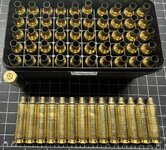
243 Brass Weight & Quality Comparison

Joined
Sep 8, 2014
Messages
2,285
Location
Front Range, Colorado
This thread is mostly a request for data. It's primarily for the purpose of predicting successful fire forming of 243 AI, but will hopefully also be good for standard 243 reference. There is a pretty significant difference in the capacity of different brands of 243 brass. So far, it seems that the lighter/thinner ones don't fire form as successfully as the thicker/heavier ones.
Can you add the following info?
  • Brand of brass
    • Average weight (out of 5 or so is fine)
    • Average number of firings before primer pockets are too loose
    • Any other brass issues to note (split necks, etc)
My hope is to identify a cheap brand of brass that fireforms well and will hold primer pockets for 10+ firings. If not, it will be back to Alpha or Lapua.

  • Alpha Munitions
    • 176 grains avg. ES of no more than 1.5 grains
    • 5 so far, pockets feel new still. Even when loaded a bit too hot.
    • Only come head stamped 260 Rem. Brass are a smidge longer than others. 100% fire forming success out of 100.
  • Federal
    • 175 grains avg.
    • 4 firings so far, not enough data to know for sure.
    • A couple split necks, minor splits only. Reputation for soft case heads, not sure on that yet.
  • Winchester
    • 160 grains average
    • 3 so far, not enough data to say.
    • 50% failure rate in fire forming. Completely ruptured shoulders.
 
What is the firing load in regards to primer pocket life? Even great brass is gonna suck if you stand on it, so if you're wanting to collect some data what parameters do you want? You should specific LRP and SRP also.

I had a bunch of LRP dogtown ammo / once fired brass which is supposedly nosler that I'll be shooting through mine initially because I already had it. Only shot 40 through so far but all formed fine, no formed firings yet.

Starline I think would be the one to try out to see how it holds up as a mid cost/quality brass.
 
Hopefully the fire forming doesn't mean much. I've been using a pretty mild load for it that produces very low pressure signs. That's an important detail, please include the load and velocity for the primer pocket data. There could be a lot of variation there for sure.

40 with no failures is a good sign.

That's what I'm thinking as well. I'm debating between that and forming the rest of the Federal I have on hand.
 
Back
Top