Nomosendero
Lil-Rokslider
- Joined
- Apr 21, 2021
- Messages
- 293
I think you got lucky killing that Squirrel with a 77TMK, I use a .458 Lott!

Follow along with the video below to see how to install our site as a web app on your home screen.
Note: This feature may not be available in some browsers.
It's not a matter of ethics. Common sense will tell anyone that a larger caliber will be more effective than a smaller one. Otherwise we'd all be hunting with .22 LR's or better yet, .177 air rifles.
Again, I ask, what's the point? So far, nobody has answered that.
Welp, I'm off to hunt rhinos with a blowgun, just to see if it can be done. Wish me luck!
I wouldnt want a .223 to fight off a large brown, polar, or grizzly bear but it would sure beat a sharp stick.
Haha!
Sent from my iPhone using Tapatalk


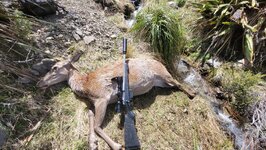
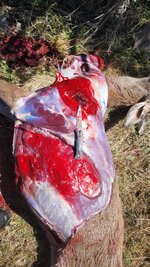
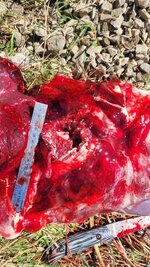
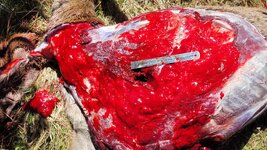
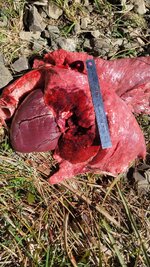
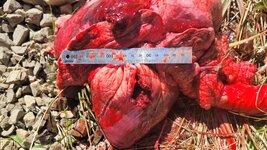
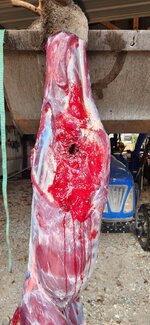
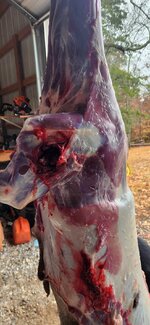
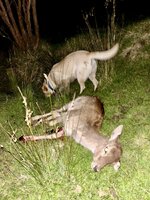
If I could get consistent exits, I would keep using them. Unfortunately, I’m 100% at no exits on deer I’ve shot. My search continues for a better bullet for my 223.My boy got another one this morning same as yesterday. This was a small 8pt. 16" Tikka 223 with 77tmks over 24.2gr varget in starline brass. He bucked when shot and we watched him fall 25yds past that. For southern whitetails, not sure what else you would need. I think I'll be building a left handed version with a Maven instead of the trijicon.
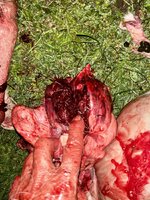
Entrance wound under the shoulder and exit through the offside shoulder.
Maybe a nosler partition?If I could get consistent exits, I would keep using them. Unfortunately, I’m 100% at no exits on deer I’ve shot. My search continues for a better bullet for my 223.

If I could get consistent exits, I would keep using them. Unfortunately, I’m 100% at no exits on deer I’ve shot. My search continues for a better bullet for my 223.

It’s not common sense. It’s a position taken in what people think would be the case because they’re missing many factors that come into play when it comes to terminal performance. The biggest bullet failures I’ve seen on game was a 300 RUM shooting 180 grain bullets. Bullet diameter is a minimal part of the equation for bullet performance. The two biggest factors are impact velocity and bullet construction. These need to be paired together to produce the desired results. The problem with this is we have 100% control over the bullet we choose so we get the construction we want. What we can’t completely control is impact velocity. Rarely, if ever will a hunter know the exact distance they will be shooting and thus we can’t control impact velocity as it’s dependent on shot distance. From what I’ve seen from following this whole thread is the 77 TMK has a broad impact velocity range where it has been proven to perform great on game from a 223. I have my doubts on its ability to perform the same at close ranges if it’s used in a 22 creedmore or a 220 swift at much higher velocities. The point is that this combination has been proven to be effective on game when used within its impact velocity window. Every combination in every caliber has an optimum velocity window so larger calibers also have these limitations. On the edges of these velocity windows the combinations can still produce the desired results but if we stray too far we can have complete bullet failures and lost game which is what happened with the 300 RUM example I referenced earlier. So to answer your question of what’s the point? The point is this is a proven combination, it’s effective. What else should we be looking for when trying to take game? Many people are choosing this combination for just that reason. I’ve never even fired a TMK but after seeing the results here I’m considering using it, while not in a 223 or 5.56 but in another smaller caliber at approximately the same muzzle velocity. I have tons of other options of larger calibers but I’m considering this combination for Wisconsin whitetails purely from a performance standpoint. I have nothing to prove by using a “smaller” caliber. I’m considering this because of the examples shown in this thread make me believe it’ll serve my purposes perfectly from zero yards out to the maximum range I’d ever expect to be shooting a deer and that’s something that has been a struggle with many of the larger calibers. Sure they’ll perform well at a distance where impact velocity is slower but finding a bullet that’ll perform from zero to max shot distance is not always an easy task.
Sent from my iPhone using Tapatalk
The post you quoted was from 5 years ago by a guy that I think has been banned for a while now.
Genuine question- why does exit matter to you?If I could get consistent exits, I would keep using them. Unfortunately, I’m 100% at no exits on deer I’ve shot. My search continues for a better bullet for my 223.
Because I can’t find it if it doesn’t bleed. Two holes have always given me better blood trails.Genuine question- why does exit matter to you?
I’m gonna give 70 grain Accubonds a try this season. I’m just waiting on the season to open.Maybe a nosler partition?
Don’t know. I haven’t shot anything with that bullet over 150 yards. I’m 2800 fps at the muzzle.What's your impact velocity been? I mean we have basically been point blank range but we have a 16" barrel.
They're killers. I have them to swap too if I ever run out of 77tmkLong ass thread and very interesting with solid results. Haven't read through the whole thing but checked out many of the pics from the “cheat sheet”. Seems like a lot of 77 TMK results.
Any use the old 75 gr Amax? I still have a ton of those sitting around and have them loaded to 2900 fps out of my Tikkler. If I can get a draw, I'd love to be able to gun one through an elk or Muley. They shoot lights out so reluctant to go stock up on TMKs if they're both basically apples-to-apples.
Aha!Saw the impact at the shot, he hopped and then started staggering right away, I was tracking him in the scope waiting for him to stop (he was coming my way) and as soon as he stopped I was pressing the trigger and he fell as the trigger broke and I grazed his back on that shot