Legal, yes, but context could leave someone open to legitimate suspicion by game wardens or other law enforcement. If I'm tagged-out but still carrying a gun around, and not specifically in grizzly or grow territory, it could be interpreted as hunting without tags - especially if I have game processing gear on me for helping with a friends' animal.
The more work I have to do, the more desirable and useful a handgun is. Gates, livestock, fencing, firewood, getting in and out of vehicles repeatedly, on and off horses, loading up, unpacking, etc - having two hands free and not having a rifle banging around or tempting me to put it down all lend toward having an OWB handgun on me. That includes gear selection that enforces that - not putting it on the pack's waistbelt, but having it in a chest harness or separate belt that doesn't get taken off until bedtime.
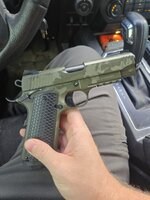
No question, in a fight the rifle's preferable by far, but balancing out everything, the handgun is always on me. And that's an aspect of why I've always put so much work into handgunning - the handgun is always there, and in the vast majority of circumstances will not be a backup, but the one and only fighting firearm available. The greater the likelihood of a problem though, the more the rifle will be there too.
As mentioned, this really is a common and understandable thing for people to think, until they shoot them. The reality is that they're long, the balance point moves way further forward and gives the muzzle a lot more leverage against your wrists, which actually makes the recoil dynamics (and hence their shootability) a lot more awkward with a lot more activity in your sight picture/dot. They're also damn near impossible to conceal, and OWB holsters are almost never made specifically for a given handgun and its attached, specific suppressor.
Because of the dynamic effects, it makes them useless for handgun training - draw, fire, and manage recoil unsuppressed vs suppressed essentially make for entirely different weapon systems. It's like going from a sports car to a truck, at speed. A better analogy might be like having a sports car, and then hooking up a heavy trailer to it - it changes the experience and performance entirely, including introducing some elements that can get you into unexpected trouble.