1911’s in general, 9mm versions specifically

Man, this is such a supremely good insight. And it's not one I can ever recall hearing before. Been on both sides of this experience, and it's so true. A gun you just like, or enjoy, or especially take pride of ownership with...you'll definitely want to shoot it more. That helps in general, but also, it can definitely help get you past rough spots and training plateaus too.


Point of disagreement here, that I'll offer up for consideration on the subject, in case anyone has or is thinking of getting a DA/SA gun.

My take with DA/SA triggers has always been that if I have distance enough to need precision, I have time enough to cock the hammer back with my thumb - the exact same way I did hundreds of thousands of times in dry-fire practice across years, over and over and over, every session, every time I dry-fired the trigger. I'm not racking the slide every rep, I'm cocking the hammer back with my thumb every rep. Manually cocking the thumb to get the precision of the SA trigger is a total non-issue, no more so than the concern of disengaging a safety on an SA-only gun. And if I don't have time, I'm in point-shooting distance and that DA pull isn't enough of a handicap to matter, especially for only that first round.

All that is also separate from tens of thousands of DA dry-fire repetitions as well. I might feel entirely different about this if there were competition rules that required a DA pull on the first round, handicapping me, but as an EDC or woods gun, it's just not an issue.

Separately, if I'm appendix carrying, I've never hesitated with concern in carrying hammer-down with a long 8-10lb DA trigger, the same way the striker-fired guns give me pause for the same reason as you put it, them being pretty unforgiving of user error.
I believe SA/DA has its place and often carry one as well. Second strike capability (albeit rare) HAS happened and been useful, exposed hammer holstering safety (thumb preventing hammer from cocking), and to your point, SA is always an option time pending (just like a revolver). Not always my top choice, but I do like them and for certain use cases, they have their place as well.
 
Man, this is such a supremely good insight. And it's not one I can ever recall hearing before. Been on both sides of this experience, and it's so true. A gun you just like, or enjoy, or especially take pride of ownership with...you'll definitely want to shoot it more. That helps in general, but also, it can definitely help get you past rough spots and training plateaus too.


Same. I've never heard it and it makes a lot of sense. I've never been particularly excited about the Glocks I shoot. I just knew they worked and if I put in my time they would do what I wanted. The excitement came from grinding out the practice to build a skillset most don't possess. I could also afford three of them: carry, back up carry, and competition.

At this point I could afford most any gun and when holding those Staccato pistols it is a world apart. I am actually excited about finding one and learning to use it. Weird.
 
Man, this is such a supremely good insight. And it's not one I can ever recall hearing before. Been on both sides of this experience, and it's so true. A gun you just like, or enjoy, or especially take pride of ownership with...you'll definitely want to shoot it more. That helps in general, but also, it can definitely help get you past rough spots and training plateaus too.


Point of disagreement here, that I'll offer up for consideration on the subject, in case anyone has or is thinking of getting a DA/SA gun.

My take with DA/SA triggers has always been that if I have distance enough to need precision, I have time enough to cock the hammer back with my thumb - the exact same way I did hundreds of thousands of times in dry-fire practice across years, over and over and over, every session, every time I dry-fired the trigger. I'm not racking the slide every rep, I'm cocking the hammer back with my thumb every rep. Manually cocking the thumb to get the precision of the SA trigger is a total non-issue, no more so than the concern of disengaging a safety on an SA-only gun. And if I don't have time, I'm in point-shooting distance and that DA pull isn't enough of a handicap to matter, especially for only that first round.

All that is also separate from tens of thousands of DA dry-fire repetitions as well. I might feel entirely different about this if there were competition rules that required a DA pull on the first round, handicapping me, but as an EDC or woods gun, it's just not an issue.

Separately, if I'm appendix carrying, I've never hesitated with concern in carrying hammer-down with a long 8-10lb DA trigger, the same way the striker-fired guns give me pause for the same reason as you put it, them being pretty unforgiving of user error.

I’m a bit hesitant to respond as I do not want this to be an argument, or taken poorly. Most of what you write is spot on, and I don’t want to be rude, but this gives me “WTF, 2002 wants their pistol shooting ideas” back. Cocking a pistols hammer is in no way the same as a thumb safety.
There are about 0 people under stress that cock the hammer of a DA/SA pistol even when that was an “idea” and trained some places 25 years ago. Missing with a DA is not about distance, time, or anything else. It’s about that 2 vastly different trigger pulls is objectively a hindrance to performance for no good benefit. Pistols are difficult enough for people to gain any competency whatsoever in, adding a DA/SA trigger doesn’t make it twice as hard- it exponentially makes it more difficult in training, practice, and stress.

Your use of “point shooting”- I actually don’t know how to respond to that. “Point shooting” at anything other than out of eyeline contact shots has been so thoroughly proven to be an extremely poor thing in actual measured shooting tasks, that it’s hard for me to square your general solid thoughts on pistols with it.

I don’t want to write a 10 page dissertation about it, and I certainly am not meaning this to be an appeal to authority, but point shooting, cocking the hammer of a DA/SA, “Israeli carry”, not being able to see your sights under stress, etc, etc. we’re all trained and used in places, were tested ad nauseam, measured directly side by side with every other technique, and all have been proven to completely fall apart under high stress pressure testing. Not one legitimate entity or place that takes shooting a pistol seriously under stress uses any of those things any longer.

Empirical evidence has lead all roads to solid, optimized on demand gun handling, two handed thumbs forward grips, every shot aimed from contact to max range, CNS or at worst very high center chest/spine targeting.
 
CNS or at worst very high center chest/spine targeting.
If I interpreted this correctly then the data says that shooters should target the head/neck in combat pistol shooting, only taking a high center chest shot when either capabilities or shot presentation don't allow for the former?

Obviously high cns hits stop threats the fastest I just don't know enough about combat pistol shooting to have a say in the smaller target being hit consistently enough under pressure to offset the size compared to the aforementioned high center chest shot.
 
If I interpreted this correctly then the data says that shooters should target the head/neck in combat pistol shooting, only taking a high center chest shot when either capabilities or shot presentation don't allow for the former?

Obviously high cns hits stop threats the fastest I just don't know enough about combat pistol shooting to have a say in the smaller target being hit consistently enough under pressure to offset the size compared to the aforementioned high center chest shot.
Take your noggin spin it on vertical axis and compare it to actual vital zone on your chest, ain't much different. Could be I just have a fat head. One is an instant stop mechanism, the other isn't.
 
High COM is how I've trained. I'm responsible for every round I fire and keeping them on target is critical is my rationale.
 
I’m a bit hesitant to respond as I do not want this to be an argument, or taken poorly. Most of what you write is spot on, and I don’t want to be rude, but this gives me “WTF, 2002 wants their pistol shooting ideas” back.

I literally laughed out loud when I read this. We're good, no offense taken, and when you put it that way I do actually see where you're coming from, as it did sound pretty 2002.

There are about 0 people under stress that cock the hammer of a DA/SA pistol even when that was an “idea” and trained some places 25 years ago.

The problem here, is that I've done it several times "under stress and on demand", including a 1-round hit on a running coyote at about 60 yards chasing one of my horses I had at the time. Granted, that's certainly not the same thing as being on a 2-way range, but thumbing the hammer for a first-round SA trigger pull is a viable option if you need to make a precision shot with a DA/SA gun, with little time to make it happen. That horse was panicking and was headed for barbed-wire, 5-figure disaster.

Keep in mind that my use of the technique is context, judgment, and discretion-dependent, at levels that may not be appropriate to ask of a new shooter, or as part of instruction in a 101-level handgun class. I personally would argue that manually engaging SA on an DA/SA gun, however, is a basic-level skill that should be taught from the beginning. I have noticed a couple of times, that when the two of us have disagreed on pistol stuff, that that aspect seems to be in there somewhere - one of us knowing a technique is perfectly valid and viable based on personal, sometimes real-world experience, and the other voicing objection not actually on whether its viable, but whether it's something that is appropriate for newer or lesser experienced shooters.

The front-sight focus vs "soft focus/target focus" thing in another thread is a good example of that, which is related to the point-shooting comment here...


Your use of “point shooting”- I actually don’t know how to respond to that. “Point shooting” at anything other than out of eyeline contact shots

Yes, "point shooting" is antiquated and invalidated term, used as short-hand here - my bad. In this context I meant it within the spectrum of contact-distance shooting, through covering the 2-3 yard target with the back of the slide as an "aiming" method, to the flash-sight-picture at 3-4ish yards, to the soft-focus/semi-focus/front-sight focus out to 5-7 yards, depending on the dynamics of the reality of that moment. Should not have used the discredited term, as it didn't describe what was meant. I'm actually a little embarrassed, as you're right - "point shooting" has been thoroughly discredited.

To my point though, out to 5-7 yards and through that spectrum of aiming solutions - the choice of which is dictated by the immediacy and nature of the threat in that moment - DA isn't handicapping me enough within the time and accuracy needs of that moment to warrant thumbing the hammer. And if the choice beyond 7yds is a possible miss with the first round on DA and just hope no innocents or property are damaged, or thumb the hammer and execute a CNS shot to end the threat as fast as possible, I'm thumbing the hammer. If I have any degree of the initiative, or if any degree of precision is needed, that gun goes into SA mode manually and is used like any other SA gun. Because I've personally validated it in my own reality, multiple real-world times, twice in very high-stress, high-consequence events.

Now, if you wanted to say that it may not be the best approach to teach a new shooter, there may be some validity to that. But it's highly arguable. You let the mindset craft the skillset around the toolset for the mission and job at hand - so if someone is using a DA/SA gun, when precision is necessary the skillset of thumbing the hammer is a proven and necessary one. Going all the way back to the advent of DA revolvers. Thumbing the hammer back is just a non-issue, second nature, no-brainer kind of thing. It only seems weird in comparison to other gun designs that came later.

You go DA when you are in point/contact/conversational distances facing immediate violence, but for God's sake, be responsible with your shots with maximum precision any time you are afforded the ability to do so, by going SA. DA is not the primary mode of fire, it's the "oh $h*t I'm about to die" mode when you have zero time and distance to do anything else, and the initiative has been taken from you. Speed, surprise, and violence of action come with having the initiative, and are SA. "Do you know why I pulled you over today? WAIT OH CRAP DROP THE GUN!" is DA.

But I went away from DA/SA guns because I didn't want to have to f*ck around with all that.

It is simply better to get the best tool for the job, and until some of the SAO designs of the last few years came out, I've simply never found striker-fired guns to be better at making consistent, fast hits from contact-distance to 100 yards better than DA/SA guns. But as a woods gun or edc? I'd take a hammer-fired DA/SA Sig over any striker fired gun I've ever put any time into, save possibly a couple of the P365 variants.

“Israeli carry”

Dude bro, that was just a low-down, dirty ol' below-the-belt mean punch right there, man. *grin*. Besides, ain't no bouncy houses around to practice that patented bob-n'-weave CQB thing they 'teach'.

 
Just finished reading this entire thread and I have a few questions. I’m not an experienced pistol shooter and have never handled a 1911 so these may seem very fundamental or stulid questions to those more experience with the pistol.

From what I’ve gathered in this thread, some of the things that make the 1911 an easy to shoot pistol is the trigger, slimness of the grip as well as the grip angle.

I don’t think I’ve seen the weight mentioned as a reason why the 1911 is an easier pistol to shoot. Does this come into a play at all?

Similar to light rifles are more difficult to shoot precision shots with compared to heavier rifles, I would suspect the same thing applies to pistols, is this true? How much less perceived recoil does a 1911 have over a Glock 19 or Sig 365?

On the other hand, the weight also seems to be a drawback for people who want an EDC pistol. Is there such a thing as a polymer 1911 (or as many components as possible being polymer) to help reduce weight? I suspect this has been prodiced before, but I don’t think I’ve heard of a polymer 1911. If it has, is the weight savings significant? Are there reliability issues with polymer 1911s?
 
Just finished reading this entire thread and I have a few questions. I’m not an experienced pistol shooter and have never handled a 1911 so these may seem very fundamental or stulid questions to those more experience with the pistol.

From what I’ve gathered in this thread, some of the things that make the 1911 an easy to shoot pistol is the slimness of the grip as well as the grip angle.

I don’t think I’ve seen the weight mentioned as a reason why the 1911 is an easier pistol to shoot. Does this come into a play at all?

Similar to light rifles are more difficult to shoot precision shots with compared to heavier rifles, I would suspect the same thing applies to pistols, is this true? How much less perceived recoil does a 1911 have over a Glock 19 or Sig 365?

On the other hand, the weight also seems to be a drawback for people who want an EDC pistol. Is there such a thing as a polymer 1911 (or as many components as possible being polymer) to help reduce weight? I suspect this has been prodiced before, but I don’t think I’ve heard of a polymer 1911. If it has, is the weight savings significant? Are there reliability issues with polymer 1911s?

Form makes a great point about the blockiness/square-sidedness(?) of 1911s being a big part of their shootability, and how it helps keeps consistency in your grip and how that impacts sight alignment, etc, combined with the grip angle and the trigger. Something to the effect that the more curves a grip has, the easier it is to make unintentional inputs with your hands that move the sights off. I'd actually enjoy seeing him elaborating on that, because it's not something I've heard much about but makes a lot of sense.

Weight can help a bit, and can help a lot when you get into big full-sized guns, especially gamer guns, but the differences are going to be a bit less pronounced with something you'd consider for EDC. Generally speaking, with compact versions of any gun the recoil can get pretty snappy compared to full-sized variants. I wouldn't say it's a major factor in stock single-stacks, but it's not nothing. Helps, but not major.

Regarding polymer-framed 1911s/2011s, most of them are actually a polymer grip-module that the serialized "fire control unit" is nestled in, and some of those can be comparable to polymer striker fired guns in general. IIRC, the Staccato C is about 26oz, and a Glock 19 is only about 2oz lighter.


EDIT: This is a really good thread from a few weeks back - lots of great content, and a bit more broad of a discussion on handgun selection: https://rokslide.com/forums/threads/most-reliable-and-shootable-9mm-semi-auto-pistols.401481/
 
I’m a bit hesitant to respond as I do not want this to be an argument, or taken poorly. Most of what you write is spot on, and I don’t want to be rude, but this gives me “WTF, 2002 wants their pistol shooting ideas” back. Cocking a pistols hammer is in no way the same as a thumb safety.
There are about 0 people under stress that cock the hammer of a DA/SA pistol even when that was an “idea” and trained some places 25 years ago. Missing with a DA is not about distance, time, or anything else. It’s about that 2 vastly different trigger pulls is objectively a hindrance to performance for no good benefit. Pistols are difficult enough for people to gain any competency whatsoever in, adding a DA/SA trigger doesn’t make it twice as hard- it exponentially makes it more difficult in training, practice, and stress.

Your use of “point shooting”- I actually don’t know how to respond to that. “Point shooting” at anything other than out of eyeline contact shots has been so thoroughly proven to be an extremely poor thing in actual measured shooting tasks, that it’s hard for me to square your general solid thoughts on pistols with it.

I don’t want to write a 10 page dissertation about it, and I certainly am not meaning this to be an appeal to authority, but point shooting, cocking the hammer of a DA/SA, “Israeli carry”, not being able to see your sights under stress, etc, etc. we’re all trained and used in places, were tested ad nauseam, measured directly side by side with every other technique, and all have been proven to completely fall apart under high stress pressure testing. Not one legitimate entity or place that takes shooting a pistol seriously under stress uses any of those things any longer.

Empirical evidence has lead all roads to solid, optimized on demand gun handling, two handed thumbs forward grips, every shot aimed from contact to max range, CNS or at worst very high center chest/spine targeting.

Was just getting my targets ready for the morning, and realized that actually defining precision might be worthwhile to the discussion, in terms of what people might be able to expect of a gun and putting in enough work. What "shootability" enhances.

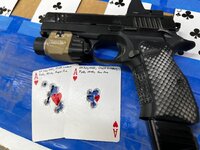
These are a couple of targets from this morning - both 15 feet/5 yards, off-hand, from low-ready, both 10 rounds each. Target on the left is rapid-fire (one string of 10 shots without lowering the gun, 10 second par), target on the right is slow-fire, untimed per shot, but 3 minute par for the full string).

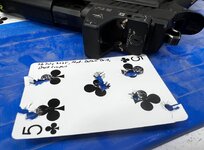
The 5 of clubs in the other photo was from a few days ago, and is one of my better Modified Dalton Drills lately. Two shots per club/spade, etc for 10 rounds, 30 second par, 15 feet, starting at low-ready. It's a tough one. Four didn't cut black, so it's pretty crap in technical terms, but they were close and the target was fast at around 20 seconds. These are all good days and a selection of great groups - it obviously doesn't always go like this, but it's what I personally mean by precision. Some guns assist in this, others get in the way.

BTW, for those who are a bit new to some of the discussion, the gun is a Dan Wesson DWX Compact. While it's not a 1911, DW essentially combined the trigger, internals, and basic slide lines of the 1911 with the grip ergonomics of the CZ-75 family, and made some significant improvements in reducing overall bearing/friction surface area, which helps with reliability. A best of both worlds kind of experiment, and so far it's been pretty good.


DWXc.jpegDalton Drill.jpeg
 
Take your noggin spin it on vertical axis and compare it to actual vital zone on your chest, ain't much different. Could be I just have a fat head. One is an instant stop mechanism, the other isn't.
Brain and neck size compared to torso.

Again just wondering what the actual data is saying. I, personally, not applying this to anyone else, always heard to go center mass because it's a larger target. Once again, I heard people who catch bullets in the meaty bits (usually) stop fighting back effectively.

But I never actually looked into the data from people doing combat with pistols, and have never been involved in a lethal combat scenario. As such my real world input on the matter is limited
 

Attachments

  • anatomy overlay.png
    anatomy overlay.png
    824.5 KB · Views: 17
Once again, I heard people who catch bullets in the meaty bits (usually) stop fighting back effectively

You can blow out a dude's heart, and have him literally be a dead man walking - and he still has about 15 seconds of oxygen in his muscle and brain to keep trying to kill you. The only thing that truly ends a fight instantly and safely for everyone around is a CNS hit.
 
I would still be confident to go up against most opponents one on one with my S&W model 15 with decent ammo.
 
Given the wide availability of body armor, I can see the logic behind aiming higher if I'm trying to stop a threat.
 
If I interpreted this correctly then the data says that shooters should target the head/neck in combat pistol shooting, only taking a high center chest shot when either capabilities or shot presentation don't allow for the former?

Obviously high cns hits stop threats the fastest I just don't know enough about combat pistol shooting to have a say in the smaller target being hit consistently enough under pressure to offset the size compared to the aforementioned high center chest shot.

Quite a few years back (I think the study was published in the 2015-2017 timeframe), the US military did a study on servicemember combat lethality in relation to weapons used vs shot placement vs shot distance vs time. Sadly, I don't actually have that study in front of me and it has been a few years since I read it, so the percentages below might be off slightly but they are close and I will try to find a digital copy and upload it so others can read through it as well or at least post the actual name of the study so they can look it up.

To roughly sum the study up, it found that at CQB ranges (roughly 5-15 yards if I remember correctly) when using rifles hits to COM resulted in a roughly 80% one shot stop rate (meaning the aggressor immediately stopped aggressive action) with each successive round increasing that rate proportionally (ie one round had an 80% chance of stopping the fight and two had a 96% chance and so on). In that same scenario, a head shot had a roughly 95% chance with each successive round increasing the rate proportionally. Using handguns, those numbers dropped to roughly 70% for COM and 90% for headshots. The researchers arrived at those numbers based off of studying after action reports from military and police shootings, so not the absolute best scientific technique but it's not like they could just go out and shoot random people.

The more interesting thing that the researchers found was that among average trained servicemembers with an infantry MOS, the difference in time to make a single head shot vs two COM shots was that the single head shot slightly faster on average than the two COM using a rifle at CQB distances with any additional follow up shots being roughly the same. Using handguns, the time difference for one head vs two COM was a slight increase with roughly equal follow ups. Among highly trained servicemembers (think Delta, SEALS, Rangers, etc.), the single headshot was faster with both rifles and handguns again with roughly equal follow up shots. This portion of the test was done in shoot houses designed for CQB training and other static ranges with targets being considered neutralized once a single headshot or two COM hits were recorded.

It also found that the average trained servicemembers had a higher chance of missing the headshot on their first round using a rifle vs missing with at least one of the COM shots requiring a follow up, and they were more likely than not to miss the headshot using a handgun, but with the higher trained service members the chances of a miss was roughly the same. For non infantry or special operations MOS servicemembers the two rounds COM was much faster and more accurate than the headshot using both rifles and handguns.

At longer ranges the lethality percentages and the times required for accurate hits changed for both handguns and rifles, which isn't really germane in this context but suffice it to say rifles are much more lethal and faster than handguns as the distance increases.

This study actually demonstrates why the standard training for both military and law enforcement focuses on aiming COM and firing until the threat is stopped vs aiming for a headshot. However, in more advanced training (like what Delta, Devgru, and other special operations/SWAT units go through) headshots are more likely to start becoming the preferred target at CQB ranges.

So basically, when starting out with a handgun practice for accurate COM hits as fast as you can make them and then when you become much more proficient (I would recommend waiting until you can perform sub 2.5 second Bill Drills "cold" on demand), then you can start practicing for headshots at the same speed.
 
Quite a few years back (I think the study was published in the 2015-2017 timeframe), the US military did a study on servicemember combat lethality in relation to weapons used vs shot placement vs shot distance vs time. Sadly, I don't actually have that study in front of me and it has been a few years since I read it, so the percentages below might be off slightly but they are close and I will try to find a digital copy and upload it so others can read through it as well or at least post the actual name of the study so they can look it up.

To roughly sum the study up, it found that at CQB ranges (roughly 5-15 yards if I remember correctly) when using rifles hits to COM resulted in a roughly 80% one shot stop rate (meaning the aggressor immediately stopped aggressive action) with each successive round increasing that rate proportionally (ie one round had an 80% chance of stopping the fight and two had a 96% chance and so on). In that same scenario, a head shot had a roughly 95% chance with each successive round increasing the rate proportionally. Using handguns, those numbers dropped to roughly 70% for COM and 90% for headshots. The researchers arrived at those numbers based off of studying after action reports from military and police shootings, so not the absolute best scientific technique but it's not like they could just go out and shoot random people.

The more interesting thing that the researchers found was that among average trained servicemembers with an infantry MOS, the difference in time to make a single head shot vs two COM shots was that the single head shot slightly faster on average than the two COM using a rifle at CQB distances with any additional follow up shots being roughly the same. Using handguns, the time difference for one head vs two COM was a slight increase with roughly equal follow ups. Among highly trained servicemembers (think Delta, SEALS, Rangers, etc.), the single headshot was faster with both rifles and handguns again with roughly equal follow up shots. This portion of the test was done in shoot houses designed for CQB training and other static ranges with targets being considered neutralized once a single headshot or two COM hits were recorded.

It also found that the average trained servicemembers had a higher chance of missing the headshot on their first round using a rifle vs missing with at least one of the COM shots requiring a follow up, and they were more likely than not to miss the headshot using a handgun, but with the higher trained service members the chances of a miss was roughly the same. For non infantry or special operations MOS servicemembers the two rounds COM was much faster and more accurate than the headshot using both rifles and handguns.

At longer ranges the lethality percentages and the times required for accurate hits changed for both handguns and rifles, which isn't really germane in this context but suffice it to say rifles are much more lethal and faster than handguns as the distance increases.

This study actually demonstrates why the standard training for both military and law enforcement focuses on aiming COM and firing until the threat is stopped vs aiming for a headshot. However, in more advanced training (like what Delta, Devgru, and other special operations/SWAT units go through) headshots are more likely to start becoming the preferred target at CQB ranges.

So basically, when starting out with a handgun practice for accurate COM hits as fast as you can make them and then when you become much more proficient (I would recommend waiting until you can perform sub 2.5 second Bill Drills "cold" on demand), then you can start practicing for headshots at the same speed.
Thanks for an actual data summary. This is what I was asking
 
You can blow out a dude's heart, and have him literally be a dead man walking - and he still has about 15 seconds of oxygen in his muscle and brain to keep trying to kill you. The only thing that truly ends a fight instantly and safely for everyone around is a CNS hit.
Obviously?
 
This study actually demonstrates why the standard training for both military and law enforcement focuses on aiming COM and firing until the threat is stopped vs aiming for a headshot. However, in more advanced training (like what Delta, Devgru, and other special operations/SWAT units go through) headshots are more likely to start becoming the preferred target at CQB ranges.


If you are referencing the CBA, it’s not publicly released, and those were not the conclusions.


Further, anything that is relying on someone’s memory, or perception is notoriously unreliable and more often than not inaccurate. There is no need for someone’s belief of opinion, or story. There are hundreds and hundreds of videos of shootings that anyone can watch and see what happens when people are shot.


So basically, when starting out with a handgun practice for accurate COM hits as fast as you can make them and then when you become much more proficient (I would recommend waiting until you can perform sub 2.5 second Bill Drills "cold" on demand), then you can start practicing for headshots at the same speed.

What is the percentage of people- including “Delta, Devgru, and other special operations/SWAT units” that you believe are doing sub 2.5 sec clean bill drills cold on demand?
 
If you are referencing the CBA, it’s not publicly released, and those were not the conclusions.

It wasn't the CBA because read it well after I left the military and overseas contractor world and it was definitely in a publicly accessible journal aimed at the DIB. I am fairly certain that I still have a copy of it on my reloading bench so I'll check when I get back home.

Further, anything that is relying on someone’s memory, or perception is notoriously unreliable and more often than not inaccurate. There is no need for someone’s belief of opinion, or story. There are hundreds and hundreds of videos of shootings that anyone can watch and see what happens when people are shot.

Completely agree on that, and it is possible that those were included as well I just remember that it seemed to focus on AAR's.

What is the percentage of people- including “Delta, Devgru, and other special operations/SWAT units” that you believe are doing sub 2.5 sec clean bill drills cold on demand?

On demand with a handgun, people (or at least shooters) in general, probably well less than 1%. People in those sort of specialized units, I would guess around 40-50%, based on the time I spent training and deploying with them (which was only maybe 50 or so guys at that level). Probably around the same when you look at competitive shooters who actually train and compete regularly (ie someone who is a low level A or high B class USPSA or high level SS or low expert class IDPA shooter).

That was basically my way of saying don't train to make headshots for personal defense with a handgun unless you are one of the top .5% of shooters; and, even then be honest with yourself and understand that being able to make that sort of shot on a static range, or even in competition, is not the same as doing it in a life or death scenario.
 
Back
Top