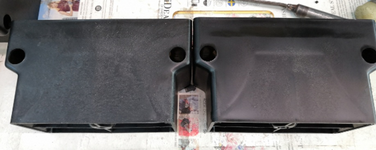
Why don't mid-range firearms manufacturers make 50% Glass filled Nylon stocks?

Macchina

Lil-Rokslider
Joined
Jan 16, 2015
Messages
172
I have been a Product Design Engineer for 20 years, my role for the last 13 years has been in high strength consumer products, most of them polymer (with some diecast aluminum, fabricated steel, and wood designs too).

I am always tinkering with my guns, and am shocked at the materials polymer stocks are made of. We do a lot of PA6 Nylon with glass fill. We use 10%-50% depending on the application. I've never done a burn analysis on a stock, but most appear to be made from 10%-15% Nylon and a few that were glass filled Polypro (we do this on parts that need to be low cost).

We use mid-grade polymers for most parts (mostly because the market demands some recycled content). 10% GF nylon is about $1.50 per pound and 50% is about $2 per pound. Polymer prices vary but the price of 50% vs 10% as you change the grade of base PA6.

A Ruger American synthetic stock weighs 1.8 Lbs, most are a bit heavier. So if we call it 2lbs the difference between going low glass and ultra-high glass is about $1 cost (throw another 50% in there for the cost of tool maintenance and the multiple profit margins and I'd say the cost to the end consumer would be about $3). The only negatives to 50% glass filled nylon are appearance (you see all that glass on the surface unless you flash cool the tool) and it is a bit less impact resistant. To me the appearance of high glass nylon would look great on a hunting rifle, and besides you can hide that glass with a heavy texture if you want. The pros are it is multitudes stiffer, stronger, and much less likely to warp during the cooling phase (the reason a lot of barrels touch the stock).

I had a 1.5lb 50% glass filled PA6 part once that the customer doubted was strong enough for the 350 Lbs load it was designed for. It was about the size of a rifle stock (it looked like a hollow banana sliced down the long axis). I made a video of me driving the front tire of my F150 over it and parking. It deflected about 1/4" under that load...

Maybe I missed it, but why have we never seen a high-glass Nylon synthetic stock??? Manufacturers could go 2 ways: they could make incredibly stiff stocks for $3 more to the customer or they could make ultralight stocks the weigh about 1Lb and cost the same as the standard flexible stock every manufacturer seems to sell.

Just my nerdy 2 cents....
 
Interesting write-up and question.

What was the Remington Nylon 66 22 rifle made of relative to what you're talking about?

Is the polymer separate from the glass fill (or CF fill) amount? I always assumed Nylon 6 e.g., was a glass filled nylon, but maybe that's separate from the Nylon itself (?).
 
FRP is a universe unto itself. As long as requirements are properly specified (and met), some pretty crazy stuff can be accomplished.
 
I have been a Product Design Engineer for 20 years, my role for the last 13 years has been in high strength consumer products, most of them polymer (with some diecast aluminum, fabricated steel, and wood designs too).

I am always tinkering with my guns, and am shocked at the materials polymer stocks are made of. We do a lot of PA6 Nylon with glass fill. We use 10%-50% depending on the application. I've never done a burn analysis on a stock, but most appear to be made from 10%-15% Nylon and a few that were glass filled Polypro (we do this on parts that need to be low cost).

We use mid-grade polymers for most parts (mostly because the market demands some recycled content). 10% GF nylon is about $1.50 per pound and 50% is about $2 per pound. Polymer prices vary but the price of 50% vs 10% as you change the grade of base PA6.

A Ruger American synthetic stock weighs 1.8 Lbs, most are a bit heavier. So if we call it 2lbs the difference between going low glass and ultra-high glass is about $1 cost (throw another 50% in there for the cost of tool maintenance and the multiple profit margins and I'd say the cost to the end consumer would be about $3). The only negatives to 50% glass filled nylon are appearance (you see all that glass on the surface unless you flash cool the tool) and it is a bit less impact resistant. To me the appearance of high glass nylon would look great on a hunting rifle, and besides you can hide that glass with a heavy texture if you want. The pros are it is multitudes stiffer, stronger, and much less likely to warp during the cooling phase (the reason a lot of barrels touch the stock).

I had a 1.5lb 50% glass filled PA6 part once that the customer doubted was strong enough for the 350 Lbs load it was designed for. It was about the size of a rifle stock (it looked like a hollow banana sliced down the long axis). I made a video of me driving the front tire of my F150 over it and parking. It deflected about 1/4" under that load...

Maybe I missed it, but why have we never seen a high-glass Nylon synthetic stock??? Manufacturers could go 2 ways: they could make incredibly stiff stocks for $3 more to the customer or they could make ultralight stocks the weigh about 1Lb and cost the same as the standard flexible stock every manufacturer seems to sell.

Just my nerdy 2 cents....


Part of the issue is that the gun-manufacturing industry has been almost entirely based around 1960s manufacturing concepts, thinking, and approaches - it's practically been a hermetic bubble of industry, impervious to what other fields are doing. Polymers were the first to really get through, but other than that, it's just been a different world.

Plenty of niche corners in it have tried different things, but it just never seems to go mainstream - bizarrely so, given the performance benefits and even manufacturing efficiencies, and as you mention, what are often marginal costs in doing better. Only in the last 5 years or so have we started seeing 3D printing and high-performance tribological coatings begin to become normalized on guns though - stuff that you could get on drill-bits 25 years ago.

Some of the more interesting stuff has been occurring when precision, high-tech manufacturers have decided to get into the gun and gun-parts game - it's particularly prevalent in the 2011 space, and increasingly in the AR space as well. Things are changing fast, but it's been baffling to see just how antiquated most of the industry remains.
 
Interesting write-up and question.

What was the Remington Nylon 66 22 rifle made of relative to what you're talking about?

Is the polymer separate from the glass fill (or CF fill) amount? I always assumed Nylon 6 e.g., was a glass filled nylon, but maybe that's separate from the Nylon itself (?).
The 6 or 66 comes from the structure of carbon atoms in the polyamide or Nylon (two names for the same thing). It doesn't have anything to do with the glass content.
Share a picture of the surface finish you mention with high glass
This is the best picture I could find quickly on the web.
e59bbee789871-10.png
The picture on the left shows the streaky glass appearance on the surface of the part vs how the one of the right looks more smooth and even.

I myself would be curious to know what manufacturers are currently using. I've also assumed it was glass filled to some degree and I think some manufacturers even mention this in the product description/marketing materials. It seems like more glass would be an easy choice but I'm not privy to any potential issues on the molding side of things that would make it more difficult.
 
Good question. We're talking about more fiberglass essentially? I would consider paying for a lighter stronger stock. I wonder if Tikka does this for their lite stocks? Is that how they're bringing weight down?
 
The 6 or 66 comes from the structure of carbon atoms in the polyamide or Nylon (two names for the same thing). It doesn't have anything to do with the glass content.

This is the best picture I could find quickly on the web.
View attachment 1000968
The picture on the left shows the streaky glass appearance on the surface of the part vs how the one of the right looks more smooth and even.

I myself would be curious to know what manufacturers are currently using. I've also assumed it was glass filled to some degree and I think some manufacturers even mention this in the product description/marketing materials. It seems like more glass would be an easy choice but I'm not privy to any potential issues on the molding side of things that would make it more difficult.


Your insights are extremely interesting, I hope you stick around and keep sharing.

Completely off-topic but kinda related - back in the 1990s I purchased an in-bed truck box for general gear and tools. Went off to college, dad sold the truck, kept the box out back in the high-desert sun. Fast-forward to last year, I helped him clean out that property, and found that truck box out back in the open air. Our sun up here is absolutely brutal on synthetics, especially plastics. Just turns them to powder, or makes them extremely fragile, generally discolors them quickly as well. Between altitude, more sunny desert days and clear skies, and dry air, I've always assumed that's what did the damage.

What was extremely interesting to me about that truck box, is that the knobs/latches of the opening mechanism looked a little decayed at the surface level, and all the pigments and labeling around them were bleached, but the box body itself looked as good as it did in the 1990s - no visible surface changes that I could tell (without having a control), it was flexible, durable, and tough still.

If you wouldn't mind sharing, what do you think is going on with all this - both the decay side, and especially, what kind of plastics can just be left out like that for decades with no noticeable degradation?
 
We're talking about more fiberglass essentially?
Fiberglass is a bit of a catch-all, typically referring to a thermoset polymer that incorporates glass strands. The strands can be chopped & random, oriented (studs, window frames and doors), or laid up using woven material (boat hulls, surfboards, gun stocks).

I wonder if Tikka does this for their lite stocks? Is that how they're bringing weight down?
Tikka (like many others now) uses a thermoplastic resin shell with added glass strands for strength. The weight reduction comes from the hollow spaces inside the shell, which are optimized in the design. Thermoplastics are tough, durable and easy to mass produce.
 
Exposure to heat, ozone, and UV radiation tends to break polymer chains over time, reducing their strength and ductility. The fibers generally aren't affected, which is why you eventually get those prickly bits on fiberglass ladders. Fiberglass boats and tanks need regular maintenance of their outer layers.

The least expensive, most effective way to prevent UV damage is to add carbon black to the mix. That's why black poly irrigation pipe will survive 20+ years in the desert sun. Lighter colors (think vinyl fencing and window frames) require more exotic additives for UV resistance. Those additives cost more, eventually wear out, and can be somewhat scary biologically.

Worth noting that acrylic is immune to UV damage (it passes right though the stuff). Makes fantastic greenhouse glazing.
 
If you wouldn't mind sharing, what do you think is going on with all this - both the decay side, and especially, what kind of plastics can just be left out like that for decades with no noticeable degradation?
Appreciate the kind words. My knowledge, mostly coming from my career, is limited on this subject. What I do know is some polymers have better inherent UV resistance than others and there are additives which can be blended into the resin mixtures which can improve UV resistance. What winds up in a product totally depends on what the designers spec out for the part.
 
It seems like more glass would be an easy choice but I'm not privy to any potential issues on the molding side of things that would make it more difficult.
I cant speak to cost or process differences, but wouldnt a significant increase in glass %volume be a pretty significant weight increase?

I have no idea what % glass my tikka is, but nowhere near 50%, and I have to imagine that bumping to 50% would be another half pound to a full pound. And that wouldnt market the best for mass consumers. Thoughts?
 
I cant speak to cost or process differences, but wouldnt a significant increase in glass %volume be a pretty significant weight increase?

I have no idea what % glass my tikka is, but nowhere near 50%, and I have to imagine that bumping to 50% would be another half pound to a full pound. And that wouldnt market the best for mass consumers. Thoughts?
Using Nylon 6 as an example, 50% glass fill is ~12% more dense than 20% glass fill meaning a part with a volume of 30 cubic inches weighs 1.52 lbs @ 20% and 1.71 lbs @ 50%.

To OPs point however, you could likely shave weight in the structure of the stock due to the higher strength of the 50% glass material.
 
Interesting write-up and question.

What was the Remington Nylon 66 22 rifle made of relative to what you're talking about?

Is the polymer separate from the glass fill (or CF fill) amount? I always assumed Nylon 6 e.g., was a glass filled nylon, but maybe that's separate from the Nylon itself (?).

My Dad had one of these when I growing up. From what I remember it was high gloss and manufacturing in the 80's was not able to flash cool the tools so I'm guessing it was an unfilled PA6 nylon. Glass filled Nylon tech has really advanced since the turn of the millenium.

30% Glass filled nylon 6 would be designated (but doesn't have to be) PA6+30%GF or something like that. Nylon 6 is just the type of Nylon. The two most common Nylons are Nylon 6 (more flexible, cheaper, but pretty much worse at everything else) and Nylon 66 (more expensive, stiffer, stronger, more resistant to chemicals and water, higher fatigue life, etc).

Not all Nylon 6 grades are the same though! Recycled Nylon (especially recycled glass filled nylon) is weaker. When you recycle glass filled nylon (almost always post-industrial meaning it's the runners and sprues from the parts you ran yesterday in the injection mold plant just ground back up) because the glass fibers are broken when the plastic is shredded and shorter glass fibers are weaker.

Nylon is also hydroscopic, which means it absorbs water into it's matrix. This can be from the air, from rain, or anything. Water significantly reduces the strength of nylon. So when it is perfectly dry it may have a strength of 20 KSI or so (typical for mid-grade 30% glass filled PA6), but when saturated with water the strength is probably closer to 12-15 KSI!
 
Using Nylon 6 as an example, 50% glass fill is ~12% more dense than 20% glass fill meaning a part with a volume of 30 cubic inches weighs 1.52 lbs @ 20% and 1.71 lbs @ 50%.

To OPs point however, you could likely shave weight in the structure of the stock due to the higher strength of the 50% glass material.

You are spot on! UTS (Ultimate Tensile Strength) is the best identifier of general material strength, it is measured by pulling apart a standard sized piece of the material in a machine that measures the force to do so.

10% glass filled PA6 nylon has a UTS of around 9000 PSI.
50% glass filled PA6 nylon has a UTS of around 30,000 PSI.

So you are more than 3 times stronger in tension, and much stiffer as well with a high glass Nylon. For consumer products a higher glass content designed correctly is always lighter. There are constraints on how thin you can go on wall section with something like a stock because during injection molding the molten material has to flow through the whole tool and it can't flow if it's too thin. You can run multiple injection ports though to get the material in the mold at different areas.

I guarantee you I could make a stiffer stock than a standard rifle stock that weighs half as much if someone asked me to do it in 50% virgin PA6.
 
Exposure to heat, ozone, and UV radiation tends to break polymer chains over time, reducing their strength and ductility. The fibers generally aren't affected, which is why you eventually get those prickly bits on fiberglass ladders. Fiberglass boats and tanks need regular maintenance of their outer layers.

The least expensive, most effective way to prevent UV damage is to add carbon black to the mix. That's why black poly irrigation pipe will survive 20+ years in the desert sun. Lighter colors (think vinyl fencing and window frames) require more exotic additives for UV resistance. Those additives cost more, eventually wear out, and can be somewhat scary biologically.

Worth noting that acrylic is immune to UV damage (it passes right though the stuff). Makes fantastic greenhouse glazing.
You're right on about adding carbon (the colorant that makes Nylon black already). Black nylon is more UV resistant than any other color. There are very safe UV stabilizers we can add to nylons as well now-a-days. The issue is many of them degrade the strength of the material a bit and cost more. For something like a truck box, of course you're going to want to add them.... but many manufacturers don't. If they can save a few cents per item they do and it's only companies that care about their long-term image that add a bit of cost to do things like UV stabilization.

Another area where companies save money on products is in the design. Many products (such as rifle stocks) have generic rib patterns and limited lifters and slides in their tooling (lifters and slides allow a pocket to be made in a part that is not inline with the parting line of the part). We're just now starting to see rifle stocks (especially from Ruger) with intelligent design where every area that can be is hollowed out. It was typical in the past to have the pistol grip of a synthetic stock only hollowed out in a vertical direction, leaving a lot of thick areas. We are now seeing these areas hollowed out at a plane off-axis that saves a ton of weight and material.
 
Back
Top