Who’s used the 75 ELD-M on game?

Being the cheapskate that I am, I see that 77TMKs are going for $40+/100 before tax/shipping. I found 75ELDMs for $63 (all in) for 200. So I just bought 200 to try. I will probably get more TMKs for semi-auto use but for the bolt gun I'm gonna at least try the 75eldm.

I sure wish those unbranded 77TMKs were still available at unbranded prices. Don't remember if it was Creedmoor Sports or American Reloading or....ehhh, whatever, don't guess it matters as they're all gone now.

The 77 TMKs shoot better in my 22 creed than the 75 eldms do. I get random flyers with the 75 eldms where as the 77 TMKs stack right in there!
 
Sure- but you still didn’t answer why?

Because when you step outside of the world of ARs and their magazine length there’s no reason to stick with 2.26” for a .223. In this case at (just safely under) mag length I’m still nowhere close to the lands, but I have a full bullet shank in the case neck. I’ve maximized my powder capacity and velocity potential, which minimizes the pressure I need to hit to realize the velocity goals I had in mind. This allows me to approach optimum performance for this rifle, for the role I envision for it, which is 95% training at 0-500 yards and 5% shooting deer at 0-350 yards. Inherent in my use of the word ‘optimum’ is a desire to hit the desired performance level at the minimum possible pressure. Given a really long throat, that means loading to magazine length.

What I’ve just described is really an exercise in linear programming. The solution to the equation accounting for the variables relevant to what I’m doing is to load the TMK to 2.395, then use the same die setting to load the cheaper practice projectile to a slightly shorter but still-safe-pressure length.


To go any shorter is to waste capacity and either give up a bit of speed or increase the pressure it takes to hit a given speed. To go any longer is to give up magazine feeding.

And, of course, the velocity goal I’m using here, is mine, not yours. I’m sure the TMKs work great at 1800’ as you’ve said, but I’m also sure I’ll be more confident if I keep them above 2000’ for my own uses.
 
Because when you step outside of the world of ARs and their magazine length there’s no reason to stick with 2.26” for a .223. In this case at (just safely under) mag length I’m still nowhere close to the lands, but I have a full bullet shank in the case neck. I’ve maximized my powder capacity and velocity potential, which minimizes the pressure I need to hit to realize the velocity goals I had in mind. This allows me to approach optimum performance for this rifle, for the role I envision for it, which is 95% training at 0-500 yards and 5% shooting deer at 0-350 yards. Inherent in my use of the word ‘optimum’ is a desire to hit the desired performance level at the minimum possible pressure. Given a really long throat, that means loading to magazine length.

What I’ve just described is really an exercise in linear programming. The solution to the equation accounting for the variables relevant to what I’m doing is to load the TMK to 2.395, then use the same die setting to load the cheaper practice projectile to a slightly shorter but still-safe-pressure length.


To go any shorter is to waste capacity and either give up a bit of speed or increase the pressure it takes to hit a given speed. To go any longer is to give up magazine feeding.

And, of course, the velocity goal I’m using here, is mine, not yours. I’m sure the TMKs work great at 1800’ as you’ve said, but I’m also sure I’ll be more confident if I keep them above 2000’ for my own uses.
Does any of that velocity difference at the same pressure give you a higher hit probability in WEZ?

I’ll go ahead and answer… no it doesn’t. The real reason to do all of that is you like doing it, but please don’t think it’s making a measurable performance difference.
 
Replacement stems for Hornady dies are very reasonable. Redding only makes them for their expensive micrometer dies (which I don't buy) and RCBS doesn't seem to make them at all, at least not for their regular dies. Hence I'm experimenting right now with JB Weld, and I've learned to temper my expectations on such projects. Maybe it works, maybe not.

I can't seat them any longer due to mag length (2.4" in a Tikka M595) and that would be counterproductive anyway if velocity is a concern. I'm already well above the charge weight you listed, too.

If these were the only bullets I could get, yes, I'd make them work. I enjoy a bit of light experimentation every now and then but I really do try to KISS overall, though, and I'm not sure where these fit in with that in mind.
Yeah, the JB Weld trick is a cheap workaround that gets the job done as long as you make sure the bullet is straight/concentric with the seater plug.

Seating out longer would give you more space for powder. It also gets the bullet closer to the lands which increases pressure. If you're using the same components and barrel length as pressure-tested data, muzzle velocity, not charge weight, is what matters. Pressure is highly correlated with velocity.
 
Does any of that velocity difference at the same pressure give you a higher hit probability in WEZ?

I’ll go ahead and answer… no it doesn’t. The real reason to do all of that is you like doing it, but please don’t think it’s making a measurable performance difference.
When someone posts an angry but utterly pointless rant on a Saturday night I assume they're drinking and it's best to wait to respond, so I held off last night just in case that's you.

WEZ hit rates have nothing whatsoever to do with this. I simply want the cartridge to do all it can safely do speed-wise to maximize its effective range on game - with effective range defined by me as the distance at which I can keep something like a 77TMK above 2000'. Greater MV = greater effective range. That shouldn't be controversial. If it is, the problem is on your end, not mine, and there's only so much I can do to help you.
 
When someone posts an angry but utterly pointless rant on a Saturday night I assume they're drinking and it's best to wait to respond, so I held off last night just in case that's you.

WEZ hit rates have nothing whatsoever to do with this. I simply want the cartridge to do all it can safely do speed-wise to maximize its effective range on game - with effective range defined by me as the distance at which I can keep something like a 77TMK above 2000'. Greater MV = greater effective range. That shouldn't be controversial. If it is, the problem is on your end, not mine, and there's only so much I can do to help you.
Nothing about what I said was angry or ranting. The goal was to help you frame your thoughts in a way you may not have considered. It may be pointless for your perspective, but you can only consider it pointless after considering the point I was making.

Greater muzzle velocity isn’t the only thing that determines greater effective range. For most people, their ability to hit things stops far before their chambering can kill things.

Maximizing effectiveness on game is a multivariable equation.
with effective range defined by me as the distance at which I can keep something like a 77TMK above 2000'. Greater MV = greater effective range.

I was trying to help you and point out that this definition does not 1:1 correlate with effectiveness in real world situations. It isn’t as simple as “a faster bullet lets me kill things further.”

I will give you the two following scenarios to illustrate what I am talking about. The difference between the two of them is far greater than the difference you are going to achieve by loading the same cartridge with two different OALs.

Two guns shooting 77 tmk: a 16” gas gun and a 24” Tikka with identical environmentals, ammo precision, shooter precision. Over 200fps faster in the 24” gun.

The 16” hits your imposed velocity limit of 2,000 fps at just over 300 yds. The 24” hits that limit at just over 400 yds.

However:

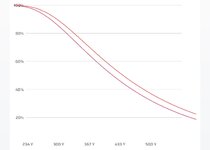
The hit rate difference in WEZ at the distance where the bullet crosses 2000 fps is dramatically different.

16”: 85% at 300yds
24”: 60% at 400yds (because you will ask, it’s 89% at 300yds)

The difference in range where each load dips below a 90% hit probability is 20 yds. That is with over a 200fps difference.

You can’t see the 20yd/4.7% increase in hit probability range in real world scenarios with more than a 200fps improvement. It’s below the threshold of statistical noise. What makes you think you’re going to see the difference of your COAL change?

You can have your own personal thresholds for when you determine a shot has an acceptable hit probability. Your situation is not going to create the over 200 fps difference in my two scenarios above, however there is no practical performance difference between the slower load and the faster load at the distance the slower load crosses below your terminal effectiveness threshold.

Here’s the graph if you are interested:
1777816182956.jpeg

This is pure indisputable data. You can read what I originally wrote. I am not telling you never load your bolt and gas gun loads differently. I am telling you that further game effectiveness distance between the two of them is not a supportable reason to do so.

If there is any anger, it appears to be on your side.

 
Sometimes simple is better. Get a marker and put a ring on the cases and bullets of the bolt action ammo and none on AR ammo. Easy to visualize and allows you to use whatever bullets you'd like to.

Jay
 
I've acquired a stash of 80g ELDM and they have been selling over on midsouth for about 2/3 the cost of TMK's so I'm following along here hoping for some more insight on their terminal performance. I don't know how closely the 75g terminal performance tracks with the 80g. Seems @Formidilosus and some other folks have reported inconsistent terminal performance out the ELDM heavy 22 cals. I forget if that was specifically in reference to the the 88's or 80's.
 
thanks for a good chuckle.
This data is totally dependent on a variety of factors you arbitrarily chose....sure they may be identical in each case, but you just pulled them out of your hat
I realize the sentences I had typed regarding the parameters somehow got deleted. The scenarios were a 12” circle (deer vitals), successful at getting range within 5 yrs, successful at calling wind within 4mph in a novel environment, 20 sd, 1.35 moa gun.

The variables weren’t “arbitrarily chosen,” but I will grant that the variables are situation dependent. If you shoot and play with WEZ enough, you start to realize that there is a massively increasing point of diminishing returns once you can shoot at or under 1.5 moa, 25 sd, and have a rangefinder. The only really observable way to increase hits in the field is either to get better at calling wind or a shoot a different caliber.

The velocities and sd I used were each measured from 100 shots of the same lot of mk262 per gun.


If you read about shooter performance in a hunting context in novel/field situations, you’ll find that a WEZ input of calling wind within 4mph is certainly realistic of people’s performance unless they are shooting thousands of rounds in a field context similar to the hunting situations. Same with the range assumption I used, but that is terrain dependent. I always use 5yds to account for rangefinder errors.
 
Back
Top