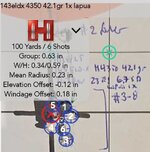
Which group to test further?

I know that for a 15 shot group the .68 inch group will get larger most likely. But wouldn’t the 1.47 inch group as well?

They'll both get larger (most likely) but because your sample size is so small there's a lot of variability in the group size. What you'll probably see is the 0.68 group will get a lot larger and the 1.47 group grow a lot less. If you were to put down 20-30 shots for each load they'll probably end up pretty close to the same.

Here's one way to look at it. A 30 shot group is pretty good approximation of the max dispersion of the system (the cone of fire). Within that 30 shot group there's 4,060 unique 3 shot combinations. Shoot 30 some time and then look at it for a minute. There's super small little bug holes. There's big ugly looking triangles. There's vertical stringing, horizontal stringing, two in one out, double grouping, in other words, whatever group shape and size (within the cone of fire) you can think of is displayed in those 4,060 combinations.

So here's the question. When you say one group is 0.68 and the other 1.47, which two of those 4,060 combinations are you looking at? :D
 
You are correct and I should clarify that the comparison of the first two groups you posted was based on the similar extreme/maximum radii being similar.

Two 5-shot groups with similar extreme spread cannot be compared statistically because extreme spread is highly unstable with so few shots. Different groups can easily show similar maximum distances even when the actual underlying dispersion is different, and there is too much uncertainty to draw meaningful conclusions. However, 5-shot groups with very different radii, like 0.5 MOA versus 1.5 MOA, are genuinely different because that gap is much larger than normal sampling variation from a stable system. When you see that kind of separation, the groups almost certainly came from different underlying distributions rather than just random chance from the same one.

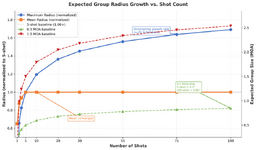
This table may be helpful in visualizing the change in maximum (extreme) radius with increasing shot count.

Shots in group
Probability that next shot sets a new max radius
Expected extreme-radius vs 5-shot
Expected mean radius vs 5-shot
1​
100%​
~0.65–0.70×​
N/A​
2​
~50%​
~0.80–0.85×​
~0.85–0.90×​
3​
~33%​
~0.90–0.95×​
~0.92–0.95×​
5​
~20%​
1.00× (baseline)​
1.00× (baseline)​
10​
~10%​
~1.15–1.20×​
~1.00×​
20​
~5%​
~1.30–1.40×​
~1.00×​
30​
~3%​
~1.40–1.55×​
~1.00×​
50​
~2%​
~1.55-1.70x~1.00
Per-shot probabilities use basic order-statistics for independent samples, where the chance that the next observation is a new maximum is approximately 1/n. Expected extreme-radius growth follows the behavior of the maximum of a 2-D dispersion distribution, which increases slowly with sample size (≈√ln n for Gaussian dispersion). Mean radius converges to the true dispersion value and remains stable with increasing sample size, unlike extreme radius which continues to grow.

Note that mean radius starts out biased low with very small samples of 2-3 shots because you haven't sampled enough of the dispersion circle. It then converges upward toward the true system dispersion as you add more shots. By around 10-15 shots it's basically locked in at the true value and stays constant, unlike extreme radius which keeps growing indefinitely.
 
I know that for a 15 shot group the .68 inch group will get larger most likely. But wouldn’t the 1.47 inch group as well?

I dont think it's unlikely to expect the 0.68" group load to continue to be better than the 1.47" one at all. Expecially if it isn't a 1 shot outlier on the bigger group.
 
They'll both get larger (most likely) but because your sample size is so small there's a lot of variability in the group size. What you'll probably see is the 0.68 group will get a lot larger and the 1.47 group grow a lot less. If you were to put down 20-30 shots for each load they'll probably end up pretty close to the same.

Here's one way to look at it. A 30 shot group is pretty good approximation of the max dispersion of the system (the cone of fire). Within that 30 shot group there's 4,060 unique 3 shot combinations. Shoot 30 some time and then look at it for a minute. There's super small little bug holes. There's big ugly looking triangles. There's vertical stringing, horizontal stringing, two in one out, double grouping, in other words, whatever group shape and size (within the cone of fire) you can think of is displayed in those 4,060 combination.

So here's the question. When you say one group is 0.68 and the other 1.47, which two of those 4,060 combinations are you looking at? :D

You are correct and I should clarify that the comparison of the first two groups you posted was based on the similar extreme/maximum radii being similar.

Two 5-shot groups with similar extreme spread cannot be compared statistically because extreme spread is highly unstable with so few shots. Different groups can easily show similar maximum distances even when the actual underlying dispersion is different, and there is too much uncertainty to draw meaningful conclusions. However, 5-shot groups with very different radii, like 0.5 MOA versus 1.5 MOA, are genuinely different because that gap is much larger than normal sampling variation from a stable system. When you see that kind of separation, the groups almost certainly came from different underlying distributions rather than just random chance from the same one.

This table may be helpful in visualizing the change in maximum (extreme) radius with increasing shot count.

Shots in group
Probability that next shot sets a new max radius
Expected extreme-radius vs 5-shot
Expected mean radius vs 5-shot
1​
100%​
~0.65–0.70×​
N/A​
2​
~50%​
~0.80–0.85×​
~0.85–0.90×​
3​
~33%​
~0.90–0.95×​
~0.92–0.95×​
5​
~20%​
1.00× (baseline)​
1.00× (baseline)​
10​
~10%​
~1.15–1.20×​
~1.00×​
20​
~5%​
~1.30–1.40×​
~1.00×​
30​
~3%​
~1.40–1.55×​
~1.00×​
50​
~2%​
~1.55-1.70x~1.00
Per-shot probabilities use basic order-statistics for independent samples, where the chance that the next observation is a new maximum is approximately 1/n. Expected extreme-radius growth follows the behavior of the maximum of a 2-D dispersion distribution, which increases slowly with sample size (≈√ln n for Gaussian dispersion). Mean radius converges to the true dispersion value and remains stable with increasing sample size, unlike extreme radius which continues to grow.

Note that mean radius starts out biased low with very small samples of 2-3 shots because you haven't sampled enough of the dispersion circle. It then converges upward toward the true system dispersion as you add more shots. By around 10-15 shots it's basically locked in at the true value and stays constant, unlike extreme radius which keeps growing indefinitely.
This is impressive stuff! Thanks for the info.

Do you ladder test powder charges then verify with 15 shot groups?

My original plan was to ladder test 2 powders (h4350 and staball 6.5) with 2 projectiles (130 eldm 140 eldm) with 5 shot groups. Pick the “best” 5 shot group of each test and load 15 and compare the four 15 shot groups. Is this sound or am I wasting components?
 
I dont think it's unlikely to expect the 0.68" group load to continue to be better than the 1.47" one at all. Expecially if it isn't a 1 shot outlier on the bigger group.
Agreed, and here's a useful visualization for 0.5 vs 1.5 (round number) group.
 

Attachments

  • image.png
    image.png
    194.2 KB · Views: 4
Back
Top