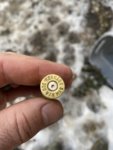
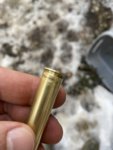
What it is is a case that was made with a belt, and subsequently lost it's belt due to excessive expansion. That brass is 100% trashed now, but there's still a lot of detective work to do to figure out how it became trash. You can see that the body of the case is about the same diameter as the widest point on the belt and the base, which could have been caused by the following things:
1. fired in a 30 nosler or 300 prc or 300 RUM chamber at some point, can't be proven or disproven at this point.
2. fired in a 300 win mag chamber at pressures high enough to nearly cause case-head separation (nothing on the base looks like it was over pressure to me, but who knows, it is difficult to prove if this happened but plenty of guys have messed up powder charges at some point or another)
3. fired in a 300 win mag chamber that is oversized in the case web area, which could be proven by doing a chamber cast if your gun has the chamber problem.
4. fired in a 300 win mag chamber where the reamer was run in too deep, causing the belt area to be 2-3x as deep as the actual belts on the cases. This shouldn't happen, belted cases are designed to headspace off the belt for the first firing and SAAMI specs are intended to control this depth. Again, this could be proven with a chamber cast if your gun is the culprit.
5. a reloading die that is oversized in the base area and not squeezing the brass down, this could be proven by measuring fired cases, resized cases, unfired cases, and the inside of the die itself.
It concerns me that you don't know if the cases arrived like this when you bought them, if they became like this when you resized them, or when you seated the bullets, or if they became like this when you fired them. At a minimum, you had to have touched a case from this batch 120 times to load, fire, and eject the cases. That number could easily double if you trimmed the cases and used a case lube that is wiped on and off. Knowing when the shape deviated from what's expected would enable you to quickly pinpoint what the problem was. There's no way that you should have got home with 20 empties from your own loads before you realized that there was a problem with all of the cases. (For anyone else who might read this in the future, if you pull a case out of your gun that looks like this STOP SHOOTING THOSE LOADS BECAUSE SOMETHING IS WRONG.)
I'm also concerned that you didn't back off your load when using brass that had been fired in someone else's gun first. Not all chambers are the same, and unless you're full length sizing back to SAAMI minimum specs each time the brass coming out of your dies has the potential to be different, particularly when fired in different guns before firing. We already know you're not going back to SAAMI minimum based on your die setup, so there is going to be a difference between your once fired brass and that other guys once fired brass. Anytime you fire the first shell of a new recipe (powder, bullet, seating depth, primer, brass, air temperature), you need to go over that case carefully and look for abnormalities. It's a safety issue for you and those around you.
You said it's too tough to measure things like shoulder bump, but that excuse won't help your eyesight or buddies face if your next reloading anomaly is catastrophic. There are thousands of people who figured out how to make measurements of cases, powder, bullets, etc and can tell you in excruciating detail the dimensions of their cases. If that's beyond your skill then you should focus on self improvement until you have developed the skills needed to control the variables and document them in order to reload safely.
If you have the skills and it's more of a focus/attention issue, I strongly encourage you to increase your attention to detail while you're reloading or give it up until you are able to really focus. When you're reloading, your bench is no place for a beer, whiskey, joint, inquisitive child, tv with your favorite show, or someone you're trying to become intimate with. 50% focused during this hobby is the most dangerous place to be.