UT Collar Data & New Co-host

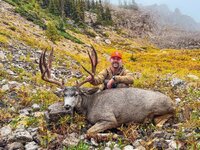
What a whopper of a buck @Jaden Bales! Congratulations!!

@robby denning you talked briefly with Randy about the body health conditions of does and how that potentially affects estrus cycles. Years ago, I remember reading/hearing about studies in whitetail deer that depending on body condition in yearling fawns they were seeing fawns coming into their first estrus cycle in mid-December and getting bred. If I remember correctly it was a study on the “2nd rut”.

Image how quickly herds could grow if fawns are putting on enough body mass their first 6 months of life to reach reproductive capability. With that being said and previous studies done on neonatal conditions. Would a 6 month old fawn actually be able to give birth to a buck that would display his full antler potential? Cool stuff.

Lush summer habitat is SO important.
 
What a whopper of a buck @Jaden Bales! Congratulations!!

@robby denning you talked briefly with Randy about the body health conditions of does and how that potentially affects estrus cycles. Years ago, I remember reading/hearing about studies in whitetail deer that depending on body condition in yearling fawns they were seeing fawns coming into their first estrus cycle in mid-December and getting bred. If I remember correctly it was a study on the “2nd rut”.

Image how quickly herds could grow if fawns are putting on enough body mass their first 6 months of life to reach reproductive capability. With that being said and previous studies done on neonatal conditions. Would a 6 month old fawn actually be able to give birth to a buck that would display his full antler potential? Cool stuff.

Lush summer habitat is SO important.
I know more about the elk "2nd rut" than deer, but I believe they are similar phenomena. Timing of estrus is highly related to the age of the female, the older the female, the more repeatable the timing of the estrus. I believe this has to do mostly with body size/condition, but I'm sure there are other factors involved. In MT we see a significant "second rut" in places where the population is growing rapidly, hence more young animals.

As far as a herd's ability to respond quickly if does (or cows) were able to be bred at 6 months, there is a reason that is a rare phenomenon in the wild. Young animals tend to have smaller young, and in the case you describe, would be having those young well into the normal growing season. Both of these factors significantly decrease fawn (or calf) body size at the onset of 1st winter, causing very low (if any) overwinter survival. The timing of the estrus cycles are directly tied to maximize Age-0 body size and condition. Thus, the only real variations you will see are those dominated by winter (MT, WY, CO, etc) and those timed with seasonal monsoon moisture (think AZ).
 
Back
Top