FDIC insured too. X will get some of my money at 6% and FDIC insured.Risk-free 6% hell yeah
Eddie

Follow along with the video below to see how to install our site as a web app on your home screen.
Note: This feature may not be available in some browsers.
FDIC insured too. X will get some of my money at 6% and FDIC insured.Risk-free 6% hell yeah

Kind of seems like a no brainer. Especially in the world today where the market is a crap shoot. 6% guaranteed up to 250k. Seems too good to be true but sign me up.FDIC insured too. X will get some of my money at 6% and FDIC insured.
Eddie
Why is she even questioning this?Heres a horrible story and a lesson for everyone to learn self sufficiency in investing and understanding your finances;
Kathy Ireland made famous by Sports illustrated was once worth $420 Million is broke. She is saying she was scammed by her managers.....Fox story HERE


I'm guessing they're sharing the profits of the CC...they're getting your money to loan CC users at 29% and paying you 6% and making 23%, minus expenses?!?6% FDIC insured money is nuts. I'd read the fine print carefully on that before making any big moves.
why not post the question and get everyones uneducated or unprofessional opinion?If anyone is financial advisor on here. I had a basic question I wanted to ask if you could just send me a pm. Thz
Cause it's probably one of those no question is a dumb question, but it is dumb, Ha.why not post the question and get everyones uneducated or unprofessional opinion?
Cause it's probably one of those no question is a dumb question, but it is dumb, Ha.
But F it. Here goes. Have a roth IRA through work that I contribute alot into. Wanted to get into investing on the side more or less to learn more about it. And have something to dip into if I decided to retire early. So I opened a standard brokerage account. Then learned I could have another roth Ira in additional to the one at work. Alot of my side investing is into long term dividend etf and stocks. So it probably makes sense to have it in a roth vs standard. But also wanted a more liquid account that I'm not locked out of if the need arises.
And with 2 little kids. The idea of maxing out my 401, a roth ira and having a side brokerage is not a reality at the moment.
So what says the wkr's.
Cash out my brokerage and move it roth Ira. Or leave as is. And open a roth ira and start contributing into that instead.

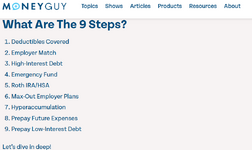
Most people on here (I think) would give you an order of operations similar to the below. This is from the Money Guys. Their website and book dive into these 9 steps in more detail.Cause it's probably one of those no question is a dumb question, but it is dumb, Ha.
But F it. Here goes. Have a roth IRA through work that I contribute alot into. Wanted to get into investing on the side more or less to learn more about it. And have something to dip into if I decided to retire early. So I opened a standard brokerage account. Then learned I could have another roth Ira in additional to the one at work. Alot of my side investing is into long term dividend etf and stocks. So it probably makes sense to have it in a roth vs standard. But also wanted a more liquid account that I'm not locked out of if the need arises.
And with 2 little kids. The idea of maxing out my 401, a roth ira and having a side brokerage is not a reality at the moment.
So what says the wkr's.
Cash out my brokerage and move it roth Ira. Or leave as is. And open a roth ira and start contributing into that instead.
STRC had massive inflows today. Strategy sold enough STRC (287 million dollars) today to buy 4,100 Bitcoin. The current 11.5% yearly dividend (paid monthly) is very tempting. The monthly dividend is paid out as return of capital so it's not taxable. Your cost basis is reduced with each dividend payment so depending on the amount of the monthly dividend could be 8 to 10 years before your cost basis is zero. Assuming you hold until your cost basis is zero you'll pay long term capital gains on the entire sale price. I like this structure for my non-qualified account.Thoughts on STRC?

Thoughts on STRC?

"If you can't identify the liquidity, then you're it"Thoughts on STRC?
742 million dollars of STRC traded today. Strategy is sitting on 2.25 billion dollars in cash reserves. That's enough to pay the STRC dividends for 55.5 years. They are also sitting on 738,731 Bitcoins in their treasury. Their total debt is 8.4 billion for a net leverage of 11%."If you can't identify the liquidity, then you're it"





