Stuck on Quick Drop

I agree with this. What seems wild to me is guys neutering cartridges to line up or shooting magnums when they don't want to or getting a longer barrel than they want to, just to be able to line up better. At best, you are saving a few seconds over a dope card, and you are still doing some mental calcs. Easier calcs, sure.

FYI - You can also tweak the zero to make it line up better.

Not sure who coined the term "Quick Drop" but it's nothing new. Just something in the shooter's toolbox. One could stumble upon it, just running predictions in a ballistic engine and looking for quick solutions.

Here's a post I made in 2021 about it vs BDC and tweaking the zero, but I don't recall anyone calling it Quick Drop then.

https://www.24hourcampfire.com/ubbt...3-9-power-vs-4-5-14-for-big-game#Post16147325
 
Reading this thread I am getting a very basic understanding of quick drop. What I am trying to wrap my head around is you all are essentially building your rifle and loads to utilize quick drop?
So you are potentially compromising optimal lethality for quick drop? Please correct me if my limited brain power is not grasping this concept.
I am here to learn. Flame away.
this is a "bigger is better" way of thinking.
"Neutering" a cartridge to fit QD isn't really a thing.

A cartridge that fits QD and is EFFECTIVE is not neutered.

It may be slower than whatever 30" barrel short mag...but if it's acceptable for the job, it's acceptable for the job.

What is the job?

what is the range?
what does the bullet need to do?
what is the minimum velocity needed for the bullet to do its job?

rifle caddy hands you appropriate rifle/bullet combo to do described job...
 
not if you learn to mil your target.
Flash milling: Deer, elk, etc are usually xx inches(Mils) brisket to back for a given species.

using your reticle to measure a known target, a close range approximation is made. QD can then be used to place a bullet inside that measured object.
it might make sense to put some milling references on the back of your dope card?
deer is...
elk is...
18" =1 Mil @ 500
36" = 2 Mil @ 500

Don't get hung up on the milling margin of error, our ability to call wind and shoot correctly are larger sources of error.
No doubt, i used that in AK on a moose hunt to get a rough guess on antler spread. It's just has nothing to do with qd and would provide nearly no advantage vs. A dope card. I'd actually argue a dope card or bdc turret is easier and eliminates all mental calc error.
 
not if you learn to mil your target.
Flash milling: Deer, elk, etc are usually xx inches(Mils) brisket to back for a given species.

using your reticle to measure a known target, a close range approximation is made. QD can then be used to place a bullet inside that measured object.
it might make sense to put some milling references on the back of your dope card?
deer is...
elk is...
18" =1 Mil @ 500
36" = 2 Mil @ 500

Don't get hung up on the milling margin of error, our ability to call wind and shoot correctly are larger sources of error.
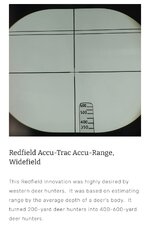
I was flash “inching” with my Redfield scope in the 70s. 😀

IMG_8272.jpeg
 
No doubt, i used that in AK on a moose hunt to get a rough guess on antler spread. It's just has nothing to do with qd and would provide nearly no advantage vs. A dope card. I'd actually argue a dope card or bdc turret is easier and eliminates all mental calc error.
QD and milling your target are alternatives to electronics.

QD or a dope card are useless unless you know your range.

know how to measure your target gives you a reference to use QD or a dope card.

"it's all talk...blah, blah..."

until you're on a $35k sheep hunt and it snowing so hard your range finder won't work and the ram is right there. Is it 275 or 350?

I'd rather know how and never need it than need it and know I chose not to learn it.
 
Thanks for all the info.
If I am tracking, it should work great for a .223 build underway, but not so much for my 6UM?
 
I don’t think it works in inches anymore.
This is new stuff.
Those were the old days before MOA/MIL/DA/QD/danger space were common terms in western hunting. It was before non-military rangefinders, too, so “about 500 yards” was anywhere between 350 and 600 yards. Chronographs were not very prevalent so most people, me included, relied on what reloading manuals or ammo catalogs gave for velocity.

Maybe there is a reason most of my shots have been under 100 yards.
 
Thanks for all the info.
If I am tracking, it should work great for a .223 build underway, but not so much for my 6UM?
It did not work for mine.. You can get closeish it certain distances but it is not dead on. Thus I have to have a backup dope card and mil targets is I have a complete electronics failure. Also as I hunt Solo 99% of the time and use range finding beenos with ballistics, wind brackets are far more important than QD for me.
 
using your reticle to measure a known target, a close range approximation is made. QD can then be used to place a bullet inside that measured object.
it might make sense to put some milling references on the back of your dope card?
do you have an example of milling references on hand that you find useful?
 
do you have an example of milling references on hand that you find useful?
18" = 1 Mil @500/.5 Mil @ 1000

36" = 2 Mil @ 500/ 1 Mil @ 1000

using this example,
18" = 2 Mil @ 250
18" = .75 Mil @ 750

54" = 3 Mil @ 500/ 1.5 Mil @ 1000

if you have this worked out, you can use it for back to brisket, antler sizing, bear nose to rump, etc.

Bears are hard! I want a hard range, then estimate body size from a known range.

I've used trees to estimate range for shooting rocks. If the average tree trunk is xx diameter on that hill, try practicing using a tree trunk as a reference.(not saying this is a good idea for game)
 
Back
Top