Statistics 101

Hschweers

Lil-Rokslider
Joined
Apr 3, 2021
Messages
280
Hey all,

It's been a while since I've taken a statistics class..... I'm looking at the New Mexico deer draw table they publish for # of applicants and who drew the tags etc. I'm calculating my own odds (since I disagree with how *un-named hunting research tool* does it).

Since an unguided nonresident is only allowed a maximum of 6% of available tags, am I incorrect in thinking the BEST draw odds you'll get in any unit is 6%? Can obviously be much worse.

Hypothetical 1: a unit has 100 tags available, 10 non residents apply total (1st, 2nd, and 3rd choice combined since they consider all options before moving to the next app), 200 residents applied total. 6 of those NRs drew.
- Your odds of drawing were 2.9%, right? You just divide 6 (maximum number of tags possible) by 210 (TOTAL applicants). It seems a lot of these websites would give that unit a 60% chance to draw since 6/10 non residents drew.

Idk... I'm getting myself all turned around. Does what I laid out sound right? And are the best draw odds a non res can have regardless of # of applicants and who drew and blahblahblah 6%?

Thanks in advance!
 
The 6% allocation to (unguided) non-residents does not directly determine your odds of drawing a tag. Your odds could be better or worse than 6% depending on how many other NR applied. In the example you gave, I would say NR odds are 60% because 6 out of 10 applicants drew.

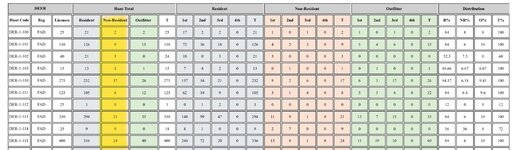
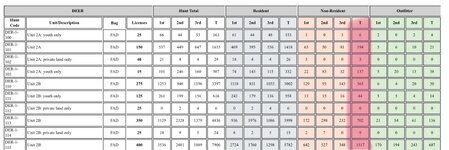
To estimate your odds as an unguided NR based on previous draw reports, divide the number highlighted in yellow (total number of unguided NR who drew the tag) by the number highlighted in pink (total number of unguided NR who applied for the tag). For example, last year 44 unguided NR applied for tag DER-1-111 and 8 of them (18.2%) were successful. 1517 unguided NR applied for tag DER-1-115 and 24 of them (1.6%) were successful. Both of those draws followed the 84-10-6 resident-outfitted-unguided NR allocation percentages, but the 6% allocation doesn’t directly determine the draw odds of an unguided NR applicant. The 6% allocation sets an upper limit on the numerator of the odds calculation; the total number of unguided NR applicants determines the denominator and completes the calculation. The result of the odds calculation could be higher, lower, or equal to 6%…it all depends on how many unguided NR are competing for that tag.
IMG_7014.jpeg
IMG_7013.jpeg
 
The 6% allocation to (unguided) non-residents does not directly determine your odds of drawing a tag. Your odds could be better or worse than 6% depending on how many other NR applied. In the example you gave, I would say NR odds are 60% because 6 out of 10 applicants drew.

To estimate your odds as an unguided NR based on previous draw reports, divide the number highlighted in yellow (total
number of unguided NR applicants) by the number highlighted in pink (total number of unguided NR who drew the tag). For example, last year 44 unguided NR applied for tag DER-1-111 and 8 of them (18.2%) were successful. 1517 unguided NR applied for tag DER-1-115 and 24 of them (1.6%) were successful (1.6%). Both of those draws followed the 84-10-6 resident-outfitted-unguided NR allocation percentages, but the 6% allocation doesn’t directly determine the draw odds of an unguided NR applicant. The 6% allocation sets an upper limit on the numerator of the odds calculation; the total number of unguided NR applicants determines the denominator and completes the calculation. The result of the odds calculation could be higher, lower, or equal to 6%…it all depends on how many unguided NR are competing for that tag.
View attachment 1004278
View attachment 1004277
But am I misunderstanding that it’s a MAX of 6%. It could be 0% for a 100 tag hunt depending on how the draw goes. In the hypothetical I gave it ~could~ be 100 residents draw and 0 non res DIY and 0 non res guided.

Or am I wrong and they auto allocate 6% as long as there’s demand for that many?
 
But am I misunderstanding that it’s a MAX of 6%. It could be 0% for a 100 tag hunt depending on how the draw goes. In the hypothetical I gave it ~could~ be 100 residents draw and 0 non res DIY and 0 non res guided.

Or am I wrong and they auto allocate 6% as long as there’s demand for that many?
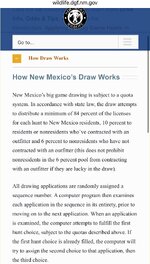
Based on the explanation below from the NM DOW website, I would say it’s more the latter. The 84-10-6 effectively creates 3 separate pools, each with its own number of tags available only to applicants meeting the requirements of that pool (resident, outfitted, or unguided NR). Sometimes the allocation percentages aren’t satisfied exactly because there aren’t enough applicants in a particular pool.
IMG_7016.jpeg

Looking at last year’s deer draw report, only 16 of 337 hunts had 0 successful unguided NR applicants (where at least 1 unguided NR entered the draw for that hunt), and all those situations occurred for hunts with a very low tag quota (10 or less). For hunts with a tag quota of 10+, the 84-10-6 allocation appears to be followed pretty closely (except for a few hunts that had few/no NR applicants). I don’t think you would ever see a hunt with a quota of 100 tags and 0 successful NR applicants.
 
Based on the explanation below from the NM DOW website, I would say it’s more the latter. The 84-10-6 effectively creates 3 separate pools, each with its own number of tags available only to applicants meeting the requirements of that pool (resident, outfitted, or unguided NR). Sometimes the allocation percentages aren’t satisfied exactly because there aren’t enough applicants in a particular pool.
View attachment 1004302

Looking at last year’s deer draw report, only 16 of 337 hunts had 0 successful unguided NR applicants (where at least 1 unguided NR entered the draw for that hunt), and all those situations occurred for hunts with a very low tag quota (10 or less). For hunts with a tag quota of 10+, the 84-10-6 allocation appears to be followed pretty closely (except for a few hunts that had few/no NR applicants). I don’t think you would ever see a hunt with a quota of 100 tags and 0 successful NR applicants.
Okay, if it’s 6% allocated then I agree we’re only competing against other unguided NRs. Thanks for that clarification.

Now the only thing I’m curious about is how Huntin’ Fool does their calculations… for DER-1-111 I agree with your math (8/44 =0.182). Huntin’ Fool puts that tag at a 22.8% odds. It’s not massively different, but 4% is 4%
 
Now the only thing I’m curious about is how Huntin’ Fool does their calculations… for DER-1-111 I agree with your math (8/44 =0.182). Huntin’ Fool puts that tag at a 22.8% odds. It’s not massively different, but 4% is 4%
The method I described is a bit oversimplified and doesn’t account for the effect of multiple choices, but it’s the best you can do with the readily available report data. Huntin’ Fool may have access to more detailed application data, and they probably use some “proprietary algorithm” to project next year’s applicant numbers/behavior (instead of just using last year’s numbers)…and yet they still arrive at a guess that IMO is no better than what you or I could arrive at for free based on last year’s published report.
 
Research much way more than you think you should have to if you are seriously considering it....I would put in for whatever units you have researched for that have a good success rate. I did, got lucky with drawing a tag, and then we got a nice bull on a self-guided public land hunt in NM.

If hunting in NM is that important to you, just go in knowing and understanding that in NM, NR are simply not likely to draw. Guided may be a little higher chances IIRC.

From what i remember all you have to lose if you don't draw is the smaller app fee...you will get refunded the tag fee if you don't draw.

There are LOTS of mule deer in NM :)
 
Okay, if it’s 6% allocated then I agree we’re only competing against other unguided NRs. Thanks for that clarification.

Now the only thing I’m curious about is how Huntin’ Fool does their calculations… for DER-1-111 I agree with your math (8/44 =0.182). Huntin’ Fool puts that tag at a 22.8% odds. It’s not massively different, but 4% is 4%

I would have to assume that 4% discrepancy is based on them running a model in which they assume that a certain number of those applications will draw another choice

So lots of assumption going on there and you know what they say


Sent from my iPhone using Tapatalk
 
Back
Top