Spotting your shot, most import factors.

They are ok. After using GRS stocks, I went back to factory. I would rather use a KRG Bravo than about anything if for some reason I wouldn’t use a ROKStok.
I recently acquired one of the T3X Sporters from Europtic after reading your praise of the Master Sporter. I realize the stocks are not identical, but close. Must say it is a very comfortable stock. Especially the grip/thumb treatment and the comb bevel and lateral, in addition to vertical adjustment.
In case anyone was wondering as I was - yes, the deeply recessed magazine well does allow use of Mamba mags.
 
I recently acquired one of the T3X Sporters from Europtic after reading your praise of the Master Sporter. I realize the stocks are not identical, but close. Must say it is a very comfortable stock. Especially the grip/thumb treatment and the comb bevel and lateral, in addition to vertical adjustment.
In case anyone was wondering as I was - yes, the deeply recessed magazine well does allow use of Mamba mags.

While not quite exactly the same, it is a dang good stock.
 
This is the video I mentioned that was sent to me. What these guys discuss about people with certain backgrounds and group-size obsession fit me perfectly. And it's exactly what was holding me back, until listening to how they flipped the speed/accuracy equation on its head. Pranka's background, coming out of the stockade and focusing on accuracy first - and then seeing him teach what's in this video - was a powerful endorsement of the idea, at least in giving it a shot. What he shares here in how he taught his 3 boys to shoot - and the substantially different performance outcomes - were also a key part of what convinced me to give this a shot.


We absolutely talked past each other. But there also is something that is likely to be missed by those just reading, or watching the video- that do not have a heavy precision at speed background. What they fail to acknowledge in the talk about how “all the people in a club stay at the same level over the course of 5 years” portion, is that there are many people that come in and shoot at the speed of an A class shooter, hit nothing- and stay exactly that same shooter for 5 years as well.

In “practice” it has to be ok to miss/fail when the goal is to force adaptation and change. In “training” misses should cause serious concern. In “testing” misses should cause behavior altering consequences or loss of job.


What may have been missed in what I shared about going fast, is that 1) It's about going fast to a certain speed, and learning how to get accurate within that speed-envelope you want, and 2) it's absolutely predicated upon being able to read a target, self-assess, and correct your shooting based on what the target's saying.

I've essentially spent my entire life under the paradigm of "Speed is fine, but accuracy is final". And it's an absolute truth. But it also held me back after some point. Flipping things upside-down and setting the speed standard first, and learning how to be as accurate as possible within that, is directly what led to these recent performance breakthroughs.


Bolded portion:

I would change that for the benefit of others to- “this is the size target you must hit on demand- no misses EVER. “This” is the time it must happen in- EVERYTIME.” When testing. Practicing to improve, yes- you must train at failure speeds.
The issue is that people really do not want to be held to on demand- right now, no failure accepted “test”, or “standard”. So they look for anyone, and anything that excuses their inability to perform on demand.


Out of curiosity- if you ran 10x bill drills (7 yards, USPSA target) back to back, and only 2 of the runs could have a even a single shot out of the “A” zone- what would your no shit average time be?
 
In “practice” it has to be ok to miss/fail when the goal is to force adaptation and change. In “training” misses should cause serious concern. In “testing” misses should cause behavior altering consequences or loss of job.

Overall, I very much agree with this. There might be a bit of nuance depending on defining practice (relaxed and just running some drills, vs pushing the absolute hell out of yourself) or training (evolutions over weeks and months, vs scenarios, vs team/mission oriented with clear benchmark standards to exceed, etc), but overall, hell yes. The testing part especially, with clear consequences for performance fails. Including things like flagging, NDs, integrity violations, etc - some things need to be absolute job-enders.

Regarding bills, I like the idea of how you're presenting it as an actual test, with 1 or 2 C's being hard disquals with consequences, across 10 runs. Guys would talk a lot less shit about their times if they were betting their guns or their careers on it. I mostly have used bills as recoil-management and draw-at-speed training, rather than as a qual of some kind, so they're used more for diagnostic, learning, and evolutions, than for setting time standards to excel, on-demand as a qual. But I like that idea, a lot. Especially if it was balanced with a distance precision qual as well. In the context as presented, from OWB, I'd feel pretty comfortable with a 2.5 second no-miss standard. Most of my runs would be around 2.10-2.25, give or take a tenth either way. A couple of the runs might be sub-2, but with that much emphasis on no-miss, with hard consequences, I don't think I could push it any harder than 2.25ish, safely.
 
Regarding bills, I like the idea of how you're presenting it as an actual test, with 1 or 2 C's being hard disquals with consequences, across 10 runs. Guys would talk a lot less shit about their times if they were betting their guns or their careers on it. I mostly have used bills as recoil-management and draw-at-speed training, rather than as a qual of some kind, so they're used more for diagnostic, learning, and evolutions, than for setting time standards to excel, on-demand as a qual. But I like that idea, a lot. Especially if it was balanced with a distance precision qual as well. In the context as presented, from OWB, I'd feel pretty comfortable with a 2.5 second no-miss standard. Most of my runs would be around 2.10-2.25, give or take a tenth either way. A couple of the runs might be sub-2, but with that much emphasis on no-miss, with hard consequences, I don't think I could push it any harder than 2.25ish, safely.

If you are averaging 2.5 sec bill drills with those parameters given, man you don’t need help with shooting unless you are trying to make USPSA GM. On demand 2.5 sec clean bill drills is excellent skill.


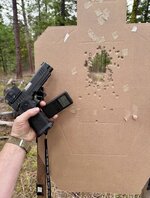
This was the last heavy day of that, that I have a picture of. Hadn’t shot a dot in a long time, so working on draws and vision.

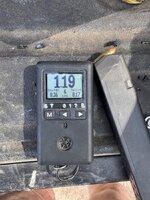
Above the neck line are head shots, below it is 250’ish bills drills and the rest in one shot draws- 7 C’s total. IIRC the slowest time was 2.10sec, and fastest was 1.5 something seconds. 80+ % were between 1.65 and 1.85 seconds. This was the last run and you can see the time.

1765948827025.jpeg
 
Holy shit, that is eye-popping...


Haha. Nah.


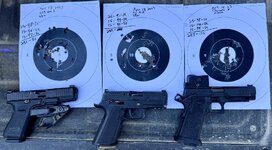
The next week. This was a test, not practice. Had to make sure I still could shoot other guns. Back to back, no break, no warm up. FBI Bullseye quals (if you haven’t shot it, it’s a nut cracker for most).

1765949468930.jpeg


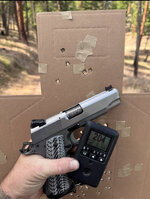
Then the next day, a bill drill cold and clean (test again) with a carbine-
1765949602903.jpeg
 
If you are averaging 2.5 sec bill drills with those parameters given, man you don’t need help with shooting unless you are trying to make USPSA GM. On demand 2.5 sec clean bill drills is excellent skill.


This was the last heavy day of that, that I have a picture of. Hadn’t shot a dot in a long time, so working on draws and vision.

Above the neck line are head shots, below it is 250’ish bills drills and the rest in one shot draws- 7 C’s total. IIRC the slowest time was 2.10sec, and fastest was 1.5 something seconds. 80+ % were between 1.65 and 1.85 seconds. This was the last run and you can see the time.

View attachment 986654
Is this from concealment or a comp type holster?
 
Haha. Nah.


The next week. This was a test, not practice. Had to make sure I still could shoot other guns. Back to back, no break, no warm up. FBI Bullseye quals (if you haven’t shot it, it’s a nut cracker for most).

View attachment 986675


Then the next day, a bill drill cold and clean (test again) with a carbine-
View attachment 986676


Some people see the mona lisa, some see the f'ing brush strokes. It's an actual pleasure to read those damn targets.

Is the FBI bullseye qual all at 25yds? What are the details on that?
 
Some people see the mona lisa, some see the f'ing brush strokes. It's an actual pleasure to read those damn targets.

Haha.


Is the FBI bullseye qual all at 25yds? What are the details on that?


String one: 25 yards, 10 rounds, 4 min.

String two: 15 yards, 5 rounds, 15 seconds. Repeat this again for a total of 10 rounds.

String three: 15 yards, 5 rounds, 10 seconds. Repeat this again for a total of 10 rounds.


Total of 30 shots and a possible 300 points. Old passing for FBI Firearms instructors on day one of class was 260pts IIRC. It’s one of the best diagnostics that can be done to see quickly whether someone can shoot well enough to be trusted to shoot around other people.
 
Then 100% I have no issue at all with that. “Compress” the time it takes to move through the full trigger travel- not “take the first good shot when it comes into the target”, or whatever was being said by others.
One of my coaches used to call that a drive-by. It usually didn't end well trying to time the wobble through the 10 to when the shot broke. Couldn't ever hide it on Scatt sessions.

While not quite exactly the same, it is a dang good stock.

You're going to end up costing me some coin as well one day. I have no use for one outside of taking a break from the AR in an XTC match now and then but that doesn't make me want one any less.
 
I’m going to nitpick here (or not nitpick).

This is the worst trend right now in shooting. First, put a gun on your collar bone that actually recoils. Do it with a 12ga. Do it with anything that does more than a PRS 30lb rifle and actually shoot/practice with it from something other than a tripod.
Common rifle/cartridge combinations exceed the requirement to break the average collar bone. Not only that, but repeated recoil on bone is painful- some students at S2H often get sore from 223’s at 200 rounds a day; and I believe we have only had 2 or 3 people out 40+ that have started with 6cm or 6.5cm’s, make it past day 2 before asking to borrow a 223.

This “bring rifle to centerline” was brought up by “tactical” dudes (not competitors first) from the old days of MP5 full auto shooting. This was an attempt to control the up and right movement for RH shooters, that happens during recoil- because almost no one understood how to make a stock that works correctly. They were able to do that because PRS guns have functionally zero movement when fired, and because nearly all shots are from some sort of standing/barricade/tripod position. It is utterly compromised for dynamic field shooting.


This was farther adopted because the common grips on stocks are absolutely atrocious. Fat, with a way too long trigger reach. When you have a bad grip angle, fat grip, and a trigger reach that is over an inch longer than it should be- you need to rotate your wrist counterclockwise and move your finger up to get to the trigger. Now look at what that does to your shoulder position and arm…. THAT is why short LOP has become the thing. As soon as you have to compromise the grip as above, your LOP must by necessity lesson, and combined with the barricaded positions that allow it, and with not having recoil- there is no apparent penalty for it. (This also relates to higher mounted scopes).


Change all of that to how a stock should be designed, and nothing about a long LOP makes shooting a rifle hard- quite the opposite. The farther your hand is from your chest, the better your index finger moves straight to the rear, the less severe angle and hence, strain is on your wrist; and the more your grip helps control recoil.
On top of that, when shooting dynamically, the farther your shooting hand is from your chest, and the farther your offhand is from your shooting hand- the more control you have over the rifle in all axis.

When you design a stock correctly- recoil pad above bore and get a solid cheek weld; then you can use a longer LOP put 90° into the shoulder pocket, and the up and right recoil goes away.

This rifle below has a 14.75” LOP, very short trigger reach of approx 1.5”, and a very well designed grip. Every single person from 12yo girls to 6’6” males that have shot it, have done easily, and almost all have stated it was the best feeling and shooting gun they have ever shot. Hell, there are 4-5 posters on here that after shooting it, went and found one and bought it.

View attachment 979888

View attachment 979889


In short: this doesn’t mean that one can’t shoot a short LOP and centerline pad well. It means that the trend of short LOP and recoil pad “centerline” is due to a combination of really poorly designed grips and stocks, a misunderstanding of what is causing sight movement during recoil, and a shooting sphere that promotes it and has no consequence for doing it.


Yes.


You need longer LOP. The standard LOP for Rokstock should have been at least 14”, but consumers wouldn’t have understood why.


I/we haven’t seen any advantage with an angled toe in timed events side by side with people specifically trying to show that there is; and only a detriment in straight line recoil.


Yes- narrow and verticle’ish, with a sub 1.7” trigger reach.


Yes.


That is exactly opposite of what your neck must do with higher rings- anyone can experience this right now. Lay prone, straight and neutral (your body straight inline with your target as below).
View attachment 979936
Now, what is less strain on your neck- head relaxed in a normal position looking down to the ground? Or- head pulled way up and looking at the ceiling.

The is the second worst trend is shooting right now. It is driven by just shooting from a standing position of some sort, and the nonsense “heads up improves target awareness” crap from certain people in the tactical community.

1st- as above, it is way more strain on the average persons neck in any position that doesn’t have the torso vertical.

2nd- for most stocks it removes the cheekweld from recoil and control. This is the negative sub component to the “heads up” high mounted scope thing. The cheeckweld offers a pretty substantial effect to recoil control through pressure and friction of the cheek into the stock. This is readily seen with an AR15 and visible laser in rapid fire at close range- remove the face from the gun or only have it touching at “jaw-weld” and the laser bounces all over the place, is very inconsistent and not predictable at all. In contrast, burry the cheek fat into the stock and the laser movement during recoil is cut in half at least, and the movement is extremely consistent and predictable. It’s not even close between them.

3rd- it’s also tangentially related to short LOP. Shorter LOP makes it more difficult for o get enough eye relief for lots of setups, and one way I get your eyebrow back, is to move your head “up”.

Now a very hard cheekweld and hard comb on the stock can and will cause some effects to the rifle (left reticle movement during recoil, and can a left trend with impacts with the ROKStok for instance). However, look at the picture above of what is on the comb. Look at the rifles below-


View attachment 979931

View attachment 979917

View attachment 979929

View attachment 979938

View attachment 979932


View attachment 979934

View attachment 979935


Yes.

Thank you so much for this response! Really helps me going forward.
 
Back
Top