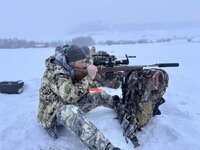
Spotting your shot, most import factors.

That’s cool. Yeah I think you’re right about it being a perishable skill. lol

It’s sounds weird, but once in position I normally dry fire a few times before every shot and visualize what the recoil would be. It seems to help my brain with recoil, maybe not shot for shot as good as burning powder, but enough I can tell a difference by the end of a good range session.
Did a bit more investigation into my reflexive blinking - shot a few mags through the gas gun, the 22 lever action and a 9mm pistol (guns I haven’t fired in a long time) while taking some video and found that on the first shot of any of these I get a full blink under recoil, but that if I continue with follow up shots in quick(ish) but not rushed succession, the blink subsides/goes away to a very slight twitch of the eye lids visible only on slow motion. If I pause in firing for a bit I get a full blink on the first round again. Makes me think I just need more rounds down range with set ups I can go blink free on and it will fade in time. It also seems like a quickly perishable skill and I imagine a hiatus will bring the reaction back. The gas gun has a muzzle break so the muzzle blast is decent - more so than the 6cm with the suppressor - but the recoil is still a bit less.
IMO, this partially explains the cold bore myth…
 
IMO, this partially explains the cold bore myth…
The myth that the cold bore is less accurate because of the rifle? I agree. This brain settling down thing, inconsistency in first shot hand placements, inconsistency in first shot pressures imparted into the pistol grip/cheek/shoulder, and probably uneven muscle tensions that can’t be seen.
 
The myth that the cold bore is less accurate because of the rifle? I agree. This brain settling down thing, inconsistency in first shot hand placements, inconsistency in first shot pressures imparted into the pistol grip/cheek/shoulder, and probably uneven muscle tensions that can’t be seen.
Cold bore is largely a myth. Clean bore, of course that is a thing, follow up shots are in a different condition.

If cold bore is mechanical, it is the rifle getting jostled so that something gets out of place and then upon the first shot it returns to its neutral position. It could be bedding, scope movement, barrel movement relative to stock if it touches, internals of the scope moving, etc.

But, the common element is always the human that is not well practiced and did not build a solid position for the first shot.

Once a shooter settles in, it is much easier to shoot small groups.

Test it by doing build and break practice. Pick up right rifle, do the Hokey Pokey, reset the rifle to low power, load the magazine again, then try to build the same position.

I guarantee that groups shot during build and break practice will not look like groups when you get settled in and fire them without breaking position.

After firing, there is often slack taken out of the human/rifle connection, fill in bags settle, eyes blink less, the rifle butt slips to a position it rests more easily in, etc.
 
Cold bore is largely a myth. Clean bore, of course that is a thing, follow up shots are in a different condition.

If cold bore is mechanical, it is the rifle getting jostled so that something gets out of place and then upon the first shot it returns to its neutral position. It could be bedding, scope movement, barrel movement relative to stock if it touches, internals of the scope moving, etc.

But, the common element is always the human that is not well practiced and did not build a solid position for the first shot.

Once a shooter settles in, it is much easier to shoot small groups.

Test it by doing build and break practice. Pick up right rifle, do the Hokey Pokey, reset the rifle to low power, load the magazine again, then try to build the same position.

I guarantee that groups shot during build and break practice will not look like groups when you get settled in and fire them without breaking position.

After firing, there is often slack taken out of the human/rifle connection, fill in bags settle, eyes blink less, the rifle butt slips to a position it rests more easily in, etc.
Yes good advice.

Definitely no substitute for repetition.
 
I'm not a competitor but continually improving my shooting skills is what drives me.
Along the lines of blinking, I spend and have spent a lot of time behind glass for long periods which causes facial fatigue. I trained myself to use single eye optics with both eyes open. it just takes reps and the decision to be intentional.
Same with blinking. I used long range 22LR semi-auto in part to train out blinking. Seeing the bullet in flight and the hit in the scope is pretty cool. Training on a small rifle obviously scales up to larger cartridges. Seeing bullet trace and the hit in the scope never gets old.

Bandwidth might be a better way to say this. During the entire shot process until it starts over, I'm so focused on the shot process and input from the scope, my brain doesn't have the bandwidth to blink because it's tasked with getting information. Getting visual information is prioritized over blinking.
IMG_5030.jpeg
You can't see my other eye, but I'm shooting a 100yd 10 shot/60 second drill with both eyes open. The goal is 1.5" or less for 10 in under 60 seconds, not just shooting fast.
My body knows how to run the bolt so my brain is watching through the scope and correcting sight alignment the entire time. As soon as the bolt is closed, final sight refinement begins as I begin to press the trigger within wobble limits.

The shot is not "timed", the shot process is compressed to do it quickly but correctly.

Most people I've been around are pretty casual about shooting, thus they learn/improve slower.
A course like S2H or just friendly challenges can be beneficial because humans naturally want to be as good or better than the other guy. When the guy next to you is shooting smaller groups and/or doing it faster, you try harder to get better.

Being intentional with every shot is learning with every shot.

 
I'm not a competitor but continually improving my shooting skills is what drives me.
Along the lines of blinking, I spend and have spent a lot of time behind glass for long periods which causes facial fatigue. I trained myself to use single eye optics with both eyes open. it just takes reps and the decision to be intentional.
Same with blinking. I used long range 22LR semi-auto in part to train out blinking. Seeing the bullet in flight and the hit in the scope is pretty cool. Training on a small rifle obviously scales up to larger cartridges. Seeing bullet trace and the hit in the scope never gets old.

Bandwidth might be a better way to say this. During the entire shot process until it starts over, I'm so focused on the shot process and input from the scope, my brain doesn't have the bandwidth to blink because it's tasked with getting information. Getting visual information is prioritized over blinking.
View attachment 986119
You can't see my other eye, but I'm shooting a 100yd 10 shot/60 second drill with both eyes open. The goal is 1.5" or less for 10 in under 60 seconds, not just shooting fast.
My body knows how to run the bolt so my brain is watching through the scope and correcting sight alignment the entire time. As soon as the bolt is closed, final sight refinement begins as I begin to press the trigger within wobble limits.

The shot is not "timed", the shot process is compressed to do it quickly but correctly.

Most people I've been around are pretty casual about shooting, thus they learn/improve slower.
A course like S2H or just friendly challenges can be beneficial because humans naturally want to be as good or better than the other guy. When the guy next to you is shooting smaller groups and/or doing it faster, you try harder to get better.

Being intentional with every shot is learning with every shot.
Good stuff and practical advice.
 
Test it by doing build and break practice. Pick up right rifle, do the Hokey Pokey, reset the rifle to low power, load the magazine again, then try to build the same position.


Good way to get a true zero on rifles used for hunting


Sent from my iPhone using Tapatalk
 
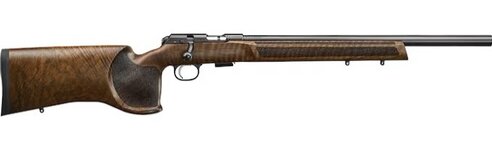
This rifle below has a 14.75” LOP, very short trigger reach of approx 1.5”, and a very well designed grip. Every single person from 12yo girls to 6’6” males that have shot it, have done easily, and almost all have stated it was the best feeling and shooting gun they have ever shot. Hell, there are 4-5 posters on here that after shooting it, went and found one and bought it.

View attachment 979889

This stock looks similar to the CZ 457 MTR which is one of my favorite stocks to shoot. It's on a 22LR so recoil doesn't exist for comparison but, the grip and fit are second to none among the handful of stocks I've owned. I'd be delighted to find something similar for a Tikka.

Image.jpeg
 
This stock looks similar to the CZ 457 MTR which is one of my favorite stocks to shoot. It's on a 22LR so recoil doesn't exist for comparison but, the grip and fit are second to none among the handful of stocks I've owned. I'd be delighted to find something similar for a Tikka.

View attachment 986172


Right now the ROKStok is the closet thing to it in shooting. There is work being done on one that is much closer.
 
I'm not a competitor but continually improving my shooting skills is what drives me.
Along the lines of blinking, I spend and have spent a lot of time behind glass for long periods which causes facial fatigue. I trained myself to use single eye optics with both eyes open. it just takes reps and the decision to be intentional.
Same with blinking. I used long range 22LR semi-auto in part to train out blinking. Seeing the bullet in flight and the hit in the scope is pretty cool. Training on a small rifle obviously scales up to larger cartridges. Seeing bullet trace and the hit in the scope never gets old.

Bandwidth might be a better way to say this. During the entire shot process until it starts over, I'm so focused on the shot process and input from the scope, my brain doesn't have the bandwidth to blink because it's tasked with getting information. Getting visual information is prioritized over blinking.
View attachment 986119
You can't see my other eye, but I'm shooting a 100yd 10 shot/60 second drill with both eyes open. The goal is 1.5" or less for 10 in under 60 seconds, not just shooting fast.
My body knows how to run the bolt so my brain is watching through the scope and correcting sight alignment the entire time. As soon as the bolt is closed, final sight refinement begins as I begin to press the trigger within wobble limits.

The shot is not "timed", the shot process is compressed to do it quickly but correctly.

Most people I've been around are pretty casual about shooting, thus they learn/improve slower.
A course like S2H or just friendly challenges can be beneficial because humans naturally want to be as good or better than the other guy. When the guy next to you is shooting smaller groups and/or doing it faster, you try harder to get better.

Being intentional with every shot is learning with every shot.
I'll add that the 22LR semi auto was not rapid fire trigger yanking.
semi-auto to reduce the shot process to trigger press-recoil-reset only for higher reps on that aspect only.
 
Right now the ROKStok is the closet thing to it in shooting. There is work being done on one that is much closer.

Are these of any comparison to that tikka sporter stock you have?
93ec9cad0f7a075458262b74f2af09bd.jpg


Sent from my iPhone using Tapatalk
 
@RockAndSage gave later description that isn’t “timing” in that sense but is just speeding up the process and pressing the trigger inside what I would say is getting a clean break inside the well practiced wobble—not snatching over the target with hope and a prayer.

The shot is not "timed", the shot process is compressed to do it quickly but correctly.

These both are very good characterizations of what I was getting at. It's about compressing the shot process, with the cleanest trigger-press possible, and training the mind at-speed to recognize when things are lined up, staying in the moment, processing at-speed without over-processing.
 
Are these of any comparison to that tikka sporter stock you have?
93ec9cad0f7a075458262b74f2af09bd.jpg


Sent from my iPhone using Tapatalk
I haven't shot a laminate version, I did a 22-250 and a 300WM for a guy in the plastic version, Bifrost I think?

The 22-250 was ok, but its just a weird shape.
The 300WM seemed to buckle or deflect at the grip under recoil, then as that energy unwound, the muzzle would "whip" to the left no matter what I did ending up off target.
I didn't say anything to the owner and he called me up after shooting it and asked about the same thing.

I suspect the plastic version doesn't transfer energy straight back through the offset grip like it should.

I bet the laminate does though, it's very similar to a master sporter.
 
However, it is not what is actually happening, and is generally disastrous when most people try it. Even saying “mental loading” is kind of ridiculous.

That is factually incorrect. Someone with a flinch will flinch if they take 20 seconds to make a shot, or if they take 0.15 seconds to make a shot. In almost all cases the flinch will be worse the “faster” they try to go.

THAT- absolutely. All of this cause back and forth is due to text. In person, this is a 2 minute conversation and a demo.

I had to dig around to find this, but this is a clip of Rossen discussing "mental static electricity", and what I'm referring to as mental loading, and that what you at least partially seem to be referring to as anticipation - which also might include over-processing, over-thinking, over-confirming, and all sorts of other mental things that get in the way of just executing at speed. There might be some finer points of difference or refinement, but I think we're all referring to elements of the same phenomenon with it, and it might be getting lost in translation. What I think is particularly interesting, is how he goes over loosening up the elbows a bit, as a kind of a circuit-breaker or insulator in helping prevent discharge from that static electricity from becoming an input into the gun:

 
These both are very good characterizations of what I was getting at. It's about compressing the shot process, with the cleanest trigger-press possible, and training the mind at-speed to recognize when things are lined up, staying in the moment, processing at-speed without over-processing.

Then 100% I have no issue at all with that. “Compress” the time it takes to move through the full trigger travel- not “take the first good shot when it comes into the target”, or whatever was being said by others.
 
Matt can shoot of course. But also remember he is a GM that grew up in a heavily bullseye focused place that demanded controlled shooting. He was also part of the reason that it started being acceptable to shoot charlie’s sometimes as well. Some consider that missing.


This is the video I mentioned that was sent to me. What these guys discuss about people with certain backgrounds and group-size obsession fit me perfectly. And it's exactly what was holding me back, until listening to how they flipped the speed/accuracy equation on its head. Pranka's background, coming out of the stockade and focusing on accuracy first - and then seeing him teach what's in this video - was a powerful endorsement of the idea, at least in giving it a shot. What he shares here in how he taught his 3 boys to shoot - and the substantially different performance outcomes - were also a key part of what convinced me to give this a shot. The guy was part of that unit during its most intense period of transformation since right after eagle claw, and what he shared in this video was more than enough for me to set my own ideas aside and just absorb and experiment with everything he had to say.

What may have been missed in what I shared about going fast, is that 1) It's about going fast to a certain speed, and learning how to get accurate within that speed-envelope you want, and 2) it's absolutely predicated upon being able to read a target, self-assess, and correct your shooting based on what the target's saying.

I've essentially spent my entire life under the paradigm of "Speed is fine, but accuracy is final". And it's an absolute truth. But it also held me back after some point. Flipping things upside-down and setting the speed standard first, and learning how to be as accurate as possible within that, is directly what led to these recent performance breakthroughs.


When I bench shoot my 300WM or 300PRC on the range the weapon almost always jumps up and right so I’m to the right of the target after the weapons returns to battery several inches at 100 yards. I shoot pretty tight ass groups though. I usually barely grip with the left and let the bipod or bag hold the weight, but pull fairly hard against the pistol grip and jam my shoulder forward to give a damn stiff rear hold. I shoot with both eyes open.

I can see impacts in the scope on my .423 varmint rig.

Am I missing something or should I work towards keeping a site picture on these heavier calibers?

On deer or elk, somehow I usually can tell where the impact is - I think out of my left eye. Even at extended ranges I can tell what’s going on.
 
When I bench shoot my 300WM or 300PRC on the range the weapon almost always jumps up and right so I’m off several inches at 100 yards. I shoot pretty tight ass groups though. I usually barely grip with the left and let the bipod or bag hold the weight, but pull fairly hard against the pistol grip and jam my shoulder forward to give a damn stiff rear hold. I shoot with both eyes open.

I can see impacts in the scope on my .423 varmint rig.

Am I missing something or should I work towards keeping a site picture on these heavier calibers?

On deer or elk, somehow I usually can tell where the impact is - I think out of my left eye. Even at extended ranges I can tell what’s going on.
Find an old Snipers Hide video, “bipods don’t hop” and other recoil management videos. There is an older thread with videos on recoil.

Generally your don’t want to make your body a brick wall for the rifle to bounce off of, but a meat sack that absorbs the recoil.

Holding the bottom of the stock with your left hand helps guide it in a straight line. Don’t give up the chance to give added control. Think of everything acting together as shock absorbers and guides to bring it straight back and then forward.
 
while taking some video and found that on the first shot of any of these I get a full blink under recoil, but that if I continue with follow up shots in quick(ish) but not rushed succession, the blink subsides/goes away to a very slight twitch of the eye lids visible only on slow motion.

Bandwidth might be a better way to say this. During the entire shot process until it starts over, I'm so focused on the shot process and input from the scope, my brain doesn't have the bandwidth to blink because it's tasked with getting information. Getting visual information is prioritized over blinking.

@Bobrobheimer , what @longrangelead is describing here might be called "staying in the moment". It's also part of being in The Zone. He's not giving his mind any space to overload itself with BS. His bandwidth is entirely occupied by the shot process and processing the info he's taking in. He's not thinking about anything that would cause anticipation, or accumulate "mental static electricity", as is discussed in the TPC link I shared above. That blink on your first shot, followed by lessening amounts of it with follow-up shots, may be an indicator of you staying in the moment better, not anticipating, not letting the mental load/charge accumulate, after that first shot.
 
Back
Top