SilencerCo Scythe Ti failures

SilencerCo Scythe Ti Owners: Have you had a catastrophic failure?


  • Total voters
    144
What about in the same town? Will we be able to just fill out a form 4, wait for it to clear then hand it to the other guy?

Yes. Thing that's going to cause issues is technically the person should be paying up front. Some might not like that. But once that approval goes through, they own it, you don't, whether they paid you or not.
 
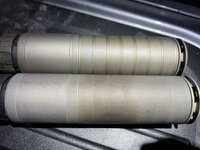
As nothing more than something I found interesting, the welds on my scythe (top in pic, sub 300 SN) and my buddy’s (near 20,000 SN) are quite different. The welds on mine seem more pronounced and wider.

The finish itself is also pretty different, ignoring the scorch marks. Round counts are similar at ~1000-1500.

Neither has had a blow up yet, but I’ll be interested to see which one lets loose first.

IMG_1822.jpeg
 
A couple of rookie questions:

1. Anyone know what the warranty is on these?
2. I purchased mine about 3 weeks ago, but didn’t finish the application process (trying to avoid the $200 fee). Should I see if I can switch cans?

I’ll be using my 6.5’s (Creedmoor and PRC) and maybe a 280ai?? Thanks in advance for your advice!
 
A couple of rookie questions:

1. Anyone know what the warranty is on these?
2. I purchased mine about 3 weeks ago, but didn’t finish the application process (trying to avoid the $200 fee). Should I see if I can switch cans?

I’ll be using my 6.5’s (Creedmoor and PRC) and maybe a 280ai?? Thanks in advance for your advice!
They fixed mine no questions asked. Dropped it off Monday had it back Friday. I haven’t had an issue with it since I got it back. I really do like the can, it shoots great. But…. I probably won’t take it to a match or hunting.
 
A couple of rookie questions:

1. Anyone know what the warranty is on these?
2. I purchased mine about 3 weeks ago, but didn’t finish the application process (trying to avoid the $200 fee). Should I see if I can switch cans?

I’ll be using my 6.5’s (Creedmoor and PRC) and maybe a 280ai?? Thanks in advance for your advice!
I don’t know about the seller refunding/changing cans. Hopefully they will if you want to (and I would want to).

The question is what are their alternate options?

Good luck!
 
I don’t know about the seller refunding/changing cans. Hopefully they will if you want to (and I would want to).

The question is what are their alternate options?

Good luck!
Do you or anyone else have any suggestions for a replacement can? This will be my first one…
 
I don’t know about the seller refunding/changing cans. Hopefully they will if you want to (and I would want to).

The question is what are their alternate options?

Good luck!
How about this one if they allow me to substitute:

DEAD AIR RXD30TI​

 
I have blown up 2 different ones up. One was on a 20” 7max Sherman less than 40 rounds on that can. Second one had like 400yds of 24” 300wsm swapped it over to my 24” 7wsm and it blew up on rd 25ish.
 
I have blown up 2 different ones up. One was on a 20” 7max Sherman less than 40 rounds on that can. Second one had like 400yds of 24” 300wsm swapped it over to my 24” 7wsm and it blew up on rd 25ish.
Did you vote in the poll to get those two counted?
 
As nothing more than something I found interesting, the welds on my scythe (top in pic, sub 300 SN) and my buddy’s (near 20,000 SN) are quite different. The welds on mine seem more pronounced and wider.

The finish itself is also pretty different, ignoring the scorch marks. Round counts are similar at ~1000-1500.

Neither has had a blow up yet, but I’ll be interested to see which one lets loose first.

View attachment 988480
Which one may fail first? That depends. Do both have full depth of fusion (100% penetration)?

All else being equal, full fusion is one of best ways to prevent weld failures. If they both have full fusion, then an educated guess would be the one with the bigger welds would fail first.

Why?

Heat, while necessary for almost all welding process, is also the enemy. A larger weld means more heat input leading to more expansion and contraction during and after welding (fatigue); stress riser at the toes of the weld (another fatigue failure result); discontinuities such as porosity and embrittlement, a result from the dissociation of shielding gases due to the higher or/and prolonged elevated temperature to produce the larger weld.

My guess is the welds were produced autogenously (without the addition of filler metal). If a filler metal was used than one with equal or less tensile strength (not more) typically is preferred. Think in terms of ductility and allowing freedom for the metal to expand and contract equally through the base metal and weld metal. If the filler metal has a higher tensile strength, or has an excessive crown (weld build-up), then all the movement from expansion and contraction of heat, due to a mag dump for example, and movement from a fired round doesn't occur in the weld but at the interface between the toe (edge of the weld) and the base metal where failure often occurs in cyclic loading. The failure can be attributed to the stress riser failure mentioned above.

I hope this makes sense.
 
Back
Top