Follow along with the video below to see how to install our site as a web app on your home screen.
Note: This feature may not be available in some browsers.
80.0 with a Berger 210 2.903 CBTO. 22 inch barrelHow much n570? I’ve got 81.6gr in mine… a bit scared to use it after reading all this, as it’s coated to match my rifle.
Same hear, on both statements. Except it ain’t for a 270Yes, I am. Mine lives on a .223 too. Have a reaper coming so I can shoot my .270 again…
You have multiple scythes? I’m sorry but thank you for showing me the positive side of only having 1…
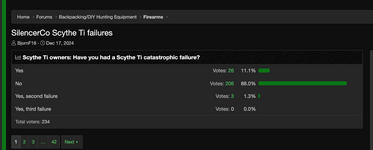
The stats haven’t recovered since the poll was lost when the thread got moved to the suppressor forum. It should be closer to 13%, IIRCI just clicked on this thread and holy cow a 20% failure rate?
I thought it was a total of three in the multiple failure category, and one of those was someone that had two scythes that each failed. But don’t quote me on thatThere were several more second failures as well before the move.

One thing to note is how many people said the bullet impacted in the group even though the suppressor failed… clearly, the event happened after the bullet left the suppressor. Consistent with a delayed explosion.
That’s my working theory, at least for some of them, given the reports of MASSIVE increases in recoil when a failure occurs.I have no dog in this hunt, but the more I read this thread, the more I wonder if this is a case of secondary explosion caused by unburnt powder residue. Unburnt powder could easily build up in the eddy areas of any suppressor and would be difficult to predict and replicate. When the next round is fired, there is a chance that the unburnt powder will hit critical mass (for lack of a better term) and have a secondary explosion.
This would be largely independent of caliber, however larger powder charges would logically be more likely… especially if the internal ballistics favored incomplete combustion & pulverization of the kernels.
If anything, this would be exacerbated by a slower firing rate. My guess is running the suppressor hot would cause the powder to burn off rather than accumulate and then explode… kind of like burning the carbon out of a motor.
Secondary explosion has been studied extensively in reduced rifle and shotgun loads (or grain bins for that matter). It’s a known phenomenon, but it’s difficult to consistently replicate. The conditions that cause it are similar… unburnt, pulverized powder distributed in a large volume, again think grain silos.
One thing to note is how many people said the bullet impacted in the group even though the suppressor failed… clearly, the event happened after the bullet left the suppressor. Consistent with a delayed explosion.
Sent from my iPhone using Tapatalk
That’s my working theory, at least for some of them, given the reports of MASSIVE increases in recoil when a failure occurs.
I think mine is gonna get a CLR soak about every 100 rounds to be safe.
I did not experience a massive recoil increase when mine failed.That’s my working theory, at least for some of them, given the reports of MASSIVE increases in recoil when a failure occurs.
I think mine is gonna get a CLR soak about every 100 rounds to be safe.
Massive increase in recoil is likely because you're sending a 1200 grain chunk of supressor 100y down range!That’s my working theory, at least for some of them, given the reports of MASSIVE increases in recoil when a failure occurs.
I think mine is gonna get a CLR soak about every 100 rounds to be safe.
@Longshot406 can you re-add your second failure to the survey? As I understand it, this was a different can from your first failure?I had my second one fail on me this morning, both on 22 inch Proofs chambered in 300 PRC
Temperatures were in the teens this morning and it failed on the second shot similar to how my first one failed. Scoped me good both times.![]()
@cliffy109 can you re-add your first and second failures in the survey?Failure #1
On a Sig Cross, 6.5 Creed (18" barrel), shooting Hornady 140 grain factory loads. The suppressor had approximately 1400 rounds through it and all of it on that rifle. I shhot a lot (obviously) and my typical range session is 60-100 rounds in a 3-4 hour period. It does get hot but I don't think I ever came close to 10 rounds in 60 seconds. I did have a cover on it which was blown to pieces.
Failure was at the first weld in front of the blast chamber.
SiCo fixed it and had it back to me in 10 days including shipping time to the East Coast. It looked brand new. No carbon to be found anywhere.
Failure #2
I've put about 400 more rounds through this can and was using it on a 16" barrel .308. I had about 60 rounds through it during this range session, shooting M80 ball ammo. Again, it was hot but I had been running 3 shot drills so I never came close to the 10 rounds/minute mark. I was not using a cover this time.
This time, it was at the third weld in front of the blast chamber.
I have this one on video but I told SiCo that I would refrain from posting it until we figured out what to do about it. It is on the way back to them now.
My zero gravity is shorter, lighter and quieter than the Scythe-Ti that I have. I have zero fear of it blowing up either. The Scythe-Ti failure rate alone should make it a non starter for anyone, unfortunately I bought one 2 months after the release, nobody saw this coming.The Scythe is an amazing can minus it blowing up. The size, suppression and weight are all top tier imo. I much prefer it over my OG, even knowing it is going to grenade at some point. If it doesn't, it will likely continue to be one of my favorites. Mine will live it's life out on my 6.5 as I think it is welded on now with carbon. After yesterday, I am confident saying it has to be approaching 2k rounds without blowing up. Ryan has one that has gone a ton of rounds as well, without blowing up.