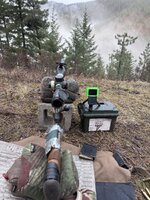
There’s some long history to how we got here, but briefly:
I and Ryan have spent a lot of time trying to get Sierra and others to make a heavy bullet in 6mm with terminal performance at the forefront.
In the beginning, the original 115gr DTAC was a normal Sierra Matchking in design- they shot well and killed fine. But then they became unavailable for a while, and when they came back they went to a pointed version, and so they became completely unsuitable terminally.
Other bullets were shot, tried, and used, but none had the characteristics that were desired. Starting around 2015 or 2016 or so, Sierra was asked about the possibility of a heavy 6mm TMK as they already had the terminal performance that was desired. Unfortunately that went nowhere.
Lots of other bullets were used, but none that were right. Eventually the 115gr DTAC became available again (2021’ish?), with the Nose Ring that was supposed to make them terminally better. They were used heavily- with lots of the results posted on here at the time.
However, while the NR DTAC killed fine and did well in elk, the long neck length during penetration was undesirable, and by the nature of how they upset there is some variability that also wasn’t optimum. So it was asked about the possibility for the 117gr tipped DTAC that had been briefly made in the 2010’ish time frame. But again that was rejected.
After that, I and later Ryan (and even later Jake at UM) went to quite a few bullet companies and spoke to them trying to get an optimized 115+ grain 6mm made- basically no one could understand why you would want a 6mm heavier than 105-110 grains. There was a potential option from a well known company offered, but they wouldn’t modify the bullet to meet the requirements set forth for the terminal ballistics, nor were they willing to make a 115+ grain version. It got to the point of Ryan and I looking at the possibility of making them ourselves.
All that started to change this year with some new people, and/or being more open to ideas at Sierra. From the beginning Ryan and I were adamant that terminal performance must be the first priority- we would not give up terminal performance for higher BC. Next was forgiveness in loading and seating depth- an aggressive design generally creates a fussy bullet (which the 95gr can be at times), and is not what was needed. Last was BC- the BC of a 115-120gr 6mm would be decent no matter how it was designed. There is a price for everything and taking a bullet to the guilt edge of possible BC makes them more prone to variability in general, and more fussy with loading.
Let’s be clear-
Sierra still says these are not hunting bullets. To them, these are match bullets.
As has been stated, the proto’s are 115, 116, and 117gr. Some measurements below with some comparisons to the 95gr TMK, and the Hornady 108gr TMK.
The bullets from left to right are- 115, 116, 117gr TMK, and the 108gr ELD-M on the right.
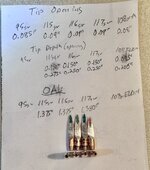
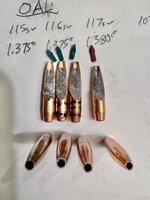
Just the measurements of the nose opening and the depth of the tips is apparent versus the ELD-M; this is so far consistent across TMK’s. How the differences between these three TMK’s manifests terminally, remains to be determined.
The 115’s were tried today, the others will be next.
The rifles used to start were a M595 Master Sporter in 6XC, and an MRC Marshall in 6cm. Both with 1-7.5” twist barrels.
The XC is the top group using the same load as it does for the 115gr DTAC, the 6cm was using a book load that is wildly low. Both were shot in fog today that was so heavy the USPSA target wasn’t visible through the scopes at all, and only a faint orange discoloration could be seen to sort of aim at-
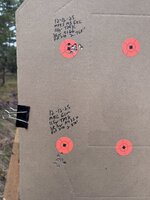
Both went right at 1 MOA.
Then the XC was shot at 985 yards to true and backwards calc the rough BC. I input .585 G1 same as the DTAC to start. It was a first round hit on a 14” target, followed up by 4 more. At the end of the session, the G1 .585 seems to be spot on.. at least for now.