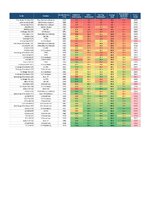
Rifle Cartridges: A Total System Performance Analysis

Joined
Apr 27, 2025
Messages
14
This sheet ranks cartridge and bullet combinations within their practical supersonic performance band using Hornady 4DOF drag data as the source of truth. Muzzle velocity is estimated per case from a realistic reference load and a fitted velocity-per-grain slope so different bullet weights reflect plausible speeds for that cartridge’s capacity. Every composite score is built from the same four underlying factors: wind drift, velocity retention, recoil impulse, and impact momentum. These elements are applied through curved (non-linear) functions rather than simple linear scaling, so performance advantages and penalties increase progressively rather than proportionally. The difference between categories is simply how those same factors are weighted. “External” emphasizes downrange performance, “Utility” increases the recoil penalty to reflect performance cost, and “Handling” weights recoil most heavily to represent controllability and impact observation. Average ranks show how consistently a load performs across weighting philosophies, with an optional durability adjustment that incorporates barrel life. “Power Factor” is included only as a reference for NRL Hunter compliance and is not used in any composite score or terminal performance evaluation.
15021.jpg
 
Think there might be a little typo on the 300prc velocity. But other than that, I have no idea what the hell this is supposed to mean. Thanks for sharing!
It's not a typo. Muzzle velocities are modeled values derived from published reference data and scaled per bullet weight using a fitted velocity-per-grain slope for each case. They won’t match every individual rifle, but they track closely with Hornady’s published reloading data for comparable barrel lengths.

What are you unclear on? Maybe I can better explain something.
 
This all means nothing without sharing the formulas behind your data.

And maybe look at the spreadsheet where 300 PRC is listed at 220fps which is in fact a typo.
 
This all means nothing without sharing the formulas behind your data.

And maybe look at the spreadsheet where 300 PRC is listed at 220fps which is in fact a typo.
Whoops! Yeah that one is a typo, 300PRC is on here several times so I thought that 2674 was the one in question.
 
This all means nothing without sharing the formulas behind your data.

And maybe look at the spreadsheet where 300 PRC is listed at 220fps which is in fact a typo.

BASE UNITS
All internal math is done in SI units.
1 grain = 0.00006479891 kg
Bullet mass (kg):
mb = Wgr * 0.00006479891
Powder mass (kg):
mp = Pgr * 0.00006479891
========================
MODELED MUZZLE VELOCITY
Each case has anchor values:
Vref = reference muzzle velocity (m/s)
Wref = reference bullet weight (grains)
s = velocity slope (m/s per grain lighter)
Modeled muzzle velocity:
V0 = Vref + s * (Wref - W)
Where: W = bullet weight (grains)
This keeps velocities internally consistent per case.
========================
MODELED POWDER CHARGE
Each case has:
Pref = reference powder charge (grains)
sp = powder slope (grains per grain of bullet weight)
Estimated powder charge:
P = Pref + sp * (W - Wref)
========================
IMPACT VELOCITY
Vd = impact velocity at benchmark distance
(from Hornady 4DOF)
Velocity retention:
R = Vd / V0
========================
WIND DRIFT METRIC
Wind drift is evaluated as drift per unit wind:
D = Drift_cm / Wind_mps
If wind = 1 m/s, then:
D = Drift_cm
Lower is better.
========================
RECOIL IMPULSE MODEL
Gas velocity constant:
Vg = assumed gas velocity (m/s)
Recoil impulse proxy:
I = mb * V0 + mp * Vg
Units: N·s (scaled impulse proxy)
This is momentum-based, not energy-based.
========================
IMPACT MOMENTUM
M = mb * Vd
Units: kg·m/s
========================
BARREL LIFE PROXY
Simple overbore proxy:
BL_raw = P / (Bore_diameter^2)
Where: P = powder charge (grains)
Bore_diameter = inches
Higher BL_raw = harder on barrels.
You can also model it as:
BL_raw = (P * V0) / Bore_area
Depending on how aggressive you want to be.
========================
CURVED SCORING FUNCTIONS
All scoring uses soft-knee curves.
For metrics where LOWER is better
(drift, recoil, barrel life):
S = 1 / (1 + (X / X0)^k)
For metrics where HIGHER is better
(retention, momentum):
S = 1 / (1 + (X0 / X)^k)
Where:
X = measured value
X0 = knee (baseline)
k = steepness factor
Properties:
If X = X0, score = 0.5
As X improves beyond knee, score approaches 1
As X worsens, score approaches 0
Non-linear. Not proportional.
========================
WIND SCORE
Swind = 1 / (1 + (D / D0)^k_wind)
D0 = wind knee (cm per m/s)
========================
VELOCITY SCORE
Svel = 1 / (1 + (R0 / R)^k_vel)
Where:
R = velocity retention
R0 = retention knee
========================
RECOIL SCORE
Srecoil = 1 / (1 + (I / I0)^k_recoil)
I0 = recoil knee
========================
MOMENTUM SCORE
Smom = 1 / (1 + (M0 / M)^k_mom)
M0 = momentum knee
========================
BARREL LIFE SCORE
Sbarrel = 1 / (1 + (BL_raw / BL0)^k_barrel)
BL0 = barrel knee
========================
COMPOSITE SCORE
All composites use the same four components:
Swind
Svel
Srecoil
Smom
General form:
Score = wd * Swind
+ wv * Svel
+ wr * Srecoil
+ wm * Smom
Where:
wd + wv + wr + wm = 1
Examples:
External Ballistics:
wd = 0.30
wv = 0.30
wr = 0.25
wm = 0.15
Balanced / Utility:
wd = 0.30
wv = 0.15
wr = 0.40
wm = 0.15
Shooter Bias:
wd = 0.25
wv = 0.00
wr = 0.60
wm = 0.15
========================
PERCENTILE RANK
Pct = 100 * rank position / total entries
(or Excel PERCENTRANK)
========================
AVERAGE RANK
AvgRank = mean(percentiles of composites)
Durability-adjusted:
AdjRank = PerformanceScore * (a + b * BarrelScore)
Where a + b = 1
========================
POWER FACTOR (NRL HUNTER ONLY)
PF = Bullet_weight_grains * Muzzle_velocity_fps / 1000
This is included only for NRL Hunter compliance reference.
It is not part of any composite score.

 
22GT 90gr should not be listed faster then 22cm 88gr.

Help me understand the external ballistic ranking. Some very good and well proven ELR combos are ranked surprisingly low.

And the purpose of the array is to sort the cartridges to what end point?

And I have an Idaho public school education. Not afraid of big words, but they do make me feel itchy some times. Jk. You clearly put a lot of work into this, and I genuinely want to understand it more better
 
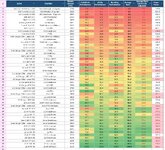
77 tmk - 223 and 22 CM. i'm sure others would appreciate the 6 and 6.5 options. if you just need the BC data you could also add the new TMKs like the 88 for 22 CM etc. etc.
Here you go. Couldn't find those bullets in the 4DOF library so I used AB Quantum.
 

Attachments

  • AISelect_20260224_155916_Sheets.jpg
    AISelect_20260224_155916_Sheets.jpg
    259.1 KB · Views: 10
Nobody told me there would be spread sheets!
I like the pretty colors though.
Is this in MOA or MILS?
Post #7 reminds me of programing in Basic.
 
22GT 90gr should not be listed faster then 22cm 88gr.

Help me understand the external ballistic ranking. Some very good and well proven ELR combos are ranked surprisingly low.

And the purpose of the array is to sort the cartridges to what end point?

And I have an Idaho public school education. Not afraid of big words, but they do make me feel itchy some times. Jk. You clearly put a lot of work into this, and I genuinely want to understand it more better
Fair critique on the 22GT. The GT-based cases are probably the weakest part of the velocity model because there isn’t much published anchor data for those wildcats. I’m fitting slopes from limited references, so that’s an area I’m open to refining.
On the ELR combos — you’re exactly right. The benchmark distance is 800m, so this is comparing cartridges while they’re still comfortably supersonic. At that distance, a lot of the big magnums’ advantages haven’t really separated themselves yet, but the recoil penalty is still very real in the scoring.
If I pushed the benchmark farther out, the ELR cartridges would climb quickly on pure external ballistics. This model just isn’t optimized around 1200–1600m performance — it’s focused on performance inside the supersonic band where most practical shooting happens.
 
Back
Top