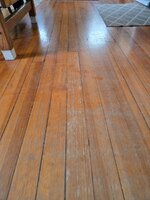
Refinish nearly 100 year old south yellow pine floor

ChrisA

WKR
Joined
Apr 7, 2014
Messages
534
Location
Iowa Crop Reporting District 6
We're planning on refinishing our southern yellow pine floor again. We pulled up linoleum, subfloor and some decorative tar paper like floor covering that was adhered directly to the wood floor underneath about 25 years ago.

I sanded and applied a single coat of McCloskey Gym Seal in 2002. The Gym Seal held up well but its finally worn through in heavy traffic areas. McCloskey is no longer available because of VOC. It appears water based finishes are the norm now but offer quicker dry time so multiple coats are easier and more timely.

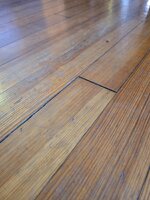
There is flex in the floor and gaps between boards up to 1/8". The McCloskey seemed to fill and seal these gaps somewhat but not completely flush and level. We don't need or necessarily want flush and level, just to seal up and fill the voids decently.

Any recommendations for a durable finish and/or thoughts on the refinishing process?

Thanks
 

Attachments

  • 20260111_113720.jpg
    20260111_113720.jpg
    277.2 KB · Views: 114
  • 20260111_114030.jpg
    20260111_114030.jpg
    360.1 KB · Views: 114
Your gaps really don't look bad, so I personally wouldn't bother. The traditional solution is to stuff oakum in large gaps. You might be able to get away with an acrylic filler color matched to your boards if it really bothers you, but I think it will look better without.
 
man I have no advice, but seeing heart pine flooring gets me very nostalgic for my Virginian youth.. awesome...
 
The only advice I have after doing half a dozen 60+ yr old wood floor restores is do a couple test patches of stain / finish to make sure it takes the toner / stain the same everywhere and you like it before you do upteen coats. Being as you have already refinshed once sometimes sanding doesnt get everything out that went deep into the pores.
 
Find the oldest floor finisher who is still doing it.

He will be on his second, or third set of knees.

I don't hire much out, but I would in that situation.

Check your depth to tongue, gives an idea how much can be sanded. If its less than 1/8" won't be much you can do. Lot of times its surprising how much is still there.

Many of those old floors were put in and actually never sanded. It wasn't an upscale thing unless quarter sawn.

The narrow boards were the premium, wider stuff was fo' dem poh folk.
 
Look at how long those boards are!
@Billy Goat I would have thought that the wider boards were premium, why the inverse?
My aunt proclaimed she was "Saving the rainforest ... Rright there in the living room floor."
 
Look at how long those boards are!
@Billy Goat I would have thought that the wider boards were premium, why the inverse?
My aunt proclaimed she was "Saving the rainforest ... Rright there in the living room floor."

Because 150 years ago, the cost was in the labor. It was a lot more expensive to make narrow t&g boards than wide ones.

Old houses, the first floor had the narrow, expensive floors. Second floor was wider. If a third, 10-12"

In the East, many of the houses the flooring was being made by hand. I still have a bunch of the T&G planes.
 
Find the oldest floor finisher who is still doing it.

He will be on his second, or third set of knees.

I don't hire much out, but I would in that situation.

Check your depth to tongue, gives an idea how much can be sanded. If its less than 1/8" won't be much you can do. Lot of times its surprising how much is still there.

Many of those old floors were put in and actually never sanded. It wasn't an upscale thing unless quarter sawn.

The narrow boards were the premium, wider stuff was fo' dem poh folk.
There's 1/4" left to the tongue. I'm going deep enough to take the old finish off and thats it. Need to fix three nails that backed out and popped about a half inch of the groove out.
 
Back
Top